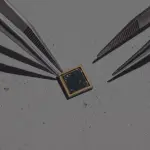
Researchers at McGill University have created a device that generates predictable bursts of sound-like particles called phonons by harnessing the energy of fast-moving electrons. The technology requires temperatures between 10 milli-Kelvin and 3.9 Kelvin, far colder than everyday temperatures, to function, allowing researchers to observe quantum effects and accelerate electrons beyond the speed of sound. “Modern communication largely relies on light, including electromagnetic waves and electrical currents,” said Michael Hilke, Associate Professor of Physics and study co-author. “In a medium such as oceans, sound can travel, whereas light and electrical currents cannot.” This development could enable sound-based lasers, offering a communication alternative in environments where traditional methods fail, and could also advance medical diagnostics and sensing tools.
Supersonic Electrons Generate Tunable Phonons
The ability to directly convert electrical energy into precisely controlled sound vibrations has moved closer to reality with the development of a device at McGill University, challenging established theories of electron behavior at near-absolute zero temperatures. Researchers demonstrated that forcing electrons to travel at supersonic speeds through a two-dimensional crystal layer releases energy not as heat, but as tunable phonons, quantized units of sound, opening possibilities for new technologies. Previous research suggested similar effects as electrons neared the sound barrier, but this study definitively shows that exceeding that limit, and accounting for the electrons’ internal heat even within a near-zero temperature crystal, is crucial for generating these controlled vibrations. The team synthesized the initial material at Princeton University and then built and analyzed the device in collaboration with the National Research Council of Canada.
This precise phonon generation has implications beyond fundamental physics, potentially enabling the creation of “phonon lasers” and offering a communication alternative in mediums where electromagnetic waves struggle. The researchers are now investigating materials like graphene to further accelerate device speed and broaden its applications in sensing, biological materials, and medical diagnostics; they are exploring new regimes because phonons are difficult to generate and harness in a controlled way.
3.9 Kelvin Temperatures Enable Quantum Observation
Researchers discovered that pushing electrons through a two-dimensional crystal layer releases energy as bursts of sound-like vibrations, termed phonons, but only when the system is chilled to these near-absolute zero temperatures, ensuring predictable electron behavior for observation. This process isn’t simply about generating sound; it’s a direct conversion of electrical energy into these quantum vibrations, a surprising connection that differs from conventional signal generation methods. This finding challenges established understandings of energy transfer within materials at the quantum level, requiring a reassessment of how electrons behave under these extreme conditions. The ability to reliably generate and manipulate phonons at these temperatures represents a significant step toward realizing sound-based lasers and their diverse applications.
In the human body, sound waves can also be a useful tool.
Magnetophonon Emission in Two-Dimensional Crystals
The device, a collaboration between McGill University and the National Research Council of Canada, relies on channeling fast electrons through an extremely thin crystal layer to produce predictable bursts of these vibrations. “At absolute zero temperatures – that is, the world of quantum physics – no sound is created unless electrons travel collectively at the speed of sound or above,” Hilke explained, highlighting the extreme conditions necessary for operation. This research builds upon previous observations of electron behavior near the sound barrier, but goes further by demonstrating that existing theoretical models require reassessment; electrons can be hot even when the surrounding crystal is near absolute zero. The initial material for the device was synthesized at Princeton University, allowing the team to analyze the resulting magnetophonon emission and its implications for energy transfer within materials. Hilke suggests that exploring alternative materials, such as graphene, could further accelerate the device’s performance and broaden its applications, offering a pathway toward high-speed communications, particularly in environments where traditional methods struggle.
Modern communication is largely based on light, including electromagnetic waves and electrical currents. In a medium such as oceans, sound can travel, whereas light and electrical currents cannot.

See today’s quantum computing news on Quantum Zeitgeist for the latest breakthroughs in qubits, hardware, algorithms, and industry deals.