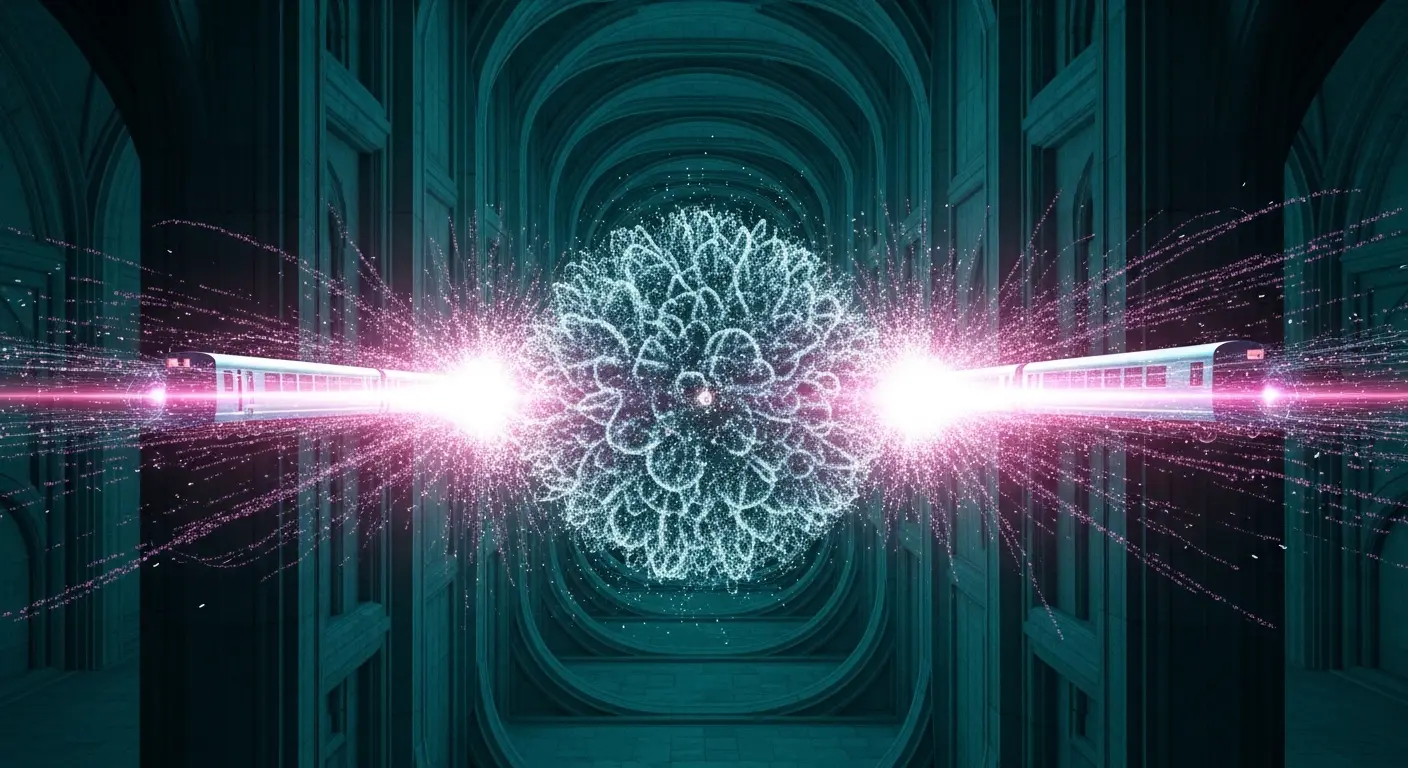
João Barata and colleagues at CERN in collaboration with Central China Normal University, University of Santiago de Compostela, Laboratory of Instrumentation and Experimental Particle Physics, University of Lisbon and University of Granada present a new framework utilising quantum simulation to compute multi-particle processes within environments such as those found in deep-inelastic scattering or heavy-ion collisions. The approach maps partonic cross-sections onto quantum circuits, offering a potential solution to the challenges of determining non-perturbative input currently limiting conventional computational methods. Successful benchmarking of dipole formation and QCD antenna radiation establishes a systematic foundation for using quantum information science to explore multi-particle dynamics in QCD media.
Quantum computation extends perturbative calculations in high-energy nuclear collisions
A six-fold increase in the perturbative order of calculations for multi-particle processes in dense nuclear matter has been achieved, surpassing leading order to reach higher orders previously limited by computational power. Conventional methods, reliant on approximations and numerical integration, struggle with the inherent complexity of Quantum Chromodynamics (QCD) and the non-perturbative input required for accurate modelling of these interactions. Perturbative calculations, which express physical quantities as a series expansion in the coupling constant of the strong force, become increasingly demanding with each higher order. This is due to the combinatorial explosion of Feynman diagrams. This advancement unlocks amplitude-level computations, directly calculating the probabilities of particle interactions, crucial for understanding the strong force at play during high-energy collisions. These collisions, such as those occurring in the Large Hadron Collider (LHC), create extreme conditions where quarks and gluons are deconfined, forming a quark-gluon plasma. Benchmarking against dipole formation and QCD antenna radiation provides a systematic foundation for applying quantum information science to explore the behaviour of quarks and gluons within a QCD medium, a state of matter created in heavy-ion collisions. The ability to accurately model these interactions is vital for interpreting experimental data from facilities like the LHC and RHIC (Relativistic Heavy Ion Collider).
Analysis of QCD antenna radiation, the characteristic patterns emitted from energetic quarks and gluons as they traverse the dense medium, revealed a detailed colour decoherence pattern and demonstrated the ability to track complex particle interactions within the dense nuclear medium. Colour decoherence refers to the loss of quantum coherence between colour charges (analogous to electric charge in electromagnetism) as the particles interact with the surrounding medium. This process is fundamental to understanding how jets of particles, originating from the initial hard scattering, are modified as they propagate through the quark-gluon plasma. The framework computed matrix elements, fundamental components describing particle interactions, with a precision allowing comparison to analytic estimates in simplified scenarios, thereby confirming the accuracy of the quantum simulation. These matrix elements represent the amplitudes for specific particle transitions and are essential for calculating observable quantities. Modifications to dipole formation, a process where virtual particles split and recombine, validate the quantum computation framework and align with existing theoretical predictions. Dipole formation is a key component of the branching process that governs the evolution of partonic showers, the cascades of particles produced in high-energy collisions. While the current focus remains on leading order processes, future work will explore simulating the full complexity of jet fragmentation, a key step for realistic heavy-ion collision modelling, and investigate the limitations of applying it to more complex scenarios. Jet fragmentation describes the hadronisation process, where the quarks and gluons produced in the collision ultimately form observable hadrons, such as protons and pions.
Advancing strong force calculations through preliminary quantum simulations of quark-gluon plasma
A novel technique for simulating the behaviour of quarks and gluons within the extraordinarily dense matter created in high-energy collisions is now available, potentially refining our understanding of the strong force. The strong force, one of the four fundamental forces of nature, governs the interactions between quarks and gluons, the constituents of protons and neutrons. Understanding its behaviour under extreme conditions, such as those found in the early universe or in heavy-ion collisions, is a major challenge in modern physics. Detailed amplitude-level computations within complex matter are now possible, potentially revealing new insights into quark and gluon behaviour, and calculations extend to higher-order, crucial for precision in particle physics. Higher-order calculations are essential for reducing theoretical uncertainties and obtaining reliable predictions that can be compared to experimental measurements. This approach enables exploration of multi-particle dynamics and raises questions regarding its extension to complex matter backgrounds. The ability to accurately simulate the interactions of multiple particles simultaneously is a significant advantage over traditional methods, which often rely on simplifying assumptions. By mapping the probabilities of these interactions onto quantum circuits, this method establishes a new computational approach for simulating particle interactions within the quark-gluon plasma, sidestepping limitations of traditional techniques. Quantum circuits leverage the principles of quantum mechanics, such as superposition and entanglement, to perform computations that are intractable for classical computers. Successful modelling of dipole formation and QCD antenna radiation, patterns revealing how energetic particles scatter, demonstrates a systematic approach to exploring these dynamics and provides a foundation for further development. The consistent agreement between the quantum simulations and established theoretical predictions provides confidence in the validity of this new approach and opens up exciting possibilities for future research. Further investigation will focus on scaling the quantum simulations to handle more complex scenarios and exploring the potential for using this technique to address other challenging problems in high-energy physics and nuclear physics.
The researchers successfully computed multi-particle processes using quantum simulation techniques, mapping partonic cross-sections to quantum circuits. This offers a new computational method for studying the behaviour of quarks and gluons within complex matter, overcoming limitations found in conventional approaches. The framework was benchmarked through analysis of dipole formation and QCD antenna radiation at leading order, demonstrating agreement with existing theoretical estimates. The authors intend to scale these quantum simulations to more complex scenarios, providing a systematic foundation for applying quantum information science to multi-particle dynamics in QCD media.
👉 More information
🗞 Quantum simulating multi-particle processes in high energy nuclear physics: dijet production and color (de)coherence
🧠 ArXiv: https://arxiv.org/abs/2604.11616
See today’s quantum computing news on Quantum Zeitgeist for the latest breakthroughs in qubits, hardware, algorithms, and industry deals.