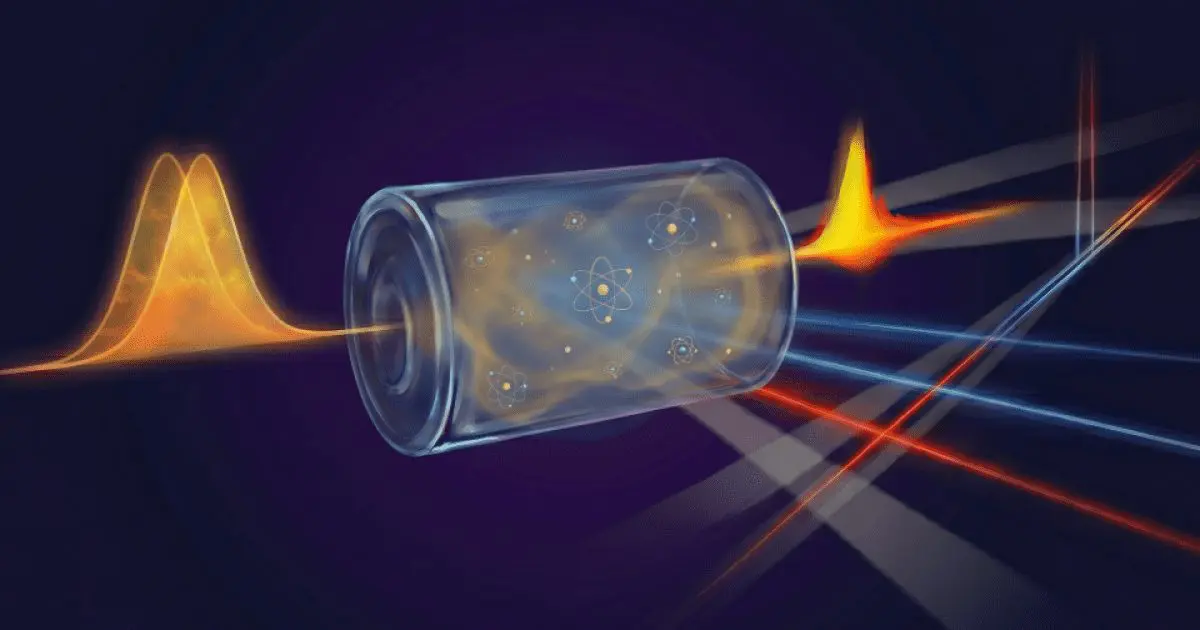
A team led by Professor Ian Walmsley at the University of Oxford has overcome a longstanding obstacle in precision measurement known as Rayleigh’s curse, achieving results beyond the limitations of standard techniques. Researchers repurposed technology originally developed for quantum networking, a photonic quantum memory implemented using warm caesium vapour, as a programmable filter to sort incoming light into specific temporal shapes called “modes.” This innovative approach allows for a more informative strategy than directly measuring light brightness, enabling the separation of extremely close spectral features essential for applications like atomic clocks and LiDAR systems. By coherently mapping temporal modes onto atoms as collective spin excitations, the team demonstrated a technique to improve frequency separation measurement, findings recently published in Nature Sensors.
Photonic Quantum Memory Filters Temporal Modes
Rayleigh’s curse, a long-standing limitation in the precision of spectroscopic measurements, has been circumvented by researchers who repurposed technology originally designed for quantum communication networks. The team, comprised of scientists from the University of Oxford, Imperial College London, and the Okinawa Institute of Science and Technology, demonstrated a method to surpass conventional intensity-based techniques by filtering incoming light based on its temporal characteristics. Rather than directly measuring brightness, the approach sorts light into specific “modes” which encode information about frequency separation; imperfections in this sorting process previously undermined the potential for increased precision. According to the published findings in Nature Sensors, a control laser pulse coherently maps a chosen temporal mode onto the atoms within the vapour, effectively storing it as a collective spin excitation while allowing other modes to pass through.
Professor Ian Walmsley, who led the research, explained that this method allows for measurements beyond the limitations imposed by Rayleigh’s curse, opening possibilities for more sensitive detection of spectral features. The ability to discern closely spaced frequencies has implications for a broad range of technologies, including atomic clocks, chemical spectroscopy, and LiDAR systems, promising enhanced performance in applications requiring precise frequency analysis. This repurposing of quantum memory technology highlights a convergence of fields, leveraging advancements in quantum networking for improvements in classical measurement science.
Conventional spectroscopic techniques, vital for applications ranging from atomic clocks to LiDAR, are fundamentally limited by a phenomenon known as Rayleigh’s curse, which hinders the ability to distinguish between closely spaced spectral features. The team’s findings suggest a pathway toward significantly enhanced precision in a variety of scientific and technological fields, potentially improving the accuracy of these critical tools.
Rather than measuring the brightness of light directly, a more informative strategy is to first sort the incoming light into specific temporal shapes, called modes, that carry the most information about the frequency separation.




See today’s quantum computing news on Quantum Zeitgeist for the latest breakthroughs in qubits, hardware, algorithms, and industry deals.