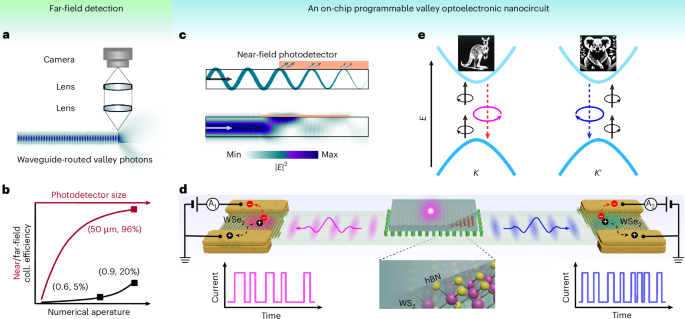
Researchers led by Chi Li and Kaijian Xing have demonstrated a fully integrated circuit capable of generating, routing, and electrically reading valley-dependent chiral photons, a critical step toward practical light-based valleytronics. Transition metal dichalcogenides couple valley-polarized excitons to valley-dependent chiral photons, but achieving on-chip control of these properties has remained a significant hurdle until now. The team’s device utilizes a meta-waveguide to generate near-unity valley-dependent chiral photons from a tungsten disulfide monolayer, selectively coupling them to unidirectional waveguide modes with 0.97 polarization selectivity. These photons are then detected by atomically thin tungsten diselenide photodetectors, enabling all-on-chip processing of valley-multiplexed images.
Tungsten Disulfide Meta-Waveguide Generates Chiral Photons
A newly developed meta-waveguide generates chiral photons with near-unity efficiency from a tungsten disulfide monolayer, representing a step toward fully integrated valley optoelectronics. Researchers detailed their device, which manipulates the “valley degree of freedom” in two-dimensional materials, in Nature Photonics. This approach utilizes the unique properties of transition metal dichalcogenides, where circularly polarized light excites valley-dependent chiral photons, particles possessing a defined “handedness” in their angular momentum. The core of the innovation lies in the meta-waveguide’s ability to generate these chiral photons through second-harmonic generation and selectively route them. The research team found that, at room temperature, their purposely designed meta-waveguide device generates near-unity valley-dependent chiral photons, achieving a polarization selectivity of 0.97. This precise control is crucial for building complex optical circuits where information is encoded in the valley state of these photons.
The device achieves selective coupling of these photons into unidirectional waveguide modes. This demonstration addresses a critical gap in lightwave valleytronics, enabling compact, programmable, and scalable valley information processing and fostering the development of light-based valleytronic quantum technologies.
Selective Routing of Valley-Dependent Waveguide Modes
The pursuit of manipulating light at the nanoscale has increasingly focused on exploiting the “valley degree of freedom” within two-dimensional materials, but fully integrating these concepts into practical devices has remained elusive. Researchers have now demonstrated a device that addresses this challenge, integrating meta-waveguide photodetectors with transition metal dichalcogenides to create a functional, on-chip nanocircuit. The device generates near-unity valley-dependent chiral photons through second-harmonic generation in an encapsulated tungsten disulfide monolayer, achieving a polarization selectivity of 0.97. The researchers describe in their recent publication that they have created a valley-driven hybrid optoelectronic nanocircuit integrating chirality-selective meta-waveguide photodetectors with transition metal dichalcogenides. This work represents a substantial step toward realizing practical valleytronics, a field that aims to use the valley degree of freedom to encode and process information. The ability to electrically read the valley state, previously a major obstacle, is particularly significant for integration with existing electronic infrastructure, opening possibilities for more complex and versatile optoelectronic systems.
Tungsten Diselenide Detects Upconverted Photons
Chi Li and colleagues have demonstrated an advance in on-chip valley optoelectronics, developing a nanocircuit capable of processing valley-multiplexed images. The research centers on the manipulation and detection of chiral photons, photons with a defined handedness, within transition metal dichalcogenides. These materials uniquely couple valley-polarized excitons to these chiral photons, a property exploited to create an integrated optical circuit. The device achieves a polarization selectivity of 0.97 at room temperature. A key innovation lies in the use of atomically thin layers of tungsten diselenide as photodetectors. These detectors are uniquely sensitive to upconverted photons, those with energy above the bandgap, allowing for electrical readout of the valley information. Previously, achieving electrical readout of valley-dependent photons presented a major hurdle; this work overcomes that challenge, potentially fostering the development of light-based valleytronic quantum technologies and offering a pathway toward scalable, on-chip optical processing. The full dataset supporting these findings is available as supplementary information accompanying the published article.
On-Chip Valley Information Processing Demonstrated
Researchers have successfully integrated the generation, routing, and electrical detection of valley-dependent chiral photons, light particles possessing a specific helical twist, all on a single silicon chip. This achievement addresses a critical gap in lightwave valleytronics, enabling compact, programmable, and scalable valley information processing and fostering the development of light-based valleytronic quantum technologies. This means the device efficiently converts input light into photons whose chirality, or twist, is directly linked to the valley state. These photons are then channeled along the waveguide, exhibiting a polarization selectivity of 0.97, before being detected by atomically thin layers of tungsten diselenide. This integration with conventional electronics is crucial for building practical, scalable devices.




See today’s quantum computing news on Quantum Zeitgeist for the latest breakthroughs in qubits, hardware, algorithms, and industry deals.