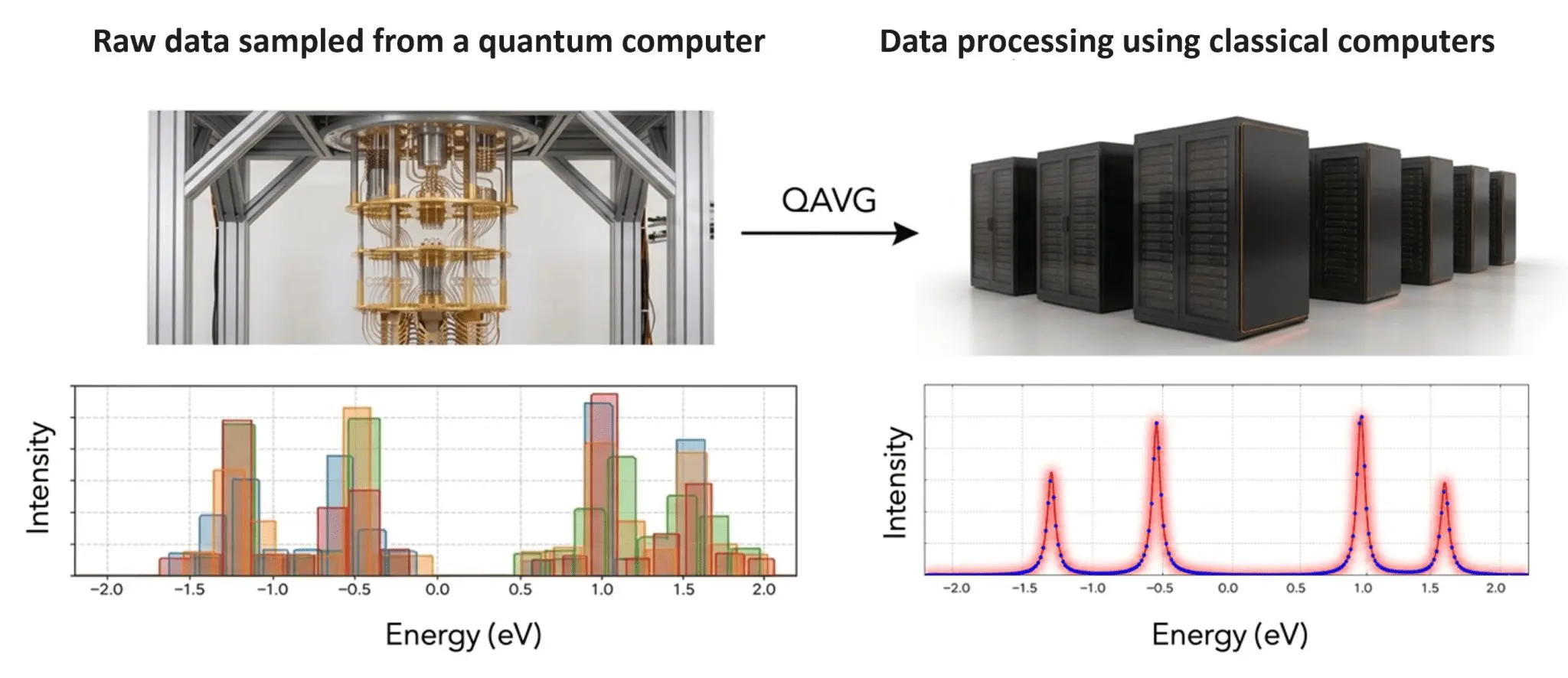
Quemix Inc. and Mitsui Kinzoku Company, Limited have jointly developed a new technology, QAVG (QPE Averaged over Variable Grids), designed to accelerate materials discovery using quantum computers. Traditionally, the highly accurate Dynamical Mean-Field Theory (DMFT) method has been limited by lengthy computation times, a challenge these companies specifically addressed through improvements to Quantum Phase Estimation (QPE), a key component of the process. The resulting technology allows for both high-speed and high-accuracy calculations, potentially shortening the timeline for practical application of DMFT in materials simulations. Lower left: Four types of data obtained by executing QPE on a quantum computer (distinguished by four different colors). Lower right: Continuous spectrum obtained by applying QAVG to the four datasets acquired from the quantum computer (blue dots indicate the actual QAVG results, while the red line represents the exact solution). Initial simulations on Quantinuum hardware suggest QAVG delivers a level of accuracy previously expected in approximately two years with hardware advancements alone.
QAVG Improves Quantum Phase Estimation for Materials Calculation
A new computational technique promises to accelerate materials discovery by optimizing quantum simulations. Quemix Inc. Traditionally, the Dynamical Mean-Field Theory (DMFT) method, while highly accurate, has been constrained by extensive computational demands; this collaboration directly addresses that challenge. The core innovation lies in improving QPE, a critical component within the DMFT process, allowing for both faster processing and greater precision. Conventional QPE methods struggle with a trade-off between energy resolution and computational cost, but QAVG circumvents this issue. Researchers validated QAVG’s effectiveness using Quantinuum’s quantum computing hardware, simulating catalytic materials and demonstrating a level of accuracy previously projected to require approximately two additional years of hardware development. This suggests a significant acceleration in the timeline for applying quantum computers to practical materials simulations, with potential impacts extending beyond DMFT calculations to the broader field of computational materials science.
Both companies intend to continue developing algorithms for quantum chemical calculations, aiming to contribute to solutions for pressing societal challenges through materials innovation; results from this research will be presented at the Q2B Tokyo international conference this June. Q2B Tokyo Official Website: https://q2b.qcware.com/conference/ -tokyo.
Dynamical Mean-Field Theory Accelerated on Quantum Computers
The pursuit of novel materials with enhanced properties increasingly relies on computational methods, yet achieving both accuracy and speed remains a significant hurdle; traditional materials simulations demand substantial resources and time. Researchers at Quemix Inc. and Mitsui Kinzoku Company, Limited have addressed this challenge by accelerating the Dynamical Mean-Field Theory (DMFT), a highly accurate but computationally intensive technique, through advancements in quantum computing. Simulations conducted on Quantinuum’s quantum computing hardware, using catalytic materials as a test case, demonstrated QAVG’s effectiveness in a real-world environment. Because QPE is broadly utilized in materials calculations, the impact of QAVG is anticipated to extend beyond DMFT, influencing the wider field of computational materials science.
QAVG makes it possible to improve both the accuracy and speed of DMFT calculations on quantum computers while suppressing the increase in computational cost.
QAVG Validation Using Quantinuum Hardware & Catalytic Simulations
Quemix Inc. and Mitsui Kinzoku Company, Limited have demonstrated the effectiveness of their jointly developed technology, QAVG, through simulations performed on Quantinuum’s quantum computing hardware. The research, focused on catalytic materials, confirms that QAVG, an improved Quantum Phase Estimation (QPE) method, functions effectively within current quantum hardware limitations. The core of this advancement lies in QAVG’s ability to generate a continuous spectrum from datasets acquired via quantum computation, as illustrated in the research team’s conceptual diagrams. Lower left depicts four types of data obtained by executing QPE on a quantum computer, and Lower right shows the continuous spectrum obtained by applying QAVG to those datasets. This approach allowed the team to achieve a level of computational accuracy approximately two years ahead of what would typically be expected from hardware evolution alone, and the implications extend beyond the specific DMFT calculations used in the study, as QPE is a broadly applicable technique within materials science.
In materials development, discovering high-performance new materials requires extensive trial and error, resulting in significant time and cost challenges.



See today’s quantum computing news on Quantum Zeitgeist for the latest breakthroughs in qubits, hardware, algorithms, and industry deals.