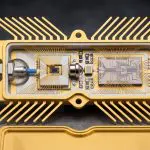
QNu Labs completed a 5.56 kilometer free-space Quantum Key Distribution link between BISAG-N and IIT Gandhinagar, marking India’s first demonstration of secure quantum communication at that scale beyond laboratory settings. The field trial generated encryption keys at a rate of 230 to 260 bits per second and integrated them with BISAG-N’s Vedic Kavach platform for dual-layer quantum security. Sunil Gupta, Co-founder and CEO of QNu Labs, highlighted the potential for deployment beyond fiber optic cables and toward satellite communication.
56km Free-Space QKD Link Established Between BISAG-N and IIT Gandhinagar
The successful transmission of quantum keys over 5.56 kilometers of open air represents an advance in practical quantum communication, achieved by QNu Labs in collaboration with BISAG-N and IIT Gandhinagar. This field trial, conducted between September 27 and 28, established a secure channel using QNu Labs’ Pointing, Acquisition and Tracking (PAT) system, demonstrating functionality beyond controlled laboratory settings. A stable Quantum Bit Error Rate below 5% was maintained throughout the experiment, a key metric for reliable key distribution.
Vedic Kavach combines post-quantum cryptography with quantum key distribution, offering a resilient approach to data protection. Vinay Thakur, DG of BISAG-N, emphasized that the integration of Vedic Kavach with QNu Labs’ QKD technology demonstrates the potential of combining post-quantum cryptography with quantum key distribution as complementary layers of security to evolve with emerging requirements.
This layered approach addresses potential vulnerabilities in both classical and quantum computing landscapes. Cmde Manish Tripathi (Retd.), In-charge of ISTF at IIT Gandhinagar, added that the demonstration provides a valuable field environment for advancing practical quantum communication technologies, bringing together academic research, indigenous technology and real-world experimentation.
Quantum security will become meaningful at scale only when technologies can move beyond controlled laboratory environments and operate across real communication infrastructure.
Sunil Gupta, Co-founder and CEO of QNu Labs




See today’s quantum computing news on Quantum Zeitgeist for the latest breakthroughs in qubits, hardware, algorithms, and industry deals.