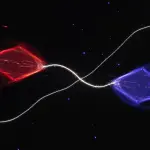
Lars Meschede, Daniel D. A. Clarke, and Ortwin Hess of Trinity College Dublin have developed a new quantum theory to address a longstanding challenge in cavity quantum magnonics: consistently quantizing lossy gyrotropic resonators. Their work establishes a finite-temperature quantum quasinormal mode (QNM) theory, using macroscopic quantum electrodynamics and complex coordinate transformations for a wide range of dissipative magnonic systems.
This approach allows for the quantitative design of hybrid quantum devices, integrating microwave photons, collective spin excitations, and superconducting or spin qubits within a single architecture, under realistic conditions, without relying on approximations. The researchers demonstrate the theory’s predictive power by modeling hybrid dielectric-magnonic resonators and observing effects like magnon-mediated qubit synchronization at both zero and finite temperatures.
Finite-Temperature Quantum Quasinormal Mode Theory for Cavity Magnonics
This theoretical framework accounts for spatially inhomogeneous, dissipative and dispersive characteristics within these systems, a step toward realizing the full potential of hybrid quantum devices. The new theory directly addresses the need for a quantized treatment of magnonic cavity resonances and their interaction with both spin and superconducting qubits, moving beyond approximations previously required for such calculations.
Unlike prior approaches, this method avoids ad hoc quantization schemes, offering a rigorous way to model energy loss and thermal fluctuations that are particularly significant at radio and microwave frequencies, the frequencies commonly used in cavity quantum magnonics experiments. The researchers extended their zero-temperature quantum theory to include finite temperatures, a generalization expected to improve the accuracy of modeling in real-world conditions.
The team’s approach builds upon auxiliary-field eigenvalue methodology, generalizing the computation of classical quasinormal modes in gyrotropic magnetic resonators to include exchange interaction and anisotropy effects. This allows for the calculation of Green’s functions and other essential quantities with greater precision. Demonstrating the theory’s capabilities, the researchers modeled qubit dynamics at 200 mK and 700 mK, using values of T1 = 1. 47 μs and T2 = 1. 45 μs for all qubits in their simulations.
This integration facilitates a versatile platform for quantum information processing, potentially enabling more complex and efficient quantum computations. The ability to accurately model these interactions, even with material dissipation and open-cavity radiation losses, is critical for building stable and scalable quantum systems.
Yttrium Iron Garnet (YIG) Properties Enable Magnonic Devices
Yttrium iron garnet’s low magnetic loss and long coherence times position it as a key material for building devices that manipulate spin waves, collective excitations used for information processing. These properties have already led to its widespread use in commercial microwave systems like filters and phase shifters, demonstrating its established role in radio-frequency and microwave technologies. Beyond these applications, YIG’s high spin density allows for strong coupling to these fields and access to nonlinear behavior, making it attractive for both classical and quantum technologies.
The potential to directly interface superconducting qubits and spin qubits with YIG opens pathways for creating quantum buses, enabling connections between spin qubits and magnonic resonators. Hybrid architectures combining the long coherence times of spin qubits for data storage with the stronger couplings of superconducting qubits for computation could become valuable components of future quantum processors.
Numerical investigations demonstrate the versatility of a new quantum quasinormal mode methodology, accurately capturing both coherent and dissipative regimes of magnon-photon coupling from fundamental principles. This approach reveals limitations in purely phenomenological quantization methods when describing interactions between cavity quantum electrodynamics and quantum excitations. Calculations reveal that tuning losses through the hybrid magnonic-photonic nature of these constructs can enable functionalities like magnon-mediated synchronization and entanglement of spatially separate qubits.
The ability to attain almost-steady states, even without continuous pumping and in the presence of realistic qubit decoherence, further expands the possibilities for device design. “Our numerical examples exhibit how the quantum QNM approach can be utilized as a quantitative basis for the design, optimization and analysis of quantum cavity magnonic devices as a functional elements of hybrid quantum processors operating under open-system and thermal conditions,” the study reports.
The elucidation of quantum field dynamics in both real space and time provides a comprehensive, four-dimensional characterization of these quantum magnonic devices. These findings suggest a path toward building more robust and versatile quantum information processing platforms using the unique properties of YIG and its ability to interface with diverse qubit technologies.
Cavity Magnonics Facilitates Hybrid Light-Matter Interfaces
The theory accounts for both open-system radiation losses and thermal fluctuations, critical factors in maintaining qubit coherence and enabling scalable quantum information processing. Demonstrations of the theory’s predictive power involve modeling hybrid dielectric-magnonic resonators interacting with both spin and superconducting qubits, revealing previously unobserved effects. Modeling these interactions revealed modal interference effects and a continuous transition from coherent to dissipative coupling demonstrating the theory’s ability to accurately capture the complex interplay between light and matter within these hybrid systems.
This detailed characterization is important for optimizing device performance and mitigating decoherence mechanisms. The theory, based on macroscopic quantum electrodynamics for non-reciprocal media achieves QNM quantization for a wide range of spatially inhomogeneous, dissipative and dispersive cavity magnonic systems.
This advancement is particularly significant given the increasing interest in using these systems for applications like optical-to-microwave transduction in quantum networks, where long-distance quantum communication relies on efficient signal conversion. “Given the diverse phenomenology and underlying interaction mechanisms in cavity quantum magnonics and hybrid architectures based upon it, an urgent demand for a rigorous and unified methodology has emerged,” the authors state, emphasizing the need for a quantitative, spatiotemporally-resolved description of quantum electromagnetic field dynamics.
The ability to model magnon-mediated synchronization is a key outcome, as it suggests pathways for creating robust entanglement between spatially separate qubits. Lars Meschede, Daniel D. Clarke and Ortwin Hess, all affiliated with CRANN and Rinn Quantum at Trinity College Dublin demonstrated this capability through simulations. These simulations showcase the theory’s versatility in analyzing complex quantum phenomena within hybrid magnonic-photonic constructs. The resulting insights are expected to play an increasingly important role in the development of quantum networks, where microwave photons are used for communication between quantum computing platforms.
Quasinormal Modes (QNMs) Quantization for Dissipative Systems
The presented quantum theory extends established macroscopic quantum electrodynamics to account for spatially varying properties within cavity magnonic systems, a step for accurately modeling real-world devices. This approach moves beyond simplified assumptions of homogeneity, allowing for the quantization of quasinormal modes, resonances inherent in dissipative systems, within complex magnetic structures.
Calculations demonstrate how the theory predicts level attraction and repulsion in spectral positions, signifying a shift between dissipative and coherent coupling between magnons and photons depending on the resonator configuration. Further refinement of the model involved analysis of Yttrium Iron Garnet (YIG) slabs, specifically examining the impact of slab length on higher-order magnonic modes.
A phenomenological quantization approach, lacking rigorous QNM treatment, failed to capture these dips, highlighting the necessity of the new theory for understanding the interplay between the Kittel mode and higher-order modes. The work extends the quantum treatment to include finite-temperature fluctuations, a particularly relevant generalization given the radio and microwave spectral domains characteristic of cavity quantum magnonics.
Spatiotemporal Quantum Field Dynamics in Magnonic Resonators
The theory’s predictive power extends to characterizing spatiotemporal quantum field dynamics and magnon-mediated qubit synchronization, even at finite temperatures. Detailed analysis of a one-dimensional Yttrium Iron Garnet (YIG) slab, capturing both fundamental ferromagnetic resonance and higher-order modes, forms a key component of the validation process. Researchers investigated the slab’s complex interplay of modes, and then embedded it within a photonic cavity to illustrate the ability to predict both coherent and dissipative magnon-photon coupling.
This approach allows for a fully spatial and temporal characterization of the quantum field dynamics, offering a four-dimensional understanding of quantum magnonic devices. The methodology’s versatility is further demonstrated by extending the model to a three-dimensional, spherically symmetric magnon-photon hybrid resonator, exploring its interaction with spin and superconducting qubits. The developed finite-temperature quantum QNM theory provides a framework for 3D, dissipative and dispersive, linear, cavity magnonic systems and their interaction with spin and superconducting qubits. This advancement allows for QNM expansions for the Green’s function and the calculation of other important quantities.
Magnon-Mediated Synchronization of Qubits at Finite Temperatures
Hybrid dielectric-magnonic resonators demonstrate magnon-mediated qubit synchronization even at 700 milliKelvin, a critical temperature beyond which the effect diminishes, according to new modeling. This synchronization occurs between spatially separate qubits, facilitated by the unique properties of these resonators and detailed in a finite-temperature quantum theory presented in the work. The calculations reveal how tuning losses, a characteristic of the hybrid magnonic-photonic design, can enable both synchronization and entanglement, even without continuous energy input.
This approach moves beyond simplified quantization schemes, offering a quantitative basis for designing devices that function under realistic conditions, including open-system interactions and thermal fluctuations. The researchers report, indicating a clear thermal limit to the effect.
The predictive power of the theory was demonstrated through simulations comparing spatially resolved magnetic-field thermal correlation functions calculated using the quantum quasinormal mode (QNM) theory and a semi-analytical approach. This work provides a framework for building functional quantum processors that use the interplay between light, spin, and superconducting qubits.
Superconducting Qubit (SC) Interactions with Cavity Magnonics
Hybrid dielectric-magnonic resonators now demonstrate modal interference effects, a consequence of a new finite-temperature quantum theory developed by Lars Meschede, Daniel D. The researchers’ approach addresses longstanding challenges in accurately modeling lossy resonances within cavity quantum magnonics, a field where non-reciprocal magnetic media and material dissipation have historically complicated theoretical treatment. This new framework allows for the creation of devices that can function reliably even with inherent energy dissipation.
Direct coupling of spin qubits to magnonic modes has previously demonstrated coherent strong coupling for various materials. This new theory provides a more robust foundation for understanding and optimizing those interactions.
👉 More information
🗞 Finite-temperature Quantum Quasinormal Mode Theory for Spatiotemporally-resolved Dissipative Cavity Quantum Magnonics
✍️ Lars Meschede, Daniel D. A. Clarke and Ortwin Hess (School of Physics, CRANN and Rinn Quantum, Trinity College Dublin, College Green, Dublin 2, Ireland)
🧠 ArXiv: https://arxiv.org/abs/2610.36385

See today’s quantum computing news on Quantum Zeitgeist for the latest breakthroughs in qubits, hardware, algorithms, and industry deals.