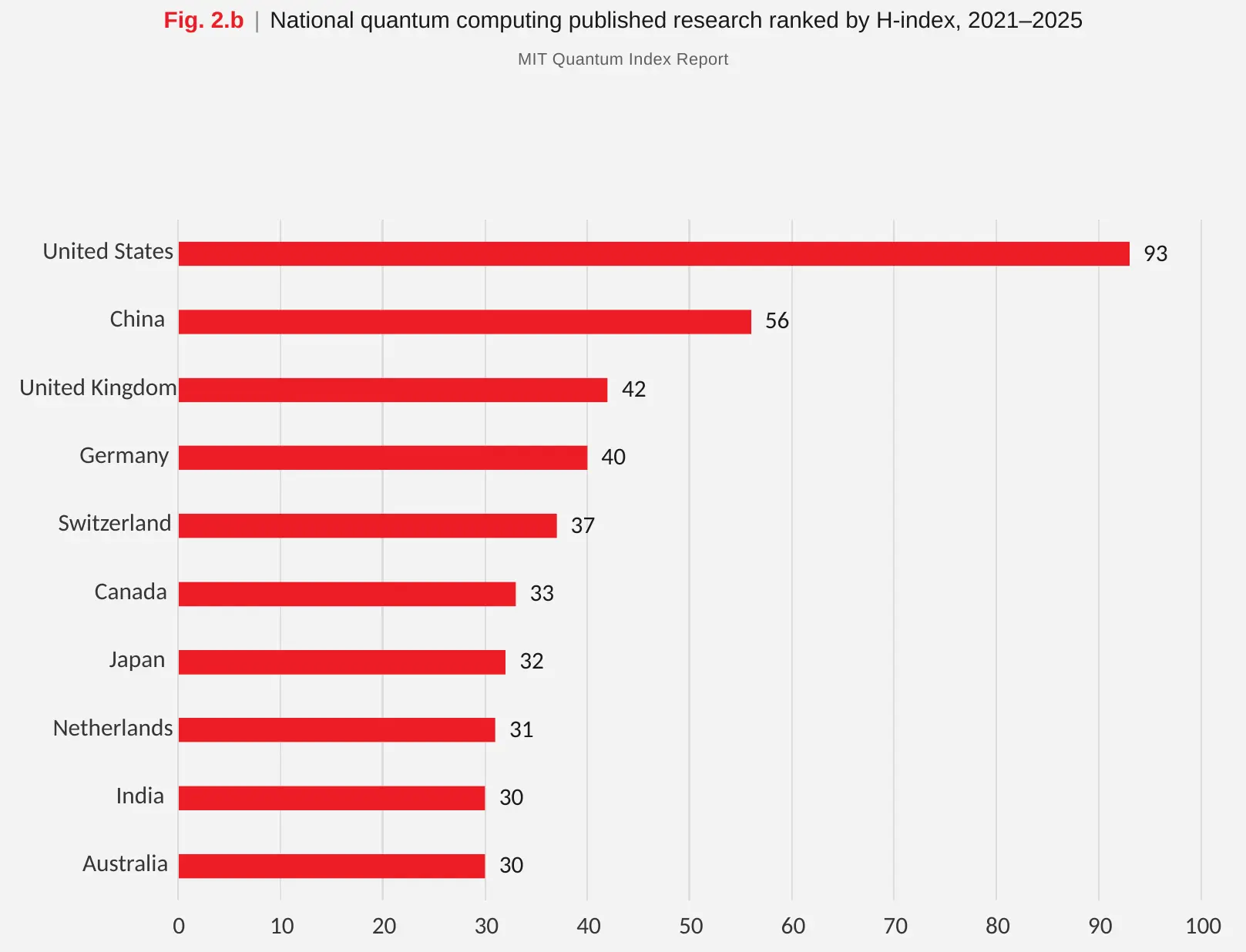
Investment in quantum computing reached $10.9 billion in 2025, demonstrating a rapidly accelerating financial commitment to the technology, according to the 2026 Quantum Index Report compiled by researchers at MIT and Accenture. While the United States maintains a lead in the influence and impact of quantum research, China filed more quantum computing patents in 2025 than the U.S., the World Intellectual Property Organization, the European Patent Office and Japan combined. “The second quantum revolution is no longer only a scientific project,” says Jonathan Ruane, Principal Investigator at the MIT Initiative on the Digital Economy, “It is also becoming an industrial, economic and geopolitical one.”
$10.9 Billion Quantum Investment Driven by Post-IPO Financing in 2025
Financing from public markets and late-stage venture capital propelled quantum computing investment to $10.9 billion. Of that total, $5.7 billion stemmed from financing for companies already listed on Nasdaq, while $2.3 billion arrived through late-stage venture rounds, indicating a shift in funding patterns. This concentration of capital signals a maturation of the quantum landscape, with established firms attracting the bulk of new investment.
Capital is now concentrating in relatively mature quantum players rather than new entrants. A June 2026 executive order in the U.S. continues to prioritize sensing, navigation, and secure communications as key near-term military applications for the technology. Quantum computing is increasingly viewed as a potential asset for artificial intelligence infrastructure. Quantinuum’s Helios quantum computer is slated for deployment within an Oracle Cloud data center, and a 200-qubit processor from Pasqal is currently operational in Aramco’s data center in Dhahran, Saudi Arabia.
These deployments suggest a growing interest in exploring hybrid classical-quantum computing architectures for demanding workloads. The report states that capital is now concentrating in relatively mature quantum players rather than new entrants, highlighting a trend towards consolidation and scaling of existing quantum businesses. Despite the substantial financial commitment, practical quantum advantage remains elusive, with current quantum computers still lagging behind classical systems for most applications.
“Most experts agree that quantum computers remain below the capabilities of classical computers for all useful tasks today,” the report acknowledges, tempering expectations while emphasizing the long-term potential of the technology. The United States currently holds a lead in research influence and citation impact, though China surpassed the U.S. in patent filings during 2025, registering 9,790 patents compared to the U.S. total of 2,423. This disparity emphasises a difference between the volume of intellectual property generated and the recognized impact of research within the scientific community.
The second quantum revolution is no longer only a scientific project. It is also becoming an industrial, economic and geopolitical one.
Jonathan Ruane, Principal Investigator and Editor-in-Chief at MIT IDE
China’s Patent Output vs. U.S. Research Influence in Quantum Computing
China’s patent activity in quantum computing dramatically outpaced that of the U.S. This volume suggests a distinct strategic emphasis on securing intellectual property rights within China’s quantum ecosystem, even as research leadership remains elsewhere. The disparity in filings does not necessarily reflect a difference in innovation quality, as metrics of research impact tell a different story.
While China’s publication volume is substantial, the U.S. continues to generate research that is more widely recognized and built upon by other scientists, according to the “Quantum Index Report 2026.” Beyond overall patent numbers, China also dominates in quantum communications, producing 35.8% of related research between 2021 and 2025, nearly tripling the 12.2% share from the U.S. This leadership extends to both output, influence and citation impact within that specific subfield. Government investment is also a key driver, with U.S. Department of Defense awards mentioning quantum reaching a record $285.3 million in 2025, a 49% increase over the previous year.
These strategic investments signal a growing recognition of quantum technologies as critical to national security and economic competitiveness, prompting governments worldwide to develop national quantum strategies, as evidenced by recent launches in Spain, Finland, Italy, the Czech Republic and Chile.
Pentagon and UK Government Prioritize Quantum Technologies and Security
Government investment in quantum technologies continues to escalate globally, with the United Kingdom committing up to £2 billion, including £1 billion earmarked for the procurement of commercial-scale quantum computers. This commitment mirrors a growing international recognition of quantum’s strategic importance, as evidenced by the U.S. These substantial allocations signal a shift toward practical application and national security considerations.
The Pentagon named quantum one of their six Critical Technology Areas. Despite increased funding, public trust in governmental oversight of quantum development is declining; a December 2025 survey revealed a drop in agreement that the government can effectively control quantum companies, falling from 63% in 2024 to 44% in 2025 among those expressing an opinion.
Support for funding the research itself remains strong, though also experiencing a slight decrease, with 69% backing government funding and 79% supporting company investment. Demand for a skilled quantum workforce is also expanding rapidly, with the share of U.S. job postings requiring quantum skills more than quintupling since 2011 and reaching a new high in early 2026. Commercially available quantum processors have increased from 40 to 56 in the past year, originating from 24 manufacturers across 11 countries, demonstrating a broadening of the quantum hardware landscape.
Quantum Processor Growth to 56 Units Across 11 Nations in 2026
H-index, a metric measuring research citation impact, stands at 93, significantly higher than China’s 56, demonstrating a qualitative difference between the volume of patents and the broader impact of the research itself. Public perception of governmental oversight of quantum technologies is becoming increasingly skeptical, even as support for research funding remains relatively strong. However, 69% of those surveyed still support government funding for quantum research, a slight decrease from 77% the previous year, and 79% continue to support company funding, down from 82%, indicating a detailed public opinion that separates funding from regulatory confidence.
Capital is now concentrating in relatively mature quantum players rather than new entrants.




See today’s quantum computing news on Quantum Zeitgeist for the latest breakthroughs in qubits, hardware, algorithms, and industry deals.