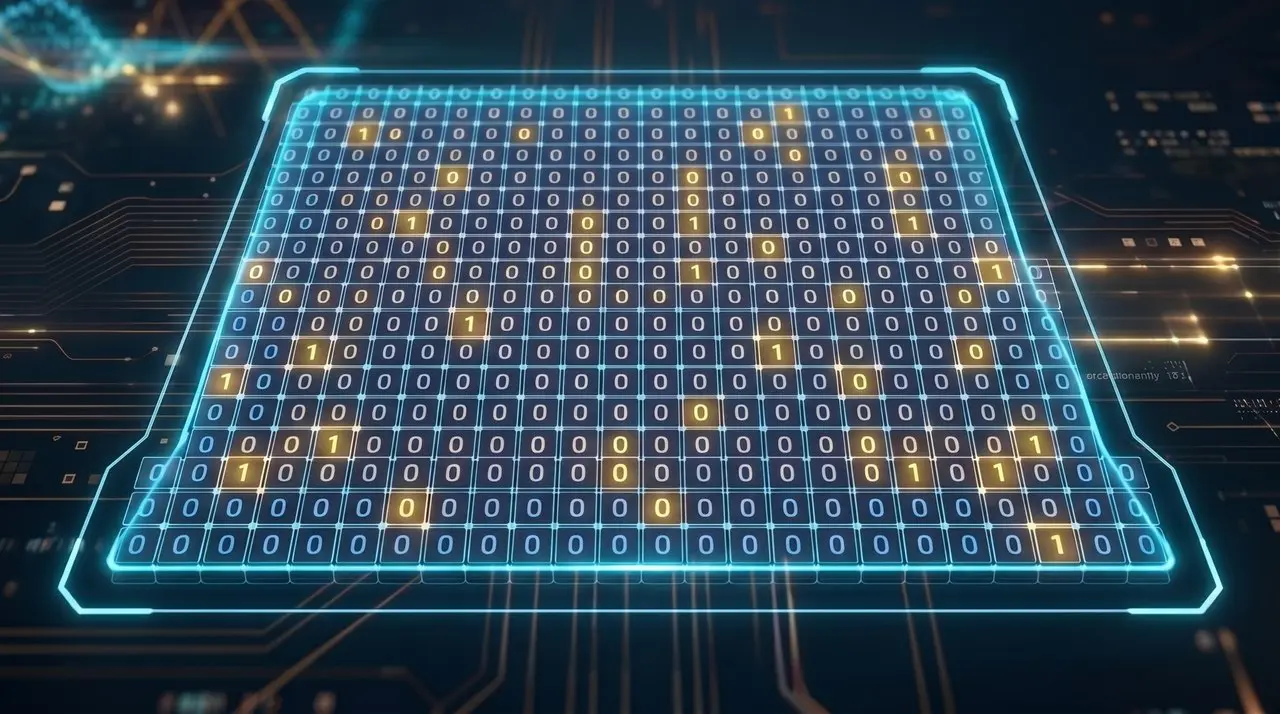
A new quantum error-correcting code enables more complex computations by protecting fragile quantum information. The construction creates codes with an efficient encoding process; its quantum circuit has logarithmic depth and requires a linear number of operations. Inspired by recent advances in classical coding techniques, the approach quantises repeat multiple accumulate codes, bringing the resulting rate-distance tradeoff close to a fundamental limit known as the CSS Gilbert, Varshamov bound.
A new quantum error correction system sharply improves protection against information loss during computation. The resulting construction approaches fundamental limits in coding theory, offering potential benefits towards building more stable and scalable quantum computers.
UC Berkeley researchers have unveiled a new quantum error correction system designed to safeguard fragile quantum information during complex calculations; this advancement addresses a vital challenge in building practical quantum computers where errors can quickly corrupt results. Inspired by techniques used in conventional data transmission, specifically repeat multiple accumulate (RMA) codes, the team has created an approach analogous to having several independent scribes each record a message then compare notes for accuracy, ensuring consistency through repeated copying and verification.
A key element is achieving ‘logarithmic depth’, meaning computational steps increase slowly like counting by powers of two, making it efficient even with large amounts of data. Consider this similar to how parity checks verify file integrity during transfers, detecting and correcting errors within qubits, the fundamental units of quantum information.
Quantising Classical Repeat Multiple Accumulate Codes for Robust Quantum Error Correction
Repeat multiple accumulate (RMA) codes inspired this quantum construction; the classical technique enhances reliability by repeatedly copying data and verifying consistency, akin to having several scribes independently record information then compare notes. In particular, adapting principles from conventional error correction into the area of fragile qubits, the basic units of quantum information, involved structuring an encoder with a simple outer circuit followed by layers that perform both classical accumulation and its inverse.
Effectively, redundancy was built directly into the quantum code itself. Circuits boasting logarithmic complexity alongside a linear number of processing steps enabled the construction of quantum CSS codes achieving performance close to theoretical limits. Building on these classical repeat multiple accumulate techniques streamlines the process through an initial circuit layer followed by repeated cycles of copying data for verification and performing its inverse operation rather than relying on complex encoding schemes.
Quantised Repeat Accumulate Codes Approach Theoretical Limits For Quantum Error Correction
The UC Berkeley team engineered quantum CSS codes attaining a relative distance within 0.001 of the optimal CSS Gilbert-Varshamov (GV) bound after only four accumulation rounds; previously, such proximity required sharply more complex encoding schemes or remained theoretically unattainable. This new construction utilises quantised repeat multiple accumulate codes to create an efficient encoder with logarithmic depth and a linear gate count, representing substantial progress in streamlining quantum computation.
Delivering performance nearing established theoretical limits while simplifying architecture for strong quantum information processing is a key advancement stemming from adapting classical RMA codes for quantum systems. Numerical estimations reveal that even after three rounds, distances were already approaching acceptable levels at 0.0311830 for specific code rates, demonstrating remarkable efficiency in encoding information as the relative distance of this novel code was measured within 0.001 of the CSS Gilbert-Varshamov bound improving upon previous methods.
Logarithmic depth and linear gates enable efficient scalable quantum error correction
UC Berkeley researchers have engineered quantum CSS codes offering a pathway towards more efficient and reliable quantum computation. These new codes demonstrate an encoding process with logarithmic depth, meaning computational steps increase slowly even with large datasets, and a linear gate count representing manageable resource demands; these features address practical limitations hindering wider adoption of quantum computing technologies. This approach provides a solid foundation for exploring more advanced, purely quantum encoding schemes going forwards, although reliance on adaptations of established classical methods may raise concerns about achieving genuinely novel quantum advantages the construction’s efficiency is valuable in itself. The team constructed new quantum CSS codes inspired by classical repeat multiple accumulate techniques utilising a streamlined encoding process to achieve a rate-distance tradeoff approaching the fundamental limit defined by the CSS Gilbert-Varshamov bound, this represents an advance in efficient quantum information processing. By structuring the encoder as a simple outer circuit followed by layers of accumulation and inverse-accumulation, they created redundancy within the code rather than relying on complex designs.
The researchers developed quantum CSS codes with performance closely matching the theoretical limits of the CSS Gilbert-Varshamov bound. This achievement allows for encoding using circuits that scale efficiently, with logarithmic depth and a linear number of gates, addressing challenges related to resource demands in quantum computation. The team intends this work as a foundation for further exploration into purely quantum encoding schemes based upon classical repeat multiple accumulate techniques.
👉 More information
🗞 Linear-Time Encodable Quantum Codes near the CSS GV Bound
✍️ Rachel Yun Zhang (UC Berkeley)
🧠 ArXiv: https://arxiv.org/abs/2610.01277



See today’s quantum computing news on Quantum Zeitgeist for the latest breakthroughs in qubits, hardware, algorithms, and industry deals.