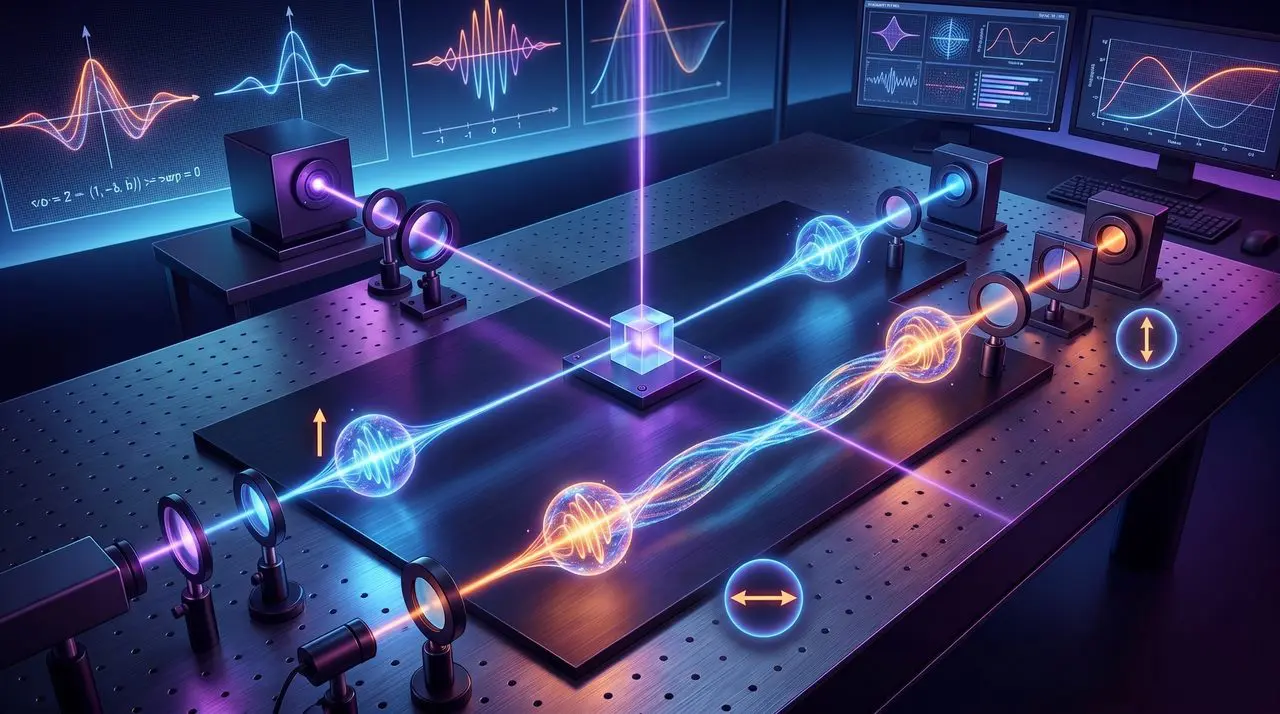
Researchers at QuTech, Delft University of Technology have achieved 98.4% removal of qubit leakage during measurement, a critical step toward building more stable quantum computers. This leakage, where quantum information escapes the computational state, introduces errors that limit the effectiveness of quantum error correction. The team integrated directly into the qubit measurement process, returning the qubit to its computational subspace without adding time to the operation. This work combines this enhanced measurement with neural-network decoding to suppress logical error rates in quantum error correction experiments.
Superconducting Qubit Leakage Limits Quantum Error Correction
This leakage, specifically the excitation of a transmon qubit to a second excited state, introduces correlated errors that hinder the effectiveness of quantum error correction, and the new technique addresses this issue directly within the measurement process. The team achieved this result by integrating a (LRU) into the standard qubit readout, a departure from conventional error correction methods that typically address errors after they occur.
The LRU operates concurrently with transmon measurement without adding to processing time, using a protocol adapted from double-drive reset of population (DDROP). This involves simultaneous drives applied to both the transmon qubit and its readout resonator, using the dispersive shift to direct the qubit back into its computational subspace.
The LRU maintains high fidelity in assigning computational states, achieving 99.2% fidelity alongside the 98.4% leakage removal fraction. The team successfully suppressed logical error rates in both memory and stability quantum error correction experiments, without relying on post-selection techniques that can skew results.
“Improved error correction with leakage reduction units built into qubit measurement in a superconducting quantum processor,” details the approach, which promises to enhance the stability and scalability of future quantum computers. The work demonstrates a significant step toward building more reliable quantum systems by tackling a fundamental source of error at its origin, rather than attempting to correct for it after the fact, and the team’s findings offer a promising pathway for advancing the field of quantum information science.
Transmon Qubit Leakage to |f⟩ Impacts Stabilizer Codes
Stabilizer codes rely on mapping physical errors to correctable Pauli errors, yet leakage, a qubit escaping the computational state, violates this principle by introducing errors outside that framework. This poses a significant challenge because leakage events cannot be addressed by standard error correction methods and can persist across multiple quantum error correction cycles, creating correlated errors in time. Further complicating matters, leakage can spread through two-qubit gates, generating spatially correlated errors that severely degrade logical qubit performance.
Researchers addressed this issue by developing a leakage reduction unit (LRU) designed to actively return leaked transmons to the computational subspace. This approach differs from strategies focused on hardware-level chip design or the implementation of leakage-tolerant quantum error correction codes, instead offering a direct solution by resetting the qubit’s state during measurement.
DDROP Adaptation Creates Leakage Reduction Unit (LRU)
Achieving 98% leakage reduction, the design of a new leakage reduction unit (LRU) demonstrates significant performance gains. The LRU’s effectiveness stems from using the dispersive shift, a phenomenon where the resonator frequency changes based on the transmon’s state, to guide the qubit back into an usable condition. This LRU operates concurrently with transmon measurement, distinguishing it from many existing leakage reduction methods that require dedicated time steps within the quantum error correction (QEC) cycle.
Adding idle time can increase the physical error rate, potentially undermining the benefits of leakage removal, a challenge this design circumvents. The protocol establishes a distinct readout of leaked states without substantial time cost, achieved through a finite delay that creates a dedicated window for resonator response sensitivity before leakage removal begins.
The LRU’s implementation involves applying simultaneous microwave drives to the transmon and resonator, guided by specific frequencies, for the transmon transition and for the resonator, when the transmon is in a defined energy state. This approach creates a one-way path from the leakage state to the computational state, effectively suppressing errors that arise from information escaping the qubit. The design is also compatible with, and effective in the presence of, Purcell filters, components used to protect transmons from energy decay through the resonator, demonstrating its robustness within existing superconducting processor architectures.
The team’s work demonstrates a high-fidelity LRU with a 99.2% computational-state assignment fidelity, meaning the protocol accurately identifies the qubit’s state after leakage reduction. This level of accuracy is essential for maintaining the integrity of quantum computations and minimizing the introduction of new errors during the correction process. The LRU’s ability to simultaneously remove leakage and preserve state fidelity represents an advancement in the pursuit of stable and reliable quantum computing, offering a pathway to mitigate correlated errors in both time and space.
LRU Operates Concurrently with Transmon Measurement
Initial experiments demonstrate a 98.4% removal of qubit leakage, a figure established through analysis of population transfer matrices showing the active return of the transmon to its computational subspace when originating from a leaked state. Optimizing drive parameters proved important not only for leakage reduction but also for minimizing the impact of the transmon drive itself on the system, with researchers finding that building up photons in the resonator before applying the drive could accelerate the reset process. Varying the delay between drives revealed a performance trade-off, highlighting the delicate balance between allowing sufficient time for pure readout and maximizing the efficiency of the leakage removal process.
These matrices detail the probability of correctly identifying the qubit’s state after measurement, demonstrating that the LRU does not compromise the accuracy of state determination. The LRU’s ability to function concurrently with measurement is a key advantage, as it avoids the time overhead associated with sequential error correction steps. This is accomplished by using the readout resonator, allowing measurement to occur simultaneously with the leakage reduction process.
The team’s work demonstrates that the LRU actively redirects the transmon from a leaked state back to its computational subspace, a critical step in maintaining qubit coherence and reducing the accumulation of errors during quantum computations. The design’s effectiveness is further highlighted by its compatibility with existing Purcell filters, components commonly used to protect qubits from environmental noise.
4% Leakage Removal Achieved with LRU Protocol
This performance is attained without adding to the time required for quantum error correction (QEC), addressing a key limitation of previous leakage mitigation strategies. The LRU’s design adapts a double-drive reset of population (DDROP) technique, repurposing it for the specific task of returning qubits to their computational state. Unlike many existing LRU protocols that introduce idle time into the QEC cycle, this implementation operates concurrently with measurement, avoiding a potential increase in the overall physical error rate.
The protocol creates a directional process for unconditional reset, specifically engineered to move the transmon from the leaked state |f⟩ to the computational state |e⟩. Following drive removal, the system rapidly decays to |e,0⟩, effectively eliminating the leakage.
The team’s experiments used a standard circuit quantum electrodynamics (cQED) architecture, with each transmon coupled to a dedicated readout resonator, and the LRU implementation is tailored for this specific configuration. Simulation data suggests that observed curvature in the results is likely not due to incomplete leakage removal by the LRU or leakage on data qubits lacking the unit. Instead, the team hypothesizes that leakage to higher excited states beyond |f⟩ may be responsible.
The LRU achieves a 98.4% leakage removal fraction without compromising the computational-state assignment fidelity (99.2%). This preservation of the logical observable is critical for reliable quantum computations and represents a step toward more robust quantum error correction.
LRU-Enhanced Measurement Enables Three-Level Readout (3RO)
The implementation of a leakage reduction unit directly within the qubit measurement process allows for a total measurement duration of 500 nanoseconds, a timeframe comparable to standard qubit readout procedures. This concurrent operation avoids introducing any additional time overhead, a critical factor for scaling quantum computations. The LRU protocol’s broad applicability stems from its reliance on a dispersively coupled readout resonator, a component already prevalent in most superconducting quantum processors.
By using this existing infrastructure, the design minimizes the barriers to adoption for existing quantum computing architectures. A high-fidelity three-level readout, or 3RO, is achieved through LRU-enhanced measurement, providing quantum error correction decoders with richer information than traditional binary outcomes. The system’s performance was quantified using a 3×3 matrix derived from population tomography, corrected for readout errors via an iterative Bayesian unfolding method utilizing data averaged over 10,000 shots.
Calibration of the LRU pulse involved preparing the transmon in the ground, first excited, or second excited state, followed by the LRU-enhanced measurement with a carefully tuned delay, , between the resonator and transmon drives. Analysis of single-shot readout data, plotted on the I-Q plane, reveals well-separated state clusters for both the LRU-enhanced measurement and a standard measurement created by simply disabling the transmon drive within the LRU sequence. The team’s methodology also included processing the I-Q voltages of measurements using both a 3RO and a 2RO classifier, allowing for direct comparison of the two readout methods on the same experimental dataset.
Controlled-Z Gate Leakage Injection Reveals LRU Advantage
Experimental validation confirms a simulation model’s accuracy when subjected to controlled-Z gate leakage injection, demonstrating a strong correlation between predicted and observed outcomes. This finding highlights the importance of addressing CZ gate leakage as a priority for improving quantum computation stability. Further analysis explored the relationship between leakage removal fraction and assignment infidelity, revealing a trade-off that is critical for optimizing quantum performance. By independently varying these parameters, researchers observed their individual effects on logical performance, providing insights into the delicate balance required for effective error suppression.
The team’s work demonstrates that the combination of leakage reduction units (LRUs) with three-level readout (3RO) consistently delivers the lowest logical error rate across all levels of controlled leakage injection on controlled-Z gates. This advantage becomes increasingly pronounced as leakage increases, emphasising the LRU’s effectiveness in mitigating error accumulation.
The logical error rate per round (ε_L) was measured as a function of the estimated leakage rate (L_1). The results showed that the LRU-3RO combination consistently outperformed other configurations. The decoder’s goal is to use measured information to determine a logical correction, and repeating the experiment for a fixed number of rounds allows for the measurement of the logical error probability (p_L).
These experiments were designed to isolate and assess the impact of different leakage sources, including CZ gate leakage and measurement-induced leakage, by sweeping their parameters while holding others constant. This comprehensive approach to error characterization and mitigation provides a robust framework for advancing the development of more reliable and scalable quantum computers.


See today’s quantum computing news on Quantum Zeitgeist for the latest breakthroughs in qubits, hardware, algorithms, and industry deals.