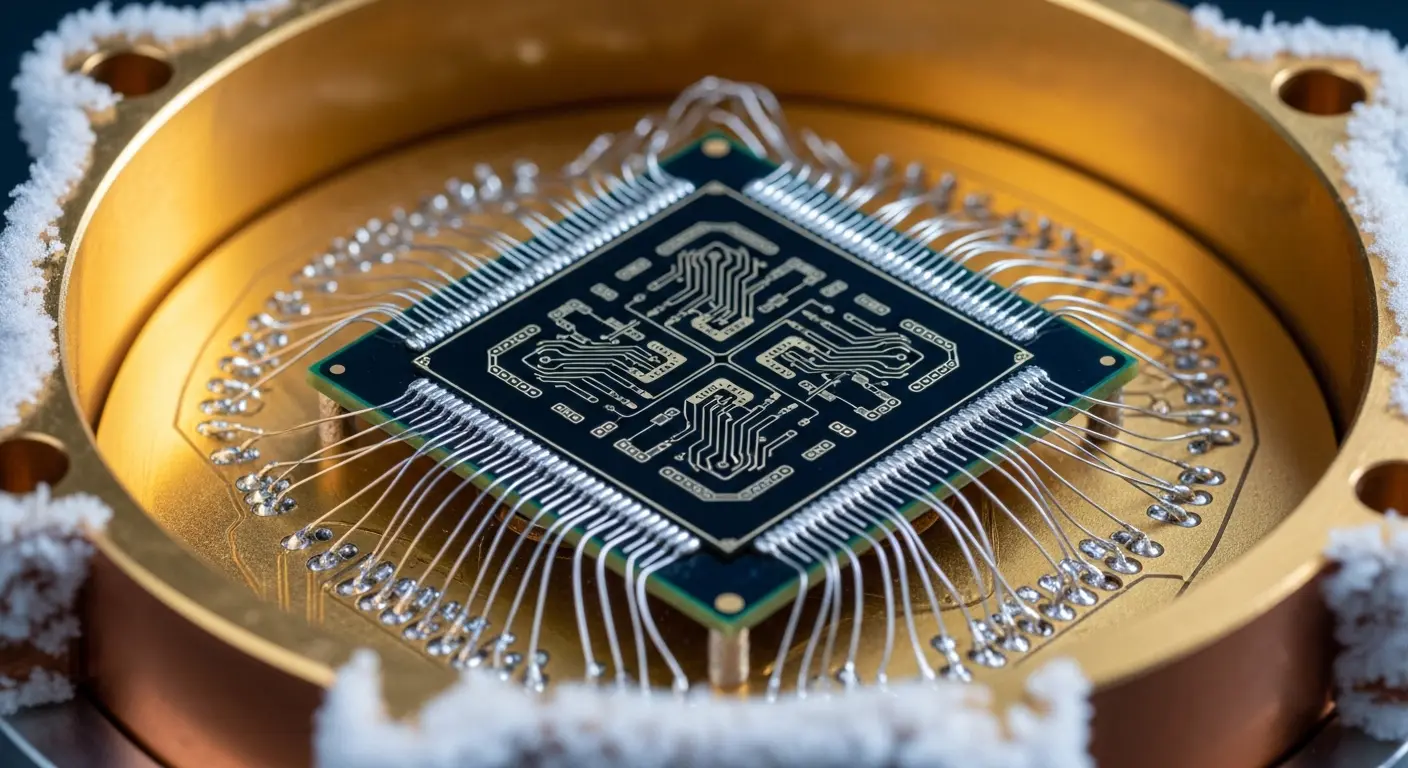
Researchers have now pinpointed the dominant defects limiting the performance of transmon qubits to within 500 nanometers of the qubit junctions, specifically identifying areas retaining residue from a fabrication process known as “liftoff.” This localization is crucial for understanding the origin of energy loss that degrades quantum system performance. By systematically altering qubit geometry, the team demonstrated a direct link between design and susceptibility to these defects, changing the “interface participation ratio” by more than an order of magnitude. These defects do not cause predictable errors; instead, they create “non-Gaussian tails” in the distribution of qubit energy relaxation time (T1), suggesting current error correction methods may be insufficient, according to the findings. Data supporting the findings is available on Mendeley Data at https://data.mendeley.com/datasets/zk2mcxvkhy/1.
Defect-Induced Decoherence in Transmon Qubits
Localized defects are now understood to be a primary source of energy loss in transmon qubits, significantly impacting their performance and hindering the development of stable quantum processors. The team’s work, published on April 20, 2026, demonstrates that these issues are not uniformly distributed, but rather concentrated at specific points within the qubit structure. The study revealed a direct correlation between qubit design and susceptibility to these defects. This finding opens a pathway for engineering improvements, suggesting that optimized qubit layouts can minimize the impact of these interfacial flaws. The implications extend beyond simple fabrication tweaks; it suggests a fundamental redesign of junction fabrication processes to avoid the residues that contribute to these defects, motivating alternative approaches to qubit junction fabrication that avoid the residues intrinsic to the liftoff process. However, the nature of the errors induced by these defects is not straightforward.
Instead, they are generating fluctuations in T1, complicating calibration and potentially rendering standard quantum error correction methods less effective. This complex error profile necessitates the development of new strategies for managing these fluctuations and maintaining qubit coherence, a challenge that will be central to building larger, more reliable quantum computers.
Interface Participation Ratio & Defect Localization
The pursuit of stable qubits continues to focus on minimizing decoherence, with researchers increasingly pinpointing the physical origins of energy loss within superconducting circuits. Current efforts are not simply about achieving higher fidelity; they’re about understanding where and how errors arise, allowing for targeted improvements in qubit fabrication and design. Recent investigations have moved beyond broad characterizations of material defects to a level of precision previously unattainable, revealing that the dominant sources of qubit energy relaxation are concentrated within a remarkably small area. This proximity is significant because it suggests a direct link between fabrication techniques and qubit performance. This control highlights the sensitivity of qubits to interfacial defects and offers a pathway for engineering more robust designs. However, these errors are not straightforward; the defects do not generate predictable fluctuations. Spectral diffusion of these defects over time also leads to fluctuations in T1, complicating calibration procedures.
we are able to localize the dominant defects to within 500 nm of the qubit junctions, where residues from liftoff are present.
T1 Relaxation Time Fluctuations & Spectral Diffusion
Researchers at the University of Wisconsin-Madison and Qolab are meticulously mapping the sources of decoherence in superconducting qubits, moving beyond broad characterization to pinpoint defect locations with unprecedented accuracy. Their work centers on understanding fluctuations in T1 relaxation time, a critical metric for qubit performance, and how these fluctuations arise from material imperfections. Beyond simply identifying where the defects reside, the research demonstrates a strong correlation between qubit geometry and susceptibility to these imperfections. This suggests that careful engineering of qubit junctions can significantly reduce energy loss and improve coherence. These non-Gaussian T1 tails present a challenge to standard quantum error correction techniques, which are often optimized for Gaussian noise distributions. Data supporting these findings is openly available on Mendeley Data, at https://data.mendeley.com/datasets/zk2mcxvkhy/1, allowing other researchers to validate and build upon these results, potentially leading to more robust and reliable quantum computing systems.



See today’s quantum computing news on Quantum Zeitgeist for the latest breakthroughs in qubits, hardware, algorithms, and industry deals.