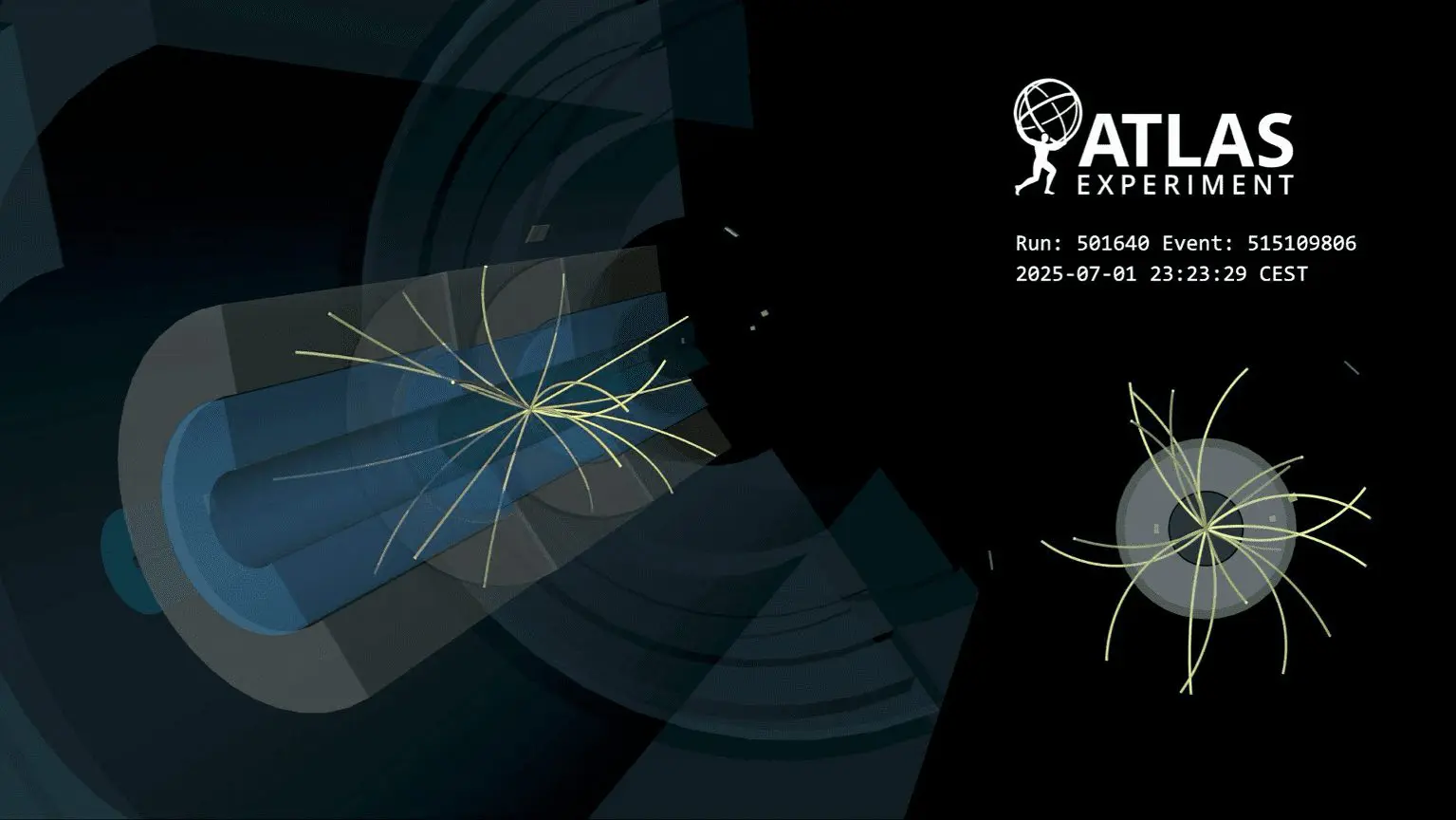
The ATLAS Collaboration has, for the first time, recreated the impact of cosmic rays within the Large Hadron Collider, offering a new path toward understanding the mysterious particles that constantly bombard Earth. Approximately one cosmic ray particle passes through a person’s head each second, yet the origins and properties of these high-energy arrivals remain incompletely understood. Current computer simulations attempting to model their behavior disagree with one another, hindering astrophysicists’ interpretations of observational data. To address this, the LHC was configured in July 2025 to collide protons with oxygen ions, simulating how cosmic rays interact with our atmosphere. By analyzing the resulting collisions and measuring the tracks of charged particles, ATLAS physicists have achieved a precision level of a few percent, providing crucial input for refining theoretical models and helping to clarify the nature of these high-energy particles arriving from space.
LHC Recreates Cosmic-Ray Collisions with Proton-Oxygen Interactions
This configuration, implemented in July 2025, utilized a proton beam to represent the cosmic ray and a beam of oxygen ions to mimic the atmospheric composition of primarily nitrogen and oxygen, allowing for detailed study of recreated cosmic-ray collisions. The resulting data, detailed in a recent paper, involved analyzing the tracks of electrically charged particles produced during these collisions, measuring their creation frequency, quantity, energies, and angles of emission. These measurements were then compared against predictions from existing computer simulations used to interpret data gathered by ground-based cosmic-ray observatories; however, current simulations disagree with one another, creating significant hurdles for astrophysicists attempting to accurately interpret cosmic ray data.
ATLAS Measures Charged Particle Distributions with Few Percent Precision
The study of cosmic rays, first detected over a century ago by Victor Hess using hot-air balloons, continues to challenge physicists despite the constant bombardment of approximately one particle passing through a person’s head each second. Modern astrophysicists rely on ground-based detectors to image the showers created when these high-energy particles interact with Earth’s atmosphere, then employ computer simulations to interpret the resulting data. A critical impediment to accurate interpretation arises from discrepancies among these simulations. These computational models, dependent on accurately representing the strong force, currently disagree with each other, hindering progress in understanding the origins and composition of cosmic rays. This configuration allowed researchers to recreate cosmic ray impacts within the controlled environment of the LHC, with the proton beam simulating the incoming cosmic ray and the oxygen ions representing Earth’s atmosphere, largely composed of nitrogen and oxygen.
The ATLAS Collaboration has now published its initial analysis of these proton-oxygen collisions, focusing on the precise measurement of charged particle distributions. ATLAS physicists analyzed the tracks left by electrically charged particles, quantifying the frequency, number, energies, and angles of their creation, and then compared these measurements to predictions from existing cosmic ray simulations.
These simulations, which are tuned to reproduce data from previous collisions of protons with heavier nuclei, disagree with one another.
Source: https://home.cern/news/news/physics/atlas-acts-cosmic-ray-laboratory

See today’s quantum computing news on Quantum Zeitgeist for the latest breakthroughs in qubits, hardware, algorithms, and industry deals.