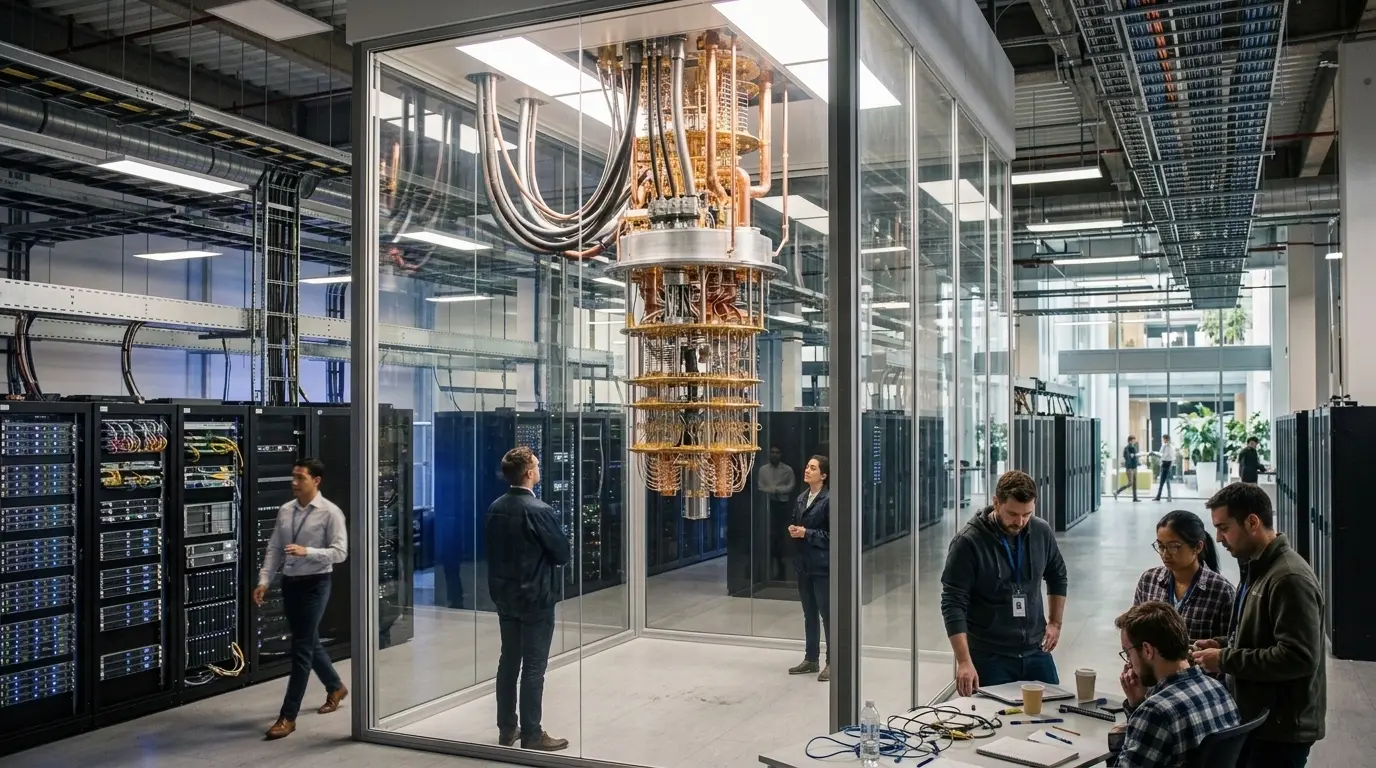
Quantum computing has moved from the physics lab to the board agenda, and the questions have changed with it. Executives no longer ask whether the science is real. They ask what it can do for a business, when it will matter, and how to reach a machine without buying a dilution refrigerator. That is the fridge that keeps a chip a hair above absolute zero. Almost no company needs to own one. Quantum computing for enterprise means answering those questions plainly, keeping what works today apart from what is still a lab result, and seeing that the subject splits in two. The compute pilot is a choice, and the security move is not.
The short answer is that access is easy and advantage is not. Any team with a company card can run a job on a real quantum computer this afternoon, through a cloud account, paying by the shot. No team can yet beat a classical computer at a task a business would pay for. The security half runs on a different clock. Governments have already set dates for retiring the encryption most firms rely on, even though nobody knows when a machine able to break it will exist.
Access is through the cloud, not the hardware. The main platforms from IBM, Amazon, Microsoft and others let a team run a real quantum job by the shot, so you do not need to own or house a machine.
The advantage is narrow and specific. Quantum computers help most with simulating quantum systems and certain optimisation and sampling tasks, not with everyday computing.
There is no broad commercial advantage yet. Almost every enterprise result to date is a pilot or a research demonstration. The field shows progress, not payoff.
Error correction is the gating problem. Labs now report dozens of logical qubits, so the count is no longer the gap. The gap is how often each logical qubit fails per step, and how many physical qubits it takes to push that rate down.
The industries moving first share a trait. Pharma, chemicals, finance, logistics and energy all have hard problems rooted in quantum physics or combinatorial complexity, which is where the technology could eventually help.
Starting early builds judgement, not results. A first project today buys skills and partners. Whether those skills carry over to later, error-corrected machines is a bet rather than an established fact.
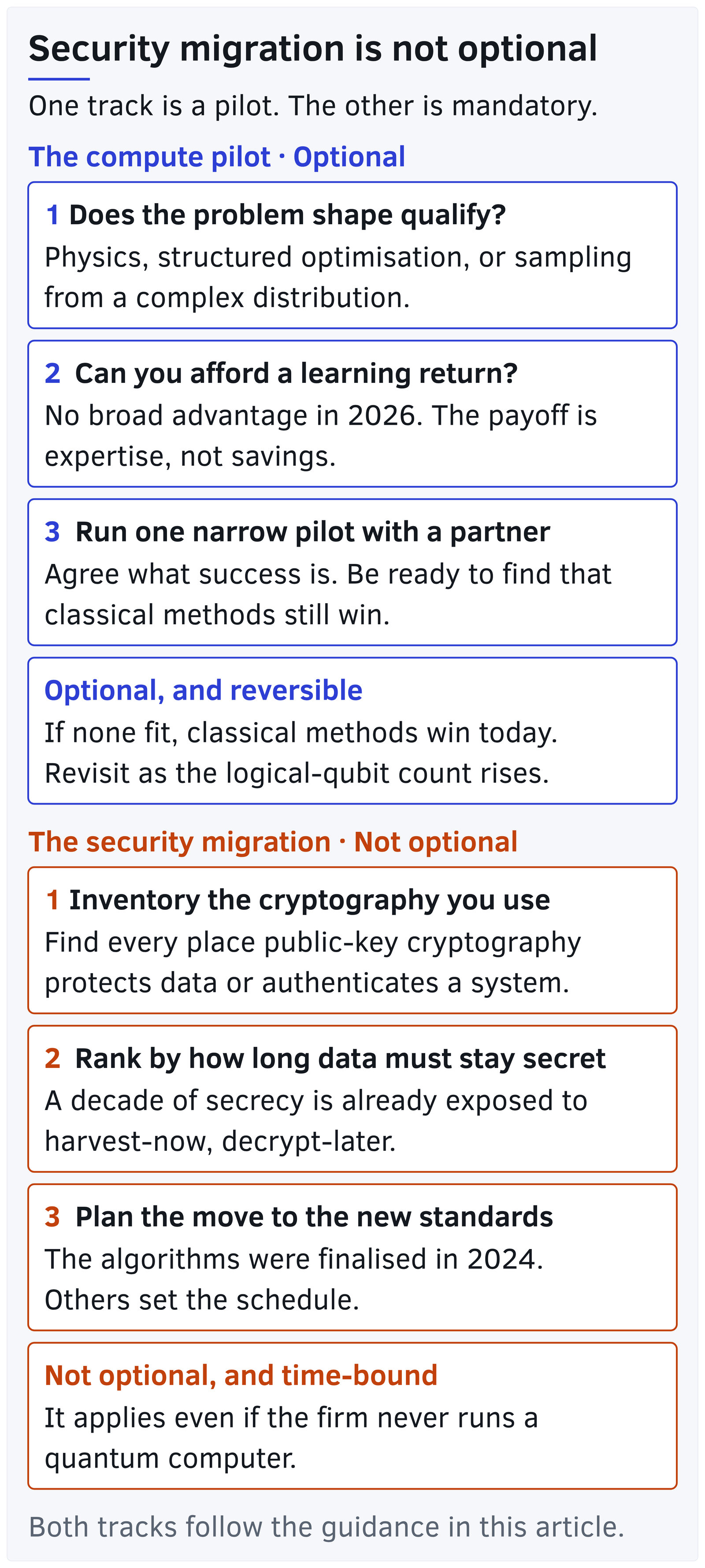
The compute pilot is a choice. The security migration is not. Every organisation has to move its encryption to the post-quantum standards NIST published in 2024, whether or not it ever runs a chemistry or optimisation job. The deadlines are set, with 2035 as the end date in the US and UK plans. When a machine able to break today’s encryption will exist is not known.
A portfolio question, not a faster server
For a business, quantum computing is not a faster version of the servers it already runs. It is a different way of doing sums. It is very good at a small set of problems and no use for most of the rest, so before a budget is signed the real question is about a portfolio of workloads. The task is to find the few where this new kind of machine could matter, not to replace anything in bulk.
The technology earns its attention for one reason. Some of the most valuable problems in industry are the kind classical computers find hardest. Simulating how molecules behave, picking the best of a vast set of choices and modelling risk across many linked variables all get hard very fast as they grow. If quantum machines mature as hoped, they could reach parts of those problems that no classical supercomputer can. That chance is why serious firms are building skills now.
Scale changes the case for it. A large firm has the research budget to run pilots, problems that last long enough to justify patience, and staff who can tell signal from sales talk. Building that judgement matters as much as any test. Whether early learners will spot a real advantage sooner than late ones is a bet rather than an established fact, but at the price of a small team it is a cheap bet.
Interference does the work, and noise is what breaks it
A classical computer stores information in bits. Each bit is firmly a 0 or a 1, and the machine works through them with logic gates in a fixed order. A quantum computer uses qubits, which can hold a blend of 0 and 1 at once, a property called superposition. Its real trick is interference. The machine steers the weights on each possible answer, called amplitudes, so that good answers build up and wrong ones cancel out. That only works while the qubits are left alone, so the same physics that gives the machine its power also makes it fragile.
The practical contrasts follow from that. They cut both ways, because a quantum computer is worse than a laptop at almost everything ordinary, from serving a web page to running a database. It is only potentially better at a narrow class of problems. Those are the ones rooted in quantum behaviour, or in a vast number of possible combinations.
| Dimension | Classical computer | Quantum computer |
|---|---|---|
| Basic unit | A bit that is either 0 or 1. | A qubit that can hold 0 and 1 at once in superposition. |
| How it computes | Deterministic logic gates step through one state at a time. | Amplitudes interfere so the right answers reinforce and wrong ones cancel. |
| Best at | Everyday work, databases, graphics and the page you are reading. | Simulating quantum systems, and some optimisation and sampling problems. |
| Hardware | Silicon transistors at room temperature. | Cryogenic superconductors, trapped ions, neutral atoms or photons. |
| Maturity | Decades of mass production and a mature toolchain. | Early. The best labs report dozens of logical qubits, with error rates still short of what long programs need. |
| Errors | Vanishingly rare, corrected invisibly. | Frequent, and error correction is the central engineering challenge. |
| Scaling | Add more transistors on a chip. | Add qubits while keeping them coherent and connected, which is far harder. |
Errors are where the two kinds of machine part ways most sharply. A transistor in a laptop almost never makes a mistake. A qubit is fragile and loses its state at the slightest nudge from its surroundings, so much of a quantum computer exists to catch and fix its errors. Today’s machines are noisy. The whole industry is racing to turn many faulty physical qubits into fewer logical ones that can be trusted.
Three ideas, none of which need the mathematics
Three ideas do most of the work, and a business reader does not need the mathematics to grasp them. Superposition lets a qubit stand for many combinations of values at once, so a set of qubits can hold a huge number of possibilities together. This is not simple parallel computing. You cannot read all those possibilities out, but it sets up the conditions for a quantum computer to do something a classical one cannot.
The second idea is entanglement, a link between qubits so tight that the state of one depends on another however far apart they sit. It lets the machine hold patterns of linked values that would be costly to track on a classical computer. The third idea is interference. That is the careful steering of amplitudes that makes the wanted answers more likely to turn up when you finally measure.
A quantum algorithm is a recipe. It sets up superposition, entanglement and interference so that when you measure, a useful result comes out with high odds. That is hard to do, and it is why only some problems have known quantum algorithms worth the trouble.
Enterprises meet the stack at its top two layers
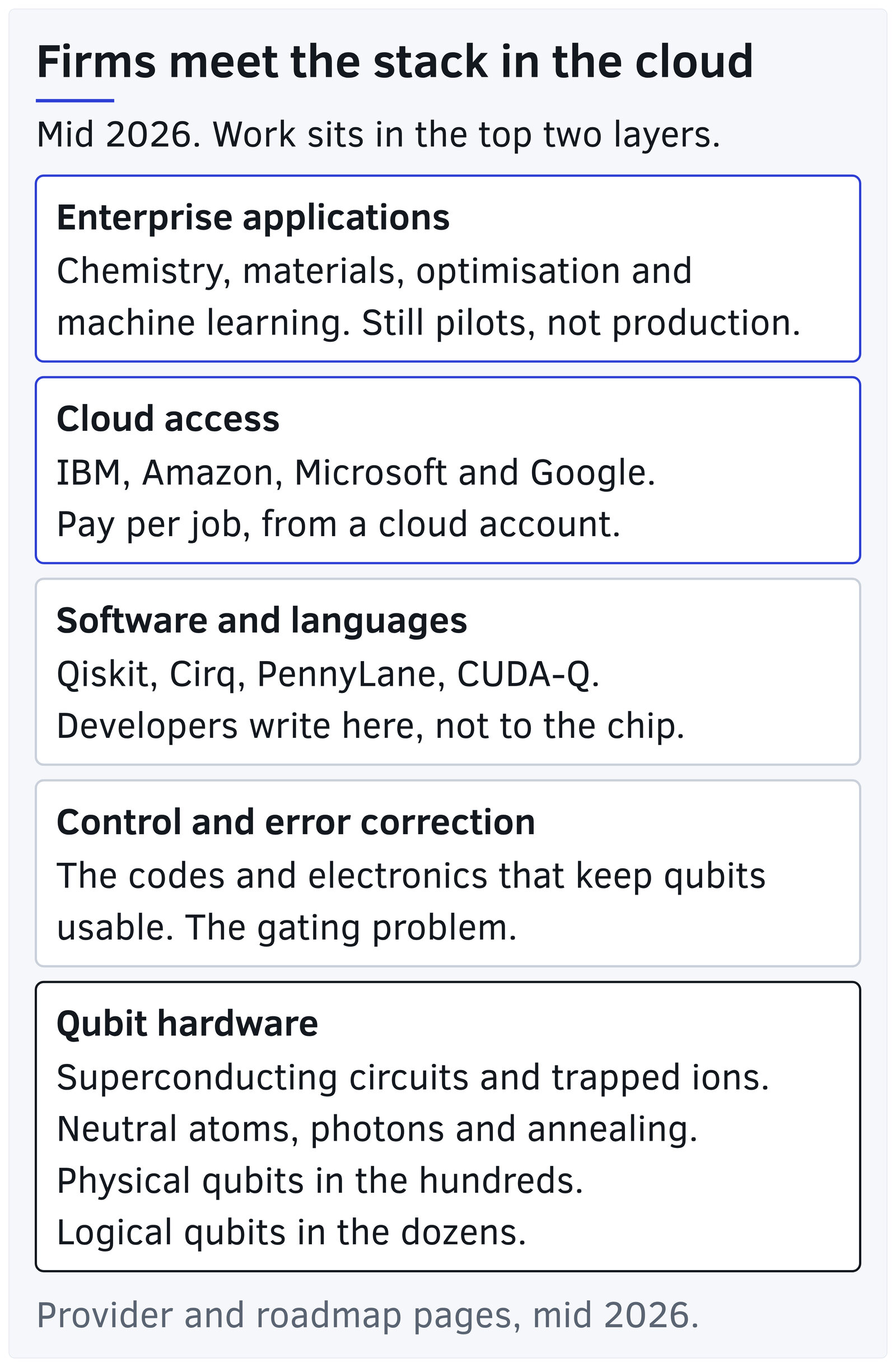
The technology sits in five layers, and a company almost always works near the top rather than the bottom. At the base sits the qubit hardware itself, built in several rival ways. Superconducting circuits, trapped ions, neutral atoms, photons and annealing machines each strike a different balance between speed, the links between qubits and stability. No single approach has won.
Above the hardware is the layer of control electronics and error correction that keeps fragile qubits usable. This is where the hardest engineering lives. Higher still are the software tools, free kits such as Qiskit, Cirq and PennyLane, along with NVIDIA’s CUDA-Q for linking quantum and classical chips. A developer writes to this software layer rather than to the hardware, and the main kits can target machines from more than one maker. The usual claim that early skills will therefore carry across machines is a bet rather than an established fact. It would be proved wrong if coding a fault-tolerant machine, one that fixes its own errors as it runs, looks nothing like the circuit-level work done on today’s noisy hardware.
The top two layers are where firms actually work. Cloud access turns a quantum computer into a service you reach over the internet and pay for by the job. The application layer sits above it. That is where a business problem in chemistry, optimisation or machine learning gets written down, and a programme that works at this level keeps its focus on outcomes rather than the physics.
Every major machine is reachable through a cloud account
The market splits into hardware builders and the cloud platforms that resell access to them. A buyer gains from knowing both. IBM runs its own superconducting machines and the widely used Qiskit software. Its published roadmap sets 2029 for Starling, a fault-tolerant machine meant to run 100 million operations on 200 logical qubits. Google’s Quantum AI group published its Willow chip error-correction result in Nature, but its hardware is reached through sponsored research rather than a broad paid cloud.
The best-known trapped-ion builders are Quantinuum and IonQ. Quantinuum’s Helios system went on sale in November 2025, and the company listed on Nasdaq in June 2026. IonQ sells access on all three big clouds. Neutral-atom firms QuEra and Pasqal, photonic builders PsiQuantum and Xanadu, the annealing pioneer D-Wave and European names such as Alice & Bob, with its cat-qubit design, round out a crowded field.
| Organisation | Technology | How enterprises access it |
|---|---|---|
| IBM | Superconducting transmons, the Qiskit toolchain | IBM Quantum Platform cloud, with on-site systems for select partners. |
| Google Quantum AI | Superconducting qubits and surface-code research | Sponsored and partner access, not a broad self-service cloud. |
| Quantinuum | Trapped-ion machines, the Helios generation | Its own cloud, on-premise systems and Azure Quantum. |
| IonQ | Trapped-ion processors | Amazon Braket, Azure Quantum and Google Cloud. |
| Microsoft | Azure Quantum as an aggregator, topological hardware research | Azure Quantum cloud across IonQ, Pasqal, Quantinuum and Rigetti. |
| Amazon | Amazon Braket as an aggregator, cat-qubit research | Braket cloud, pay per job, across several hardware makers. |
| Rigetti | Superconducting modular chiplets, the Cepheus systems | Its own cloud, Amazon Braket and Azure, plus an on-premise unit. |
| PsiQuantum | Silicon photonics, with fault tolerance as the stated goal | Building complete machines, with no qubit-time sold yet. |
| QuEra | Neutral-atom processors | Amazon Braket and its own premium access. |
| Pasqal | Neutral-atom processors from Europe | Its own cloud, Azure, Google Cloud and HPC-centre installs. |
| D-Wave | Quantum annealing for optimisation, plus a gate-model programme | The Leap cloud in real time, and on-premise purchase. |
A cloud account is the practical entry point
The practical entry point is a cloud platform. For most companies that is the way in, rather than a direct deal with a hardware maker. The three that matter are Amazon Braket, Azure Quantum and the IBM Quantum Platform, and each lets a team run jobs on real machines by the shot.
Microsoft’s Majorana 1 chip has been questioned by other physicists. It rests on an exotic qubit meant to shrug off errors, and the paper behind it says in its own words that the data do not by themselves prove such a qubit exists. D-Wave says it showed an advantage on a physics simulation. Other groups have since published classical simulations that match its results in quality.
Chemistry has the strongest case, optimisation the thinnest evidence
The useful applications fall into a few families. They differ sharply in how much evidence sits behind them. The first and strongest is simulating quantum systems, which means chemistry and materials, because a quantum computer runs on the same rules as a molecule and might model reactions that defeat classical methods. This use has the firmest footing in theory, though today’s tests are still small.
The second family is optimisation and sampling, the search for a good answer among a vast number of options. It turns up in logistics, finance and manufacturing. The promise is real but the evidence is thin, and no clear speed-up over the best classical solvers has been shown on a business optimisation problem. D-Wave’s claimed result has already been matched by classical simulation, so the safe stance is to treat any such result as provisional until classical experts have tried the problem. The third family is machine learning. There, quantum methods are a live research question, not a settled gain.
Cryptography sits slightly apart, as the one area where the impact is certain in direction if not in date. A large quantum computer running Shor’s algorithm would break the public-key encryption behind most digital security. That is why post-quantum cryptography is now a live programme in its own right. For the wider set of business problems, a 2023 survey by Alexander Dalzell and colleagues counts the hidden costs of each quantum method and sets it against the best classical one. It is the place to check whether a proposed speed-up survives that sum.
The first movers publish papers, not savings
The sectors moving first share one shape. Each has a problem worth a lot of money that classical machines find truly hard. Drug binding and battery chemistry both turn on how electrons behave, which is why drug and chemical firms were first to look. Boehringer Ingelheim, Mercedes-Benz and Mitsubishi Chemical have each put their names to published quantum chemistry work. It ran in ACS Central Science, the Journal of Chemical Physics and the Journal of Physical Chemistry A. BASF published a scheduling test in Scientific Reports instead, and its best results there came not from a quantum chip but from quantum-inspired methods run on a classical machine.
In May 2026 a team from IBM, the Cleveland Clinic and RIKEN modelled two drug molecules, each sitting in the protein it acts on, of about 11,600 and 12,600 atoms. The work, posted as arXiv:2605.01138, matched the accuracy of a trusted classical chemistry method rather than beating it. Its authors claim no advantage over classical computing. The result is about reach, not speed.
Finance moved early and loudly. So far the output has been papers rather than deployments. Goldman Sachs researchers, writing with IBM in the journal Quantum in 2021, put the hardware that pricing one kind of derivative would need at about 8,000 logical qubits, on the paper’s own estimate. HSBC said in September 2025 that it had run a trial with IBM on algorithmic bond trading. The one advantage result the sector can point to came from JPMorgan with Quantinuum and Argonne, and it was certified randomness, numbers provably unpredictable, rather than a trading edge.
Mobility and aerospace make up the other cluster, and the work there is older and more open-ended. Volkswagen researchers, with D-Wave, mapped taxi routing across Beijing onto a quantum annealer in a 2017 paper that is still widely cited. Airbus says it works with IonQ on optimisation methods. The same page records fuel-cell chemistry work it published with BMW and Quantinuum in 2023. Boeing and the Cleveland Clinic both sit on IBM’s Quantum Network member list as of October 2026, which is where a good deal of this work lives.
The pattern across all of them is the same. These firms are building skills and mapping their problems onto quantum methods, not banking savings. None of those papers claims a commercial advantage. Whether that head start pays off when the real-world applications arrive is a bet rather than an established fact, since the skills needed on later machines may differ from those learned today. What they do get now is staff who can tell a real result from a pitch.
Dozens of logical qubits exist, and how often they fail is the real gap
Vendors field physical qubits in the hundreds, and that number makes a good headline. The count that decides what can be done is logical qubits, each one built from many physical qubits so that it can survive errors. That count is no longer a handful. Quantinuum’s Helios went on sale in November 2025 with 98 physical qubits, and the company reported 48 logical qubits with errors corrected and 94 with errors only detected. Detection lets a bad run be thrown away. Correction repairs the fault and carries on. A Harvard team working with QuEra reported 48 logical qubits in Nature in December 2023, also in blocks that detect errors rather than fix them.
So the count no longer tells the leaders apart. Two other numbers do. One is code distance, the smallest number of faults that can spoil the answer unseen. The other is the logical error rate, how often a guarded qubit still fails per step. Google’s Willow result in Nature is the clearest case, and it showed that adding qubits the right way cuts errors rather than piling them up. Its distance-7 code used 101 physical qubits to guard one logical qubit, which still failed in about 0.14 per cent of correction rounds.
Error correction is closing the gap, slowly
IBM is chasing cheaper codes to cut that overhead. Its gross code, set out in Nature in 2024 by Sergey Bravyi and colleagues, is a design tested in simulation that would guard 12 logical qubits with 288 physical ones. The standard surface code would need nearly 3,000. IBM’s Loon chip, announced in November 2025, is a test bed for the wiring that code needs. Useful business programs will need hundreds or thousands of logical qubits at far lower error rates than today’s, and even the boldest roadmaps put that years away.
As of October 2026 no one has shown a quantum advantage on a practical business workload. The nearest claims are science results. Google’s Quantum Echoes paper, published in Nature on 22 October 2025, measured an interference signal on Willow in 2.1 hours per circuit. Google puts the same job at about 3.2 years on the Frontier supercomputer. Its authors call that a viable path to practical quantum advantage, not the thing itself, and the signal is a physics probe that no business buys.
IBM’s roadmap names 2026 as the year the first examples of quantum advantage will be shown. Its open advantage tracker lists candidates, not wins. Each is a case where quantum results seem to rival the best classical methods and more tests are needed. It sorts them into observable estimation, variational problems and classically verifiable problems. Three earlier entries are already marked as overtaken after classical methods caught up with them, and none of the candidates still standing is a workload a business would pay for. That is the gap between a science milestone and a return a firm could book.
Torsten Hoefler, Thomas Häner and Matthias Troyer go further in a peer-reviewed paper in Communications of the ACM. They argue that quadratic speed-ups, where a quantum machine needs the square root of the classical number of steps, are unlikely to pay for the cost of fixing errors. For optimisation, where most of those quadratic gains live, that objection stands.
Two things would undercut it. The first is a logical qubit shown to fail about once in a million steps, at a cost of tens of physical qubits rather than the hundred in Willow’s code. That test is half met. In September 2026 Quantinuum reported a code on Helios that packs two logical qubits into 20 physical qubits, plus helpers that check them, at distance six. Its error was roughly 1 to 4 in 10,000 per two-qubit logical step, so the overhead is in range but the error rate is still at least a hundred times too high. The second is work with a better than quadratic speed-up, chemistry being the clearest, where the gap over classical methods is wide enough to absorb the cost. Neither has fully arrived. That is why the technology is a skill to build rather than a product to buy.
Problem shape decides it, not the headlines
The decision to invest turns on one thing. It should follow the shape of your problems, not the noise in the headlines. A workload is a candidate if it involves simulating quantum physics, a hard optimisation with structure that classical solvers handle poorly, or sampling from complex distributions. If your challenge is a plain data, scale or software problem, quantum computing has nothing to offer it. The money is better spent elsewhere.
Timing is the other half of the judgement. There is no broad advantage today. The return on an early project comes in learning rather than savings, and that suits firms with long horizons and problems that will still matter in five years. A firm whose edge could turn on a chemistry or optimisation breakthrough has a strong reason to build skills now, while a firm with no such exposure can reasonably watch and wait. Even DARPA, the US defence research agency, gives its Quantum Benchmarking Initiative until 2033 to learn whether any machine’s value can exceed its cost. On 7 October 2026 it moved four more firms into its final stage, making six.
There is also a defensive case, and it applies to almost everyone. The same machines that might one day help with chemistry will also break today’s encryption, so every firm has a stake in the switch whether or not it runs a chemistry job. NIST published the replacement algorithms in 2024.
Two clocks run here, and only one of them is known. The deadlines are set. NIST’s draft transition plan marks RSA-2048 and its peers as deprecated after 2030, and every public-key method a quantum machine could break as disallowed after 2035. The NSA’s CNSA 2.0 rules expect US national security systems to finish the move by 2035. Britain’s NCSC aims its timetable mainly at large organisations, operators of critical national infrastructure and companies with bespoke IT. It asks them to have a plan by 2028, finish their most urgent moves by 2031 and complete the switch by 2035.
The other clock, the date when a machine able to break the codes will exist, is unknown. Craig Gidney’s 2025 estimate puts a size on that machine. It found that a 2048-bit RSA key could be broken in under a week by a machine with fewer than a million noisy qubits, about ten thousand times the 98 in Helios. That assumes one error in a thousand per gate and a correction round every microsecond. Government deadlines bind agencies and their suppliers directly, and they reach other firms through buying rules and through what auditors and customers start to ask for. So the move to new encryption is the part every firm must do, and the compute work is the part it may choose.
A first project buys judgement, not savings
A sensible first step is to build skills and pick a candidate problem, and it is small enough to fund from a team budget. That means getting a small team access to a cloud platform and working through the free tools, first on a simulator and then on real hardware. It also means finding one or two business problems whose shape fits the quantum families. The goal of this phase is judgement. That means the ability to tell a real opening from a pitch, rather than any result.
As an order of magnitude, that is two or three engineers for a quarter plus cloud time in the low thousands of dollars, not a capital programme. Two published prices anchor the estimate. IBM’s Open Plan is free and capped at ten minutes of quantum processor time in each 28-day window. Amazon Braket publishes its prices per shot, charging $0.30 for each task plus $0.08 a shot on an IonQ Forte machine and $0.000425 a shot on a Rigetti Cepheus one. A shot is a single run of a circuit, and a serious experiment needs thousands of them, so a few thousand dollars covers a great deal of early learning.
The second step is to run a focused pilot. The right partner matters, and most firms work with a hardware maker, a cloud provider or a specialist consultancy. The job in that first pilot is to frame a narrow problem, agree what success would look like, and be willing to conclude that classical methods still win. Honest pilots that map the limits are worth as much as flattering ones, because they tell you when to invest further and when to wait.
The third step is to tie the effort to the security move. That part is not optional. While a compute pilot explores where advantage might appear, the parallel job is to list where the firm uses public-key encryption and plan the switch. That work runs to deadlines that are already set, against a threat whose date nobody knows. Run together, the two strands turn a vague interest in quantum into a programme with a clear owner, a budget and a reason to exist.
Frequently asked questions
What is quantum computing for enterprise in simple terms?
It is the use of quantum computers to tackle a narrow set of hard business problems, mainly simulating molecules, certain optimisation tasks and aspects of security. For a company it is less about replacing existing systems and more about finding the few workloads where a fundamentally different machine could eventually help, and building the skills to use it. Access is almost always through a cloud service rather than owning hardware.
Can my business use a quantum computer today?
Yes, you can run real quantum jobs today through cloud platforms such as Amazon Braket, Microsoft Azure Quantum and IBM Quantum, paying by the job. What you cannot do yet is get a reliable commercial advantage over classical computers on a practical workload, because the hardware is still early and error-prone. The sensible use today is learning and piloting rather than production.
What problems is quantum computing actually good at?
The strongest fit is simulating quantum systems, which means chemistry and materials science, because a quantum computer naturally represents how molecules behave. It may also help with some optimisation and sampling problems in logistics, finance and manufacturing, though a clear advantage there is not yet proven. It is not useful for everyday computing such as databases, web serving or general analytics.
How do enterprises access quantum hardware?
Almost always through the cloud. Amazon Braket and Microsoft Azure Quantum act as aggregators offering several hardware makers, while IBM offers its own machines through the IBM Quantum Platform. All of them charge per job, so there is no need to house a machine. A handful of organisations buy on-premise systems, but for most a cloud account is the practical route.
Is there a real quantum advantage yet?
Not for practical business work as of October 2026. The strongest results so far, such as Google’s Quantum Echoes paper in Nature in October 2025, are physics measurements that their own authors call a path to practical advantage. IBM’s roadmap names 2026 for the first examples of quantum advantage, and its public tracker lists candidates still under test, none of them a business workload. Hoefler, Häner and Troyer argue in Communications of the ACM that the quadratic speed-ups behind most optimisation proposals will not pay for their error-correction overhead. For now it is a capability to build rather than a finished product.
Which companies lead in enterprise quantum computing?
IBM and Google lead in superconducting machines, Quantinuum and IonQ in trapped ions, QuEra and Pasqal in neutral atoms, PsiQuantum and Xanadu in photonics, and D-Wave in annealing. Microsoft and Amazon matter mainly as cloud aggregators that resell access to several of these makers. The field is crowded and no single hardware approach has clearly won.
How should a company start with quantum computing?
Begin small by giving a team access to a cloud platform and the open-source tools, and identify one or two business problems whose structure fits the quantum families. Then run a focused pilot with a hardware maker, cloud provider or consultancy, with clear success criteria and a willingness to conclude that classical methods still win. In parallel, start the post-quantum security migration, which every organisation needs regardless of its compute plans.
Does quantum computing threaten our encryption?
Yes, and this is the one quantum impact that is certain in direction. A sufficiently large quantum computer running Shor’s algorithm would break the public-key cryptography behind most secure communication, which is why governments have set deadlines to move off it. NIST’s draft plan disallows the main public-key methods in use today after 2035, the NSA’s CNSA 2.0 expects US national security systems to finish by 2035, and Britain’s NCSC asks large organisations, operators of critical national infrastructure and companies with bespoke IT to have a plan by 2028 and finish by 2035. Smaller firms are drawn in through their suppliers, auditors and customers. When a large enough machine will exist is not known. Every enterprise should treat that migration as the universal part of its quantum strategy, separate from any decision about compute applications.
Legal disclaimer
Quantum Zeitgeist does not provide personal investment or financial advice, and does not act as a personal financial, legal, or institutional investment adviser. We do not individually advocate the purchase or sale of any security or investment, or the use of any particular financial strategy, and all investment strategies carry the risk of loss for some or even all of your capital.
Before pursuing any financial strategy discussed here, or relying on information within this website, you should always consult a licensed financial adviser. Any analysis we provide is for informational purposes only, does not take your circumstances into account, and should not be treated as an individualised recommendation, since the securities mentioned may not be suitable for all investors.



See today’s quantum computing news on Quantum Zeitgeist for the latest breakthroughs in qubits, hardware, algorithms, and industry deals.