

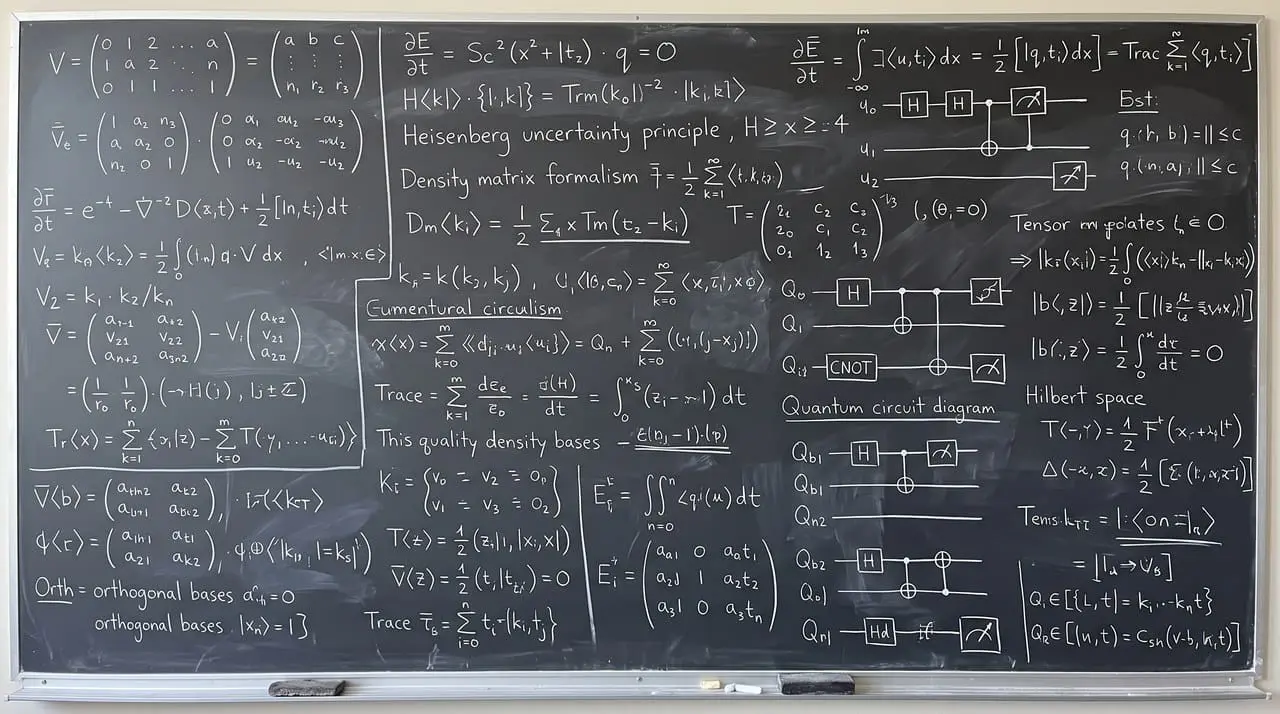
A new framework has been developed defining quantum circuit architecture witnesses, certifying the incompatibility of a unitary transformation with a specified quantum circuit architecture. Methods for determining the feasibility of implementing quantum operations are primarily constructive, meaning they attempt to build a circuit to achieve a desired transformation. However, these constructive methods generally do not provide rigorous certificates that a unitary cannot be realised using given implementation resources, leaving open the possibility that a circuit might be fundamentally impossible to construct within the constraints of a particular hardware platform.
Raphaël Mothe and Otfried Gühne, at the Institute for Scientific Computing and the Technische Universität Hannover respectively, formulate the witness construction as a semidefinite program by maximising the fidelity between the Choi state of the target unitary and those of tested circuits. The resulting witnesses provide practical and quantitative certificates of incompatibility, implying lower bounds on implementation resources such as the number of gates required and the circuit’s depth.
Rigorous certification of seven two-qubit gate quantum circuits using incompatibility witnesses
For Clifford unitaries, a specific class of unitary transformations crucial in quantum error correction and measurement-based quantum computation, a new framework enables efficient numerical certification for circuits containing approximately seven two-qubit gates, a substantial improvement over previous methods. Clifford unitaries possess the property that they map qubit states to other qubit states, and are fundamental to many quantum algorithms. Prior approaches lacked rigorous proof of impossibility; they could suggest difficulty in implementation but not definitively prove it, leaving a gap in verifying quantum computation feasibility.
This work definitively establishes whether a given quantum operation can be performed with specific hardware, providing a crucial step towards validating quantum computational designs. The quantum circuit architecture witnesses rigorously certify incompatibility between a quantum operation and a circuit design, offering quantifiable limits on resources like gate count and circuit depth. This is particularly important as the complexity of quantum circuits increases, and the resources required for implementation become a significant bottleneck.
These witnesses also provide a benchmarking tool, allowing experimental certification of operations exceeding a quantum device’s architectural capabilities, and represent a step towards more reliable quantum systems. Building upon existing methods, the framework provides a rigorous proof of impossibility, definitively establishing whether a quantum operation can be performed with given hardware, something previous approaches lacked.
The ability to definitively rule out the possibility of implementing a unitary transformation with a given circuit architecture is a significant advancement, allowing researchers to focus on more promising circuit designs and hardware configurations. This is especially relevant in the conof noisy intermediate-scale quantum (NISQ) devices, where resource limitations are particularly acute.
The technique formulates the problem as a ‘semidefinite program’ (SDP), a type of mathematical optimisation that deals with symmetric matrices and allows for the efficient solution of certain types of convex optimisation problems. SDPs are particularly well-suited for problems involving positive semi-definite matrices, such as those arising in quantum information theory. The framework maximises the similarity between the target operation and circuits tested within the defined architecture, quantified using the fidelity, a measure of how closely two quantum states resemble each other.
Furthermore, the framework extends to analytical witnesses for architectures containing an arbitrary number of gates, offering a quantifiable measure of resource limitations like gate count and circuit depth. This analytical extension provides valuable insights into the fundamental limits of quantum computation, independent of specific numerical simulations. Despite this significant advance, current fidelity measurements do not yet translate directly into guarantees for noisy, real-world quantum devices, where imperfections introduce additional challenges related to decoherence and gate errors.
Defining achievable quantum circuit complexity using established mathematical boundaries
Certifying the limits of quantum computation offers a path towards more efficient designs and realistic assessments of emerging hardware. Understanding what is not achievable with a given quantum architecture is as important as understanding what is, as it allows for the development of more targeted and efficient quantum algorithms. Extending the current framework beyond Clifford unitaries, however, presents a significant hurdle. Clifford unitaries, while important, do not encompass all possible quantum operations; many quantum algorithms rely on non-Clifford gates, such as the Toffoli gate, which are more challenging to implement.
While the method elegantly handles circuits with roughly seven two-qubit gates, scaling to more complex operations demands tackling computationally intensive ‘semidefinite programs’, a type of mathematical optimisation. The computational cost of solving SDPs grows rapidly with the size of the problem, limiting the scalability of the current approach.
A strong method has been created for definitively stating what quantum circuits cannot achieve with a given set of building blocks, offering a key benchmark for evaluating existing and future quantum hardware. Developed at London, researchers have a method to definitively assess the limits of quantum circuits, establishing benchmarks for current and future devices. This certification of incompatibility relies on ‘quantum circuit architecture witnesses’, which quantify the limits of achievable transformations given a circuit’s design. Maximising the similarity between a target operation and those possible within a given architecture establishes quantifiable boundaries on essential resources like the number of quantum gates needed, moving the field beyond simply building circuits to rigorously proving when a desired operation cannot be performed with specific hardware. This shift in focus from constructive methods to certification methods is crucial for the development of robust and reliable quantum computing systems. The ability to rigorously prove the impossibility of implementing a given unitary transformation with a specific hardware architecture will be invaluable for optimising quantum circuit designs and allocating resources effectively.
Researchers developed a method to definitively determine whether a quantum circuit can perform a specific operation given its limitations. The authors suggest this approach could be extended beyond Clifford unitaries, although this presents a computational challenge.
👉 More information
🗞 Witnessing the architecture of quantum circuits
✍️ Raphaël Mothe and Otfried Gühne
🧠 ArXiv: https://arxiv.org/abs/2608.13169


See today’s quantum computing news on Quantum Zeitgeist for the latest breakthroughs in qubits, hardware, algorithms, and industry deals.



