PsiQuantum has secured a $125 million agreement with the Defense Advanced Research Projects Agency, marking the company’s most valuable U.S. government award to date and bolstering its position in the race to build practical quantum computers. The expanded agreement supports rigorous testing and evaluation under DARPA’s Quantum Benchmarking Initiative, a program designed to validate commercial pathways to utility-scale quantum computing; PsiQuantum is currently one of only two companies participating in the initiative’s final Stage C. “DARPA’s Quantum Benchmarking Initiative is one of the most comprehensive and rigorous government programs for evaluating emerging technology that I have ever seen,” said Victor Peng, Chief Executive Officer of PsiQuantum. This performance-based award will accelerate PsiQuantum’s work across hardware, software, and infrastructure at its facilities in California and Illinois, as it aims to deliver the world’s first fault-tolerant, utility-scale quantum computer.
DARPA’s Quantum Benchmarking Initiative Validates PsiQuantum’s Stage C Progress
This award represents the most valuable U.S. government award the company has received to date. Stage C focuses specifically on verifying and validating a company’s complete approach to building, deploying, and operating quantum computers as intended, a critical step beyond theoretical designs. The performance-based award will directly fund testing and evaluation of PsiQuantum’s hardware designs, essential components, overall system performance, and associated software development, while also supporting infrastructure investments at facilities in Milpitas, California, and Chicago, Illinois. This validation extends beyond simple functionality; DARPA’s team has been granted unparalleled access to PsiQuantum’s facilities, designs, and performance data, enabling in-depth scrutiny of the company’s approach.
Dr. Pete Shadbolt, Co-Founder and Chief Scientific Officer of PsiQuantum, emphasized the value of this independent assessment, stating, “The QBI program has been admirably skeptical by design.” Expert scrutiny from DARPA has put us to the test and significantly strengthened our plans. The collaboration builds on earlier engagements with DARPA, beginning with selection for the US2QC program in January 2023, and reflects a growing confidence in PsiQuantum’s photonic approach to scaling quantum systems, particularly in addressing challenges related to cooling and connectivity. Micah Stoutimore, Managing Director of DARPA’s Quantum Benchmarking Initiative, indicated earlier this year that a utility-scale quantum computer may be realized by 2033, and DARPA intends to assess all viable pathways to that goal.
Since our first engagement with DARPA several years ago, we have been delighted to give their team unparalleled access to our most sensitive designs, performance data, and plans.
Dr. Pete Shadbolt, Co-Founder and Chief Scientific Officer of PsiQuantum
$125 Million Agreement Supports Utility-Scale Hardware and Software Evaluation
PsiQuantum’s progression through the Defense Advanced Research Projects Agency’s Quantum Benchmarking Initiative underscores a focused effort to validate pathways toward practical quantum computing; the company now stands as one of only two participants in Stage C, the program’s most advanced evaluation phase. This final stage concentrates on comprehensive verification of a company’s complete approach, extending beyond basic functionality to encompass deployment and operational aspects of utility-scale systems. The substantial investment signifies PsiQuantum’s position as a frontrunner in the field.
DARPA’s evaluation process has been notably thorough, involving extensive access to technical information, on-site reviews, and real-time demonstrations of key components and fabrication processes. PsiQuantum has also provided prototype design reports and access to Construct, its fault-tolerant algorithm development platform. Dr. Shadbolt stated, “Since our first engagement with DARPA several years ago, we have been delighted to give their team unparalleled access to our most sensitive designs, performance data, and plans.”
DARPA’s Quantum Benchmarking Initiative is one of the most comprehensive and rigorous government programs for evaluating emerging technology that I have ever seen.
Victor Peng, Chief Executive Officer of PsiQuantum
Photonic Approach Addresses Quantum Computing Scaling Challenges
PsiQuantum’s strategy for building a practical quantum computer centers on manipulating photons, a fundamentally different approach from the superconducting and trapped ion technologies currently dominating much of the field. This photonic architecture directly addresses critical scaling challenges, particularly those related to maintaining the extreme cryogenic temperatures required for qubit operation and managing the complex control electronics needed to orchestrate quantum calculations. The company has expanded operations at its PsiFactory in Milpitas, California, to include barium titanate manufacturing, edge coupling, and prototype assembly, indicating a move toward in-house production of key components. This focus on manufacturability is a key differentiator, allowing PsiQuantum to potentially leverage existing semiconductor fabrication infrastructure, a significant advantage as the industry seeks to move beyond laboratory prototypes.
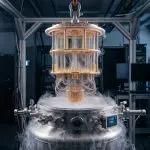
Beyond cooling and control, the photonic approach also tackles the issue of qubit connectivity, a persistent bottleneck in scaling quantum processors. PsiQuantum personnel have been working to address these challenges, as evidenced by images released showing cryogenic infrastructure arriving at PsiFactory, suggesting progress toward a scalable quantum computing solution.



See today’s quantum computing news on Quantum Zeitgeist for the latest breakthroughs in qubits, hardware, algorithms, and industry deals.