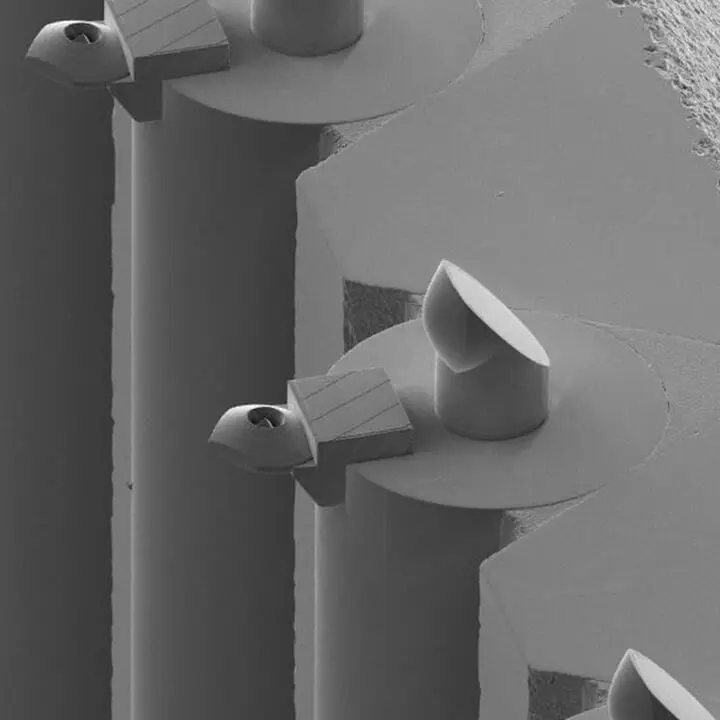
Engineers tackling the growing demands of artificial intelligence and high-performance computing now have new tools for testing increasingly complex optical systems. FormFactor’s Pharos Optical Probe Series utilizes patented fiducial technology and automated calibration to address the challenges of accurately positioning optical probes and achieving efficient optical coupling, the company says.
As silicon photonics plays a growing role in optical transceivers and emerging co-packaged optics (CPO) architectures, reliable characterization depends on consistent light coupling; even small changes in alignment can impact measurements. The series offers four probe configurations designed for a range of edge- and surface-coupling applications, aiming to deliver repeatable results for photonic device testing.
Pharos Probe Series Simplifies Silicon Photonics and CPO Testing
The Pharos SCL probe configuration is specifically designed for beam expanders and the interfaces critical to co-packaged optics, supporting the development of advanced photonic devices and emerging optical packaging architectures. FormFactor’s new probe series addresses a key challenge in validating these systems; reliable measurement data hinges on a stable and repeatable optical connection to the device under test, a connection increasingly difficult to achieve as interfaces become more tightly integrated with electronic packaging, according to the company.
This need for precision stems from the escalating bandwidth demands of artificial intelligence, high-performance computing, and data centers, all driving innovation in silicon photonics. Co-packaged optics, a technology aiming to reduce the distance electrical signals travel, presents unique testing hurdles, but the Pharos series offers solutions for both edge-coupling and surface-coupling applications.
The probes combine advanced micro-optics, patented alignment technology, and automated calibration to simplify optical testing and deliver consistent, repeatable measurements. The company states that alignment is one of the most important variables in optical testing, particularly when working with edge-coupled devices, highlighting the importance of minimizing error in these sensitive setups. The series supports a wide range of silicon photonics applications, including edge-coupled waveguides, optical transceivers, photonic integrated circuits, grating couplers, and co-packaged optics interfaces.
Generating repeatable measurement data helps engineers understand device performance and make informed decisions, and the Pharos series tackles the problem of inconsistent results stemming from the test setup itself. Engineers previously faced uncertainty about whether changes in optical measurements originated from the device being tested or from fluctuations in the testing environment; the new probes aim to eliminate that ambiguity.
Optical probes function by providing the necessary optical connection to couple light into or out of a photonic device during characterization and testing, and precise positioning and coupling are paramount. Even small alignment variations can significantly affect optical measurements, making accurate probe placement essential. Surface coupling, which typically uses grating couplers to direct light through the device surface, requires different probe geometries and alignment techniques than edge coupling, which transfers light through an optical interface at the edge of a photonic device.
The Pharos series accommodates both approaches, offering engineers options to address these different test requirements. This focus on workflow consistency is particularly important as artificial intelligence, high-performance computing, and data center applications continue to drive silicon photonics development, demanding increasingly sophisticated testing capabilities.
Co-Packaged Optics Challenges Addressed with Precise Optical Coupling
The FormFactor Pharos Optical Probe Series addresses evolving test needs across silicon photonics development, from initial characterization to high-volume manufacturing of co-packaged optics. Engineers face increasing difficulty achieving reliable optical coupling as devices become more complex, demanding solutions that streamline testing and ensure repeatable measurements. The series provides configurations tailored to both edge-coupling and surface-coupling applications, acknowledging the diverse requirements of photonic device evaluation.
Specifically designed for narrow trenches, the Pharos ECS (Edge-Coupling Short) maximizes efficiency in edge-coupling scenarios while minimizing optical loss; conversely, the Pharos ECL (Edge-Coupling Long) extends optical reach for testing at the die level and within V-grooves. Surface-coupling applications benefit from the Pharos SCS (Surface-Coupling Short), optimized for grating couplers and vertically emitting devices where precise positioning is paramount, and the Pharos SCL (Surface-Coupling Long) supports beam expanders and advanced optical packaging architectures.
The emergence of co-packaged optics as a key technology for artificial intelligence and high-performance computing necessitates advancements in testing methodologies; by integrating optical connectivity closer to compute devices, CPO architectures aim to reduce electrical signal travel and improve bandwidth and power efficiency. However, this tighter integration presents new challenges for optical probe placement and data consistency.
Four Pharos Configurations Support Diverse Photonic Device Applications
FormFactor developed the Pharos Optical Probe Series to address challenges in maintaining consistent optical test workflows, recognizing that increasingly tight integration of optical interfaces with electronic packaging complicates accurate measurement. Beyond the SCL, the Pharos family encompasses four distinct probe configurations designed for both edge- and surface-coupling applications, extending support to a broad range of silicon photonics components. The series’ ability to accommodate varying coupling methods is intended to streamline testing processes across the entire development lifecycle, from initial characterization to high-volume manufacturing.
FormFactor’s integration of its SiPh-Tools 4.0 software and AutoCal functionality further automates calibration and alignment procedures, reducing the time spent on setup and increasing the efficiency of data acquisition. This automation is particularly valuable as co-packaged optics gains prominence, demanding tighter integration and more precise positioning of optical probes.
The Pharos series’ customizable probe configurations allow engineers to tailor the optical connection to device-specific requirements, including fiber configuration, channel pitch, wavelength, mode field diameter, and emission angle. This level of adaptability is important as silicon photonics development accelerates, driven by applications in data centers and the need for increased bandwidth. Configuring probes for specific needs ensures optimal light transmission and signal integrity, contributing to more accurate and reliable test results.
The company states that by reducing variability in the test setup, engineers can have greater confidence that changes in their data are coming from the device being tested rather than differences in probe alignment, emphasizing the importance of minimizing external factors that could skew measurements. The development of this series reflects a broader industry trend toward tighter integration of optical and electronic components, requiring increasingly sophisticated testing methodologies to ensure reliable operation and performance.


See today’s quantum computing news on Quantum Zeitgeist for the latest breakthroughs in qubits, hardware, algorithms, and industry deals.