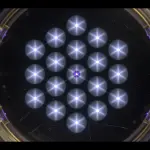
Molecular dynamics codes now simulate electromagnetically induced transparency (EIT) cooling, a technique to reach near ground state temperatures, in both two and three-dimensional configurations containing up to five hundred ions. The code efficiently cools axial modes within these 3D crystal structures which are promising platforms for future quantum sensing experiments with enhanced sensitivity. Computer simulations accurately model EIT cooling; a technique used to reach extremely low temperatures, in both two and three-dimensional ion crystals containing up to five hundred ions.
These advanced models go beyond previous capabilities limited to simpler cooling methods like Doppler cooling. The code accurately calculates forces acting on individual ions during EIT cooling which will help optimise future experiments for quantum sensing and information processing. Collaborating institutions have developed new computer simulations capable of modelling electromagnetically induced transparency (EIT) cooling, a technique for reaching extremely low temperatures in ion crystals containing up to five hundred ions; think of it like using precisely tuned sound waves to cancel out unwanted vibrations until almost nothing remains.
These models surpass previous capabilities limited to simpler methods such as Doppler cooling, accurately calculating forces on individual ions during the EIT process which will help refine future experiments. Simulations successfully demonstrate this advanced cooling method in both two and three-dimensional configurations, opening doors for enhanced quantum sensing platforms. Effectively cooling these crystal structures, particularly their natural wobble or EtimesB modes, similar to how an egg wobbles when spun, is key for achieving precise control needed for sensitive measurements.
Molecular Dynamics Enables Simulations Exceeding Doppler Limits for Larger Ion Crystal Configurations
A new molecular dynamics code now simulates EIT cooling for ion crystals containing up to 500 ions, a five-fold increase over previous capabilities limited to Doppler cooling methods. This threshold unlocks simulations of larger three-dimensional crystal configurations promising enhanced sensitivity for quantum sensing experiments. Researchers at University of Colorado, in collaboration with Indian Institute of Technology Madras and National Institute of Standards and Technology USA, can accurately calculate laser forces acting on individual ions during the EIT process by simultaneously tracking both their movement *and* internal quantum states.
Matching simulated single-ion cooling rates confirmed its accuracy when applied to more complex scenarios. Analysis extended to planar ion crystals revealing how finite laser beam width impacts axial mode cooling, a critical factor for maintaining stable crystal configurations. Deliberately altering normal modes within these three-dimensional structures supports “sympathetic” cooling of low-frequency motions typically difficult to control directly.
This framework allows modelling sub-Doppler techniques in 3D crystals, offering insights into optimising future experiments with up to 500 ions. However, it does not yet account for complexities such as nonlinear interactions between different vibrational modes or imperfections in real-world laser beams, factors important before scaling towards truly large ion systems.
Semiclassical Approximations Enable Larger Ion Crystal Simulations But Require Further Validation
Accurately simulating the cooling of hundreds of ions promises enhanced sensitivity by minimising disruptive motion and represents a leap forward for those building increasingly complex quantum sensors. However, this advance relies on approximating fully quantum behaviour using semiclassical molecular dynamics, treating particles both as waves *and* solid objects simultaneously. The work acknowledges validation only at the single-ion level, raising questions about how well these approximations hold when many ions interact within three-dimensional crystals and potentially introduce errors that scale with system size.
Simulating larger systems is notoriously difficult; nevertheless, this modelling framework represents vital progress for the field of quantum sensing. Detailed calculation of forces acting on individual ions during it involves tracking their movement alongside internal quantum properties, which is a key step for optimising future experiments. Its capabilities will accelerate development of more sensitive sensors and could unlock even larger crystal simulations within the decade, pushing the boundaries of precision measurement.
This research developed a new molecular dynamics code capable of simulating electromagnetically induced transparency (EIT) cooling, a technique used to reduce motion in chains of up to 500 trapped ions. The code models both the classical movement and internal quantum states of these ions simultaneously, allowing researchers to calculate laser forces and optimize experimental conditions.
This framework provides insights into controlling low-frequency motions within three-dimensional ion crystals, potentially enhancing sensitivity for future quantum sensing experiments; it currently validates EIT cooling rates at the single-ion level but does not yet account for complex interactions or imperfections found in real systems.
👉 More information
🗞 Semiclassical molecular dynamics simulations of electromagnetically induced transparency cooling of 2D and 3D ion crystals in a Penning trap
✍️ John Zaris, Wes Johnson, Murray J. Holland and Scott E. Parker (University of Colorado); Krishna Balaji Sogathur and Athreya Shankar (Indian Institute of Technology Madras); John J. Bollinger and Allison L. Carter (Affiliation: National Institute of Standards and Technology)
🧠 ArXiv: https://arxiv.org/abs/2610.29718



See today’s quantum computing news on Quantum Zeitgeist for the latest breakthroughs in qubits, hardware, algorithms, and industry deals.