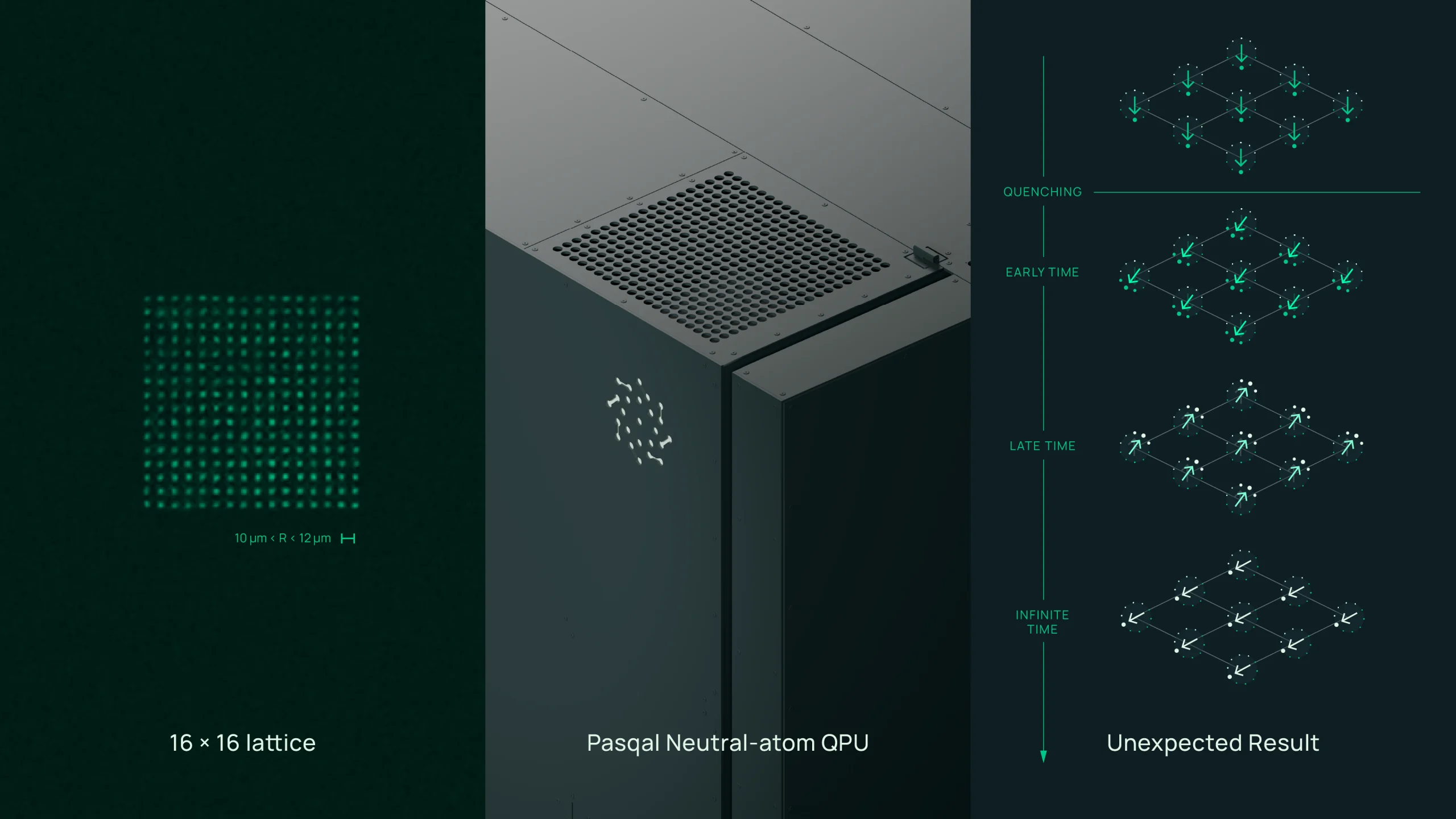
A 256-qubit quantum processor has simulated a two-dimensional quantum magnet, revealing unexpected behavior in its relaxation after a sudden change in magnetic field. The simulation, built from 256 rubidium atoms arranged in a square lattice, produced results at “late times” where three leading classical calculations failed to agree.
Researchers report the quantum approach allowed access to dynamics beyond the reach of current classical methods, offering insight into the complex evolution of quantum magnets. “The QPU results remained consistent across system sizes, giving us access to the dynamics after the classical calculations had lost control,” the team states.
Qubit QPU Simulates 2D Transverse-Field Ising Model
The simulation revealed a slow approach to thermal equilibrium, extending beyond the capabilities of three leading tensor-network calculations; these classical methods lost agreement at what researchers term “late times” in the simulation. This discrepancy emerged as the quantum processor tracked the behavior of a two-dimensional transverse-field Ising model, a system designed to isolate the competition between magnetic order and quantum fluctuations.
To physically represent the quantum magnet, the team arranged 256 rubidium atoms in a precise 16×16 square lattice. Ground and Rydberg states of these atoms encoded the two spin states essential to the transverse-field Ising model. Laser coupling created the transverse field, while interactions between Rydberg atoms established the ferromagnetic coupling.
This physical realization allowed researchers to prepare the array in a fully polarized state and then abruptly alter the transverse field, initiating the simulation of the magnetic system’s response. The resulting data showed consistent behavior across different system sizes, offering a more complete picture of the relaxation process.
The platform’s versatility extends beyond this specific simulation; the same hardware was previously used to benchmark the processor against a physical crystal of TmMgGaO₄, directly comparing the quantum results to magnetic measurements from a real material. This validation strengthens confidence in the accuracy of the quantum simulations and their relevance to observable physics.
The researchers found that at large transverse fields, the Ising dynamics are well described by a U(1)-symmetric, rotated XY model, meaning the same rubidium platform can probe different classes of spin dynamics and represent a broader range of magnetic systems, as described in their study, Exploring the Relaxation Landscape of a 2D Quantum Magnet on a 256-Qubit Processor, now available as a preprint on arXiv.
Three Relaxation Regimes Observed in Quantum Magnet Dynamics
The simulation of a two-dimensional quantum magnet revealed three distinct relaxation regimes as the transverse field increased, a finding that diverges from predictions made by three leading tensor-network calculations. These calculations, while accurate at early times, ultimately disagreed with both the quantum processor’s results and with each other when tracking the system’s evolution at later stages, specifically after time tJ reached approximately 1. Researchers mapped the magnetization and correlations across the phase diagram by repeating the simulation at different field strengths, revealing how the system relaxed within each regime.
However, a slower regime emerged, prompting investigation into whether it reflected genuine many-body dynamics or was an artifact of the finite array size or imperfections within the quantum processor itself. Separate testing ruled out these potential sources of error, and exact state-vector simulations on smaller 5×5 lattices confirmed the presence of all three regimes, including the slow relaxation, even without added noise. This ability to model complex magnetic systems, coupled with the observed relaxation regimes, offers new avenues for understanding quantum magnet dynamics and validating quantum simulations against real-world material properties.
QPU Data Extends Beyond Tensor-Network Calculation Limits
The slow relaxation observed in the simulated quantum magnet emerged precisely when three leading tensor-network calculations, classical simulations, could no longer agree at later simulation times. Researchers verified the QPU’s consistency by increasing system size, demonstrating its ability to track relaxation even as classical calculations lost predictive control.
At early times, fully converged two-dimensional tensor-network calculations agree quantitatively with the 16 × 16 QPU data up to tJ ≈ 1. The divergence of tensor-network methods stems from their reliance on compressing quantum entanglement; as entanglement grows after the simulation’s initial “quench,” maintaining accuracy becomes increasingly difficult.
The team observed that at the point where three different tensor-network calculations began to disagree with each other, their disagreement becoming as large as their disagreement with the QPU, they ceased to provide a reliable description of the late-time dynamics. The study deliberately avoids claims of computational advantage, instead focusing on identifying a regime where established classical methods fail to provide controlled late-time predictions while the QPU data remains consistent.
This transition isn’t merely a mathematical curiosity; it fundamentally alters the dynamics, creating a long-lived prethermal plateau observable throughout the experimental timescale. They hypothesize this slowdown may stem from both the breakdown of high-field approximations and critical slowing near the thermal transition point.
Source: https://www.pasqal.com/blog/unexpected-relaxation-in-a-2d-quantum-magnet-on-a-256-qubit-processor/




See today’s quantum computing news on Quantum Zeitgeist for the latest breakthroughs in qubits, hardware, algorithms, and industry deals.