

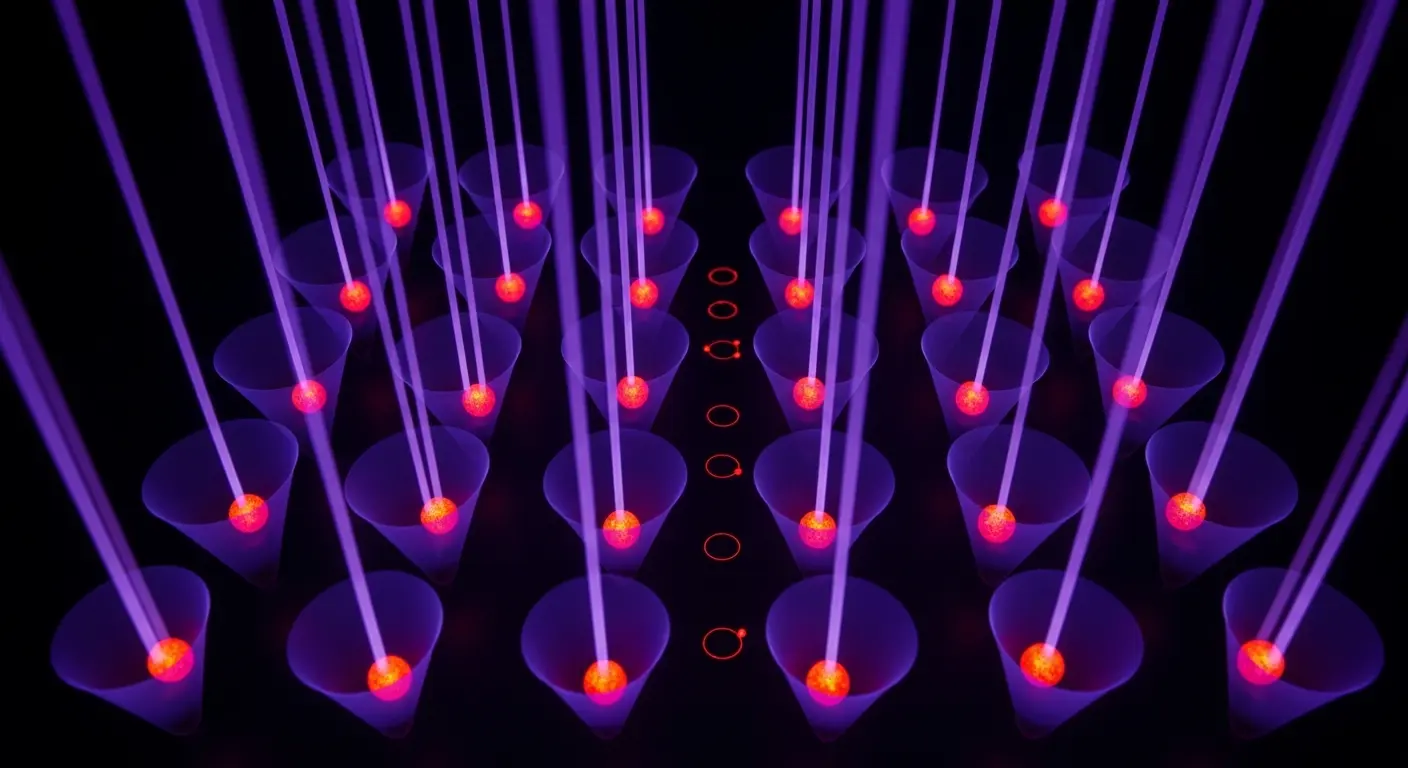
A new compact setup for creating arrays of 87 Rb atoms now offers more accessible tools for exploring quantum physics. Xue Zhao and colleagues at Renmin University and Beijing Academy of Quantum Information Sciences present a simplified and streamlined experimental design incorporating a compact vacuum system and a single cooling laser to trap and manipulate atoms. Achieving a laser-cooled sample containing 2x 10⁷ atoms at 92 K, the system demonstrates a 25×25 array of homogeneous optical traps. The advancement lowers the barriers to entry for researchers interested in optical tweezer arrays and their applications in quantum simulation and computation.
Compact magneto-optical trap enables high-density rubidium-87 atom arrays for optical tweezers
A laser-cooled sample containing 2x 10⁷ rubidium-87 atoms represents a sharp reduction in complexity for optical tweezer array experiments. Previously, achieving such atomic densities routinely necessitated vacuum systems exceeding one metre in length and multiple, precisely aligned laser stages. The core innovation lies in the integration of a two-dimensional magneto-optical trap (2D MOT) with a traditional three-dimensional magneto-optical trap (3D MOT) chamber. The 2D MOT serves as an efficient pre-cooler and atomic guide, significantly increasing the flux of atoms entering the 3D MOT. This combined approach streamlines atom capture and, crucially, maintains sufficient trapping lifetime despite the reduced vacuum system size. The system’s compact design, measuring only 40 centimetres in length, is a substantial improvement over conventional setups. The flexible control system, utilising real-time waveform generator modules, delivers precise manipulation of individual atoms within the resulting 25×25 homogeneous trap array, broadening access to quantum physics research. These waveform generators allow for dynamic control of the optical trap parameters, such as intensity and position, enabling complex atom manipulation sequences.
The achieved atomic temperature of 92 microKelvin further enhances the precision of these experiments. Lower temperatures correspond to reduced atomic motion, allowing for more accurate positioning and control of individual atoms within the optical traps. This is particularly important for high-fidelity quantum operations. Major advances in scalability, however, do not yet guarantee the long-term coherence needed for fault-tolerant quantum computation. While the system demonstrates a 25×25 array, maintaining coherence across a larger number of atoms and over extended periods remains a significant challenge. This streamlined apparatus allows for precise control, enabling manipulation of atoms within a 25×25 homogeneous trap array, which is important for exploring complex quantum phenomena such as many-body physics and quantum phase transitions. Researchers will benefit from a more manageable platform without requiring extensive resources, facilitating wider participation in this rapidly evolving field. Further investigation will focus on characterising long-term trap stability and exploring the potential for scaling array size and complexity, potentially through the use of diffractive optical elements to create larger arrays.
Reduced complexity facilitates wider access to quantum manipulation
Scientists are increasingly focused on building larger and more complex quantum systems, but maintaining control over individual atoms within these arrays presents a considerable challenge. The abstract offers little detail regarding the stability of these traps over extended periods, despite the new compact setup demonstrably simplifying the construction of optical tweezer arrays. The coherence time, which dictates how long quantum information can be reliably stored and processed, is critically dependent on maintaining stable trapping conditions and minimising sources of decoherence. Long coherence times are vital for performing meaningful quantum calculations. Decoherence arises from various factors, including collisions between atoms, fluctuations in the laser intensity, and external electromagnetic noise.
Work by Hsu et al. highlights the importance of cryogenic systems to achieve trap lifetimes exceeding several minutes, a feature absent in this demonstration. Cryogenic cooling significantly reduces the kinetic energy of the atoms, minimising their escape rate from the optical traps and suppressing collisions. While the current setup operates at room temperature, the demonstrated compactness could potentially be integrated with a cryostat in future iterations to improve trap lifetime. Despite the acknowledged absence of long-term stability data, this simplified construction demonstrably lowers the barriers to entry for researchers investigating quantum phenomena. Complex quantum systems often require substantial resources and expertise to build, including specialised vacuum technology, high-precision optics, and sophisticated control electronics. Highly focused laser beams manipulate atoms on this compact apparatus, offering a more accessible platform for experimentation. The use of readily available components and a streamlined design reduces both the cost and the technical expertise required to construct and operate the system.
The system’s use of a two-dimensional magneto-optical trap, alongside a streamlined vacuum setup, represents a practical advancement. This approach pre-cools and guides atoms towards the 3D MOT, increasing the efficiency of atom capture and reducing the required vacuum pressure. This demonstration of a compact optical tweezer array significantly simplifies the construction of experiments in quantum physics. By employing lasers and magnetic fields to capture atoms and integrating this technique with a traditional vacuum chamber, a system just 40 centimetres long was achieved. A single cooling laser and flexible control via real-time waveform generator modules enable precise manipulation of 2×10⁷ rubidium-87 atoms within a 25×25 array of optical traps. The optical traps are formed by tightly focused laser beams, creating potential wells that confine the atoms. This resulting accessibility now prompts investigation into extending array size and complexity, alongside characterising long-term trap stability for advanced quantum applications. Future research directions include exploring different trap geometries, implementing feedback control to stabilise the traps, and developing algorithms for optimising atom arrangement and manipulation within the arrays. The potential applications extend beyond quantum computation and simulation to include precision sensing and metrology.
The researchers successfully demonstrated a compact optical tweezer array capable of trapping 2x 10⁷ rubidium-87 atoms in a 25×25 configuration. This simplified setup, measuring just 40 centimetres in length, reduces the complexity and cost associated with building experiments in quantum physics. The system utilises a two-dimensional magneto-optical trap and a single cooling laser to achieve this, making it more accessible to a wider range of researchers. The authors are now focused on increasing array size, improving trap stability, and optimising atom manipulation within the arrays.
👉 More information
🗞 A compact setup for 87Rb optical tweezer arrays
🧠 ArXiv: https://arxiv.org/abs/2604.12204




See today’s quantum computing news on Quantum Zeitgeist for the latest breakthroughs in qubits, hardware, algorithms, and industry deals.



