Entanglement, a cornerstone of quantum mechanics and a vital resource for future technologies, remains notoriously difficult to detect, especially within complex many-particle systems. Hao-Yue Qi and Wei Zheng, at the Hefei National Research Center for Physical Sciences at the Microscale and the University of Science and Technology of China, now present a novel method called split spectroscopy that offers an experimentally viable way to identify entanglement in these systems. The researchers demonstrate that this technique reveals a distinct signature, a single, sharp peak, only when an eigenstate exhibits a specific, easily verifiable property, simplifying the detection process. This framework, illustrated using established spin models undergoing phase transitions, not only identifies entanglement but also provides a powerful tool for tracking these transitions and understanding the underlying scaling behaviour of quantum correlations, potentially paving the way for new experiments using platforms like Rydberg atom arrays.
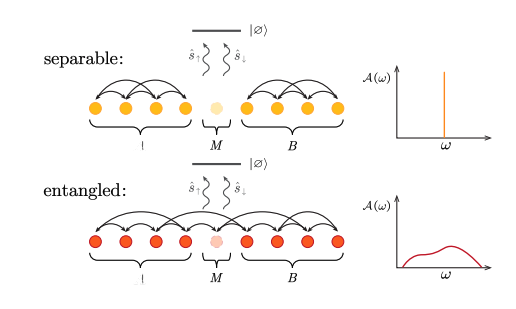
Detecting entanglement in complex systems remains a significant challenge, but this method offers a potentially practical solution. The approach involves dividing a quantum system into three interconnected parts and analysing the resulting spectral response to reveal the presence or absence of entanglement. The core principle relies on observing the spectrum produced when the system is perturbed, effectively decoupling one of the three parts.
A single, sharp peak in the spectrum indicates a “separable” state, meaning the parts are not entangled. Conversely, multiple peaks signal the presence of entanglement between the subsystems, providing a robust method for characterizing quantum states. To demonstrate the effectiveness of split spectroscopy, the team applied it to two well-known quantum spin models under different conditions. Simulations revealed that the spectral entropy, derived from the spectral response, accurately indicates quantum phase transitions, points where the system’s properties dramatically change. Importantly, the spectral entropy accurately captures how entanglement scales with system size, providing insights into the nature of the quantum state.
The results demonstrate that separable states consistently produce a single peak, while entangled states generate more complex spectra. Furthermore, the team observed that the spectral entropy exhibits singularities precisely at the points of quantum phase transitions. This connection highlights the technique’s potential for characterizing complex quantum materials and understanding their emergent properties, offering a promising pathway towards experimentally verifying entanglement in complex quantum systems and advancing quantum technologies. This research introduces split spectroscopy as a viable method for detecting entanglement within the eigenstates of quantum systems.
By applying this technique to established spin models undergoing phase transitions, they show that the resulting spectral entropy effectively indicates these critical points and accurately captures the scaling behaviour of entanglement. While the current work focuses on detecting entanglement in eigenstates, the authors acknowledge the need to extend this formalism to analyse Gibbs thermal states, representing a natural progression for future research. They also propose exploring an analytical framework to characterise the split spectroscopy for entangled states, suggesting a promising avenue for further theoretical development.
👉 More information
🗞 Detecting Entanglement via Split Spectroscopy in Many-Body Systems
🧠 ArXiv: https://arxiv.org/abs/2508.08704




See today’s quantum computing news on Quantum Zeitgeist for the latest breakthroughs in qubits, hardware, algorithms, and industry deals.