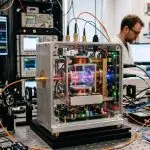
Researchers at the University of Oxford and Oxford Ionics have achieved entanglement of two, three and four matter qubits across a photonic network link. The work demonstrates remotely entangled strontium and calcium ions, as well as mixed-species GHZ states, and extends the storage time of these remotely-entangled memory qubits to more than 100 times the creation time. This advance addresses a key challenge in building scalable quantum networks by integrating robust quantum memories with photonic interfaces. The generation of multipartite entanglement is critical for applications like distributed quantum computing and quantum sensing.
Mixed-Species Trapped Ions Enable Quantum Networking
Trapped ions within a quantum network maintained entanglement for more than 100 times the creation time. This preservation of quantum states, achieved by researchers using strontium and calcium ions, represents a substantial increase in coherence time critical for complex quantum computations and distributed quantum sensing. The network architecture integrates robust quantum memory with efficient network interfaces, a combination previously challenging to realize at this scale.
The apparatus consists of two modules linked by a photonic connection, each housing one strontium-88 ion and one calcium-43 ion. Strontium-88 functions as the network interface, facilitating communication via photons, while calcium-43 is a long-lived quantum memory. This division of labor uses the strengths of each ion species. calcium-43 exhibits a significantly lower sensitivity to magnetic fields, 122 kHz mT-1 at 0. 5 mT, roughly two orders of magnitude less than the strontium network qubit.
An auxiliary qubit, also defined within the calcium-43 ground hyperfine manifold, aids in state preparation, measurement and mixed-species quantum logic operations. Entangling gates between different ion species are essential for delegating tasks based on specific requirements, such as storing quantum information and establishing network connections. Researchers implemented these mixed-species entangling gates using light-shift mediated geometric phase gates, employing Raman beams at approximately 402 nm. These gates, important for creating GHZ states and transferring quantum information, achieve durations in each module.
To further refine the quantum state transfer, mid-circuit measurements of the strontium-88 ions are performed after iSWAP gates, detecting errors in the mixed-species gates. Real-time classical communication between the modules allows the experiment to be aborted and restarted if errors are detected, enhancing the fidelity of the entangled states.
Characterization of remotely entangled strontium-88-calcium-43 and calcium-43-calcium-43 states was performed using both full and partial state tomography. The creation of multipartite entangled states, involving two, three and four qubits, demonstrates the potential to scale up entanglement beyond simple two-qubit systems, a key hurdle in building practical quantum networks.
Photonic Network Links Entangle Strontium and Calcium Qubits
Trapped strontium and calcium ions within a newly constructed quantum network maintained entanglement for a period exceeding 100 times the duration of their initial creation, a feat demonstrating significant progress toward practical quantum technologies. The architecture uses strontium ions as network interfaces and calcium ions as robust quantum memories, a design choice that directly addresses the challenge of sustaining entanglement over macroscopic distances.
This process created GHZ states, a specific type of entangled state important for distributed quantum computing and enhanced quantum sensing, with up to four qubits participating simultaneously. Full state tomography, involving 10,000 measurements, revealed entanglement fidelities of 93.1% for the three-qubit states and 91.9% for the four-qubit states.
This achievement builds upon the natural interface between trapped ions and optical photons, which facilitates the creation of remote entanglement between qubits separated by considerable distances. The team’s approach differs from many existing quantum networking schemes by directly entangling the strontium-88 ions through the optical fibre, then transferring that entanglement to the calcium-43 memory qubits within each module. This transfer is accomplished using local logic gates, allowing for the delegation of tasks based on the specific requirements of each ion species.
The resulting network architecture, according to the research, offers a pathway toward scalable quantum networks capable of supporting complex quantum computations. Oxford Ionics, a company originating research is now actively pursuing the commercialization of this technology.
GHZ States Generated Across Four Trapped-Ion Qubits
The architecture achieves this longevity by transferring quantum states from strontium ions, used for initial entanglement, to calcium ions functioning as quantum memories. The network successfully generated remotely entangled states between individual ions, including strontium-strontium, strontium-calcium and calcium-calcium pairs, alongside three- and four-qubit GHZ states. The integration of remote entanglement generation with local quantum logic demonstrates a pathway toward scalable quantum networks.
Macroscopic Distance Entanglement via Optical Fiber
This extended coherence is achieved through a network design integrating strontium-88 and calcium-43 ions, where strontium facilitates network communication and calcium provides a robust memory. The system, detailed in a recent report, demonstrates a significant leap toward practical, scalable quantum networks. The architecture uses optical fiber to distribute entanglement between the two modules, each housing one strontium and one calcium ion. Researchers directly entangled the strontium ions via this photonic link, then extended that entanglement to the calcium ions within each module using local mixed-species logic gates.
This approach uses the strengths of both ion types: strontium’s suitability for interfacing with photons and calcium’s capacity for long-duration quantum storage. The team generated remotely entangled strontium-calcium and calcium-calcium pairs, as well as more complex mixed-species GHZ states involving up to four qubits.
The process begins with optical pumping to prepare the strontium ions in a specific ground state, followed by excitation with a short pulse of light. This excitation initiates a decay that emits a photon, establishing entanglement between the photon’s polarization and the strontium ion’s internal state. The emitted photons are then interfered at a central station, heralding the successful creation of entanglement between the strontium ions in separate modules.
“There is also a 5 % branching ratio for decays to the manifold, however these result in an unsuccessful entanglement attempt and so can be neglected,” the researchers note, detailing the precision required in controlling the decay process. The calcium ions then serve as quantum memory qubits, preserving the remotely generated entanglement for over 10 seconds, a duration far exceeding the timescale of entanglement generation itself.
Transitions within the calcium-43 manifold are driven by Raman beams, allowing for manipulation and storage of the quantum information. This extended storage capability is critical for enabling complex quantum computations and long-distance quantum communication, as it allows sufficient time for processing and transmission of quantum data.
Strontium-88 as Optical Network Qubit Interface
This extended coherence allows for significantly more operations to be performed on the fragile quantum state before it degrades, exceeding the duration of the initial entanglement creation by a factor of 100. The architecture uses strontium-88 as a network interface, directly interfacing with optical photons to distribute entanglement across macroscopic distances. Each network node consists of a co-trapped strontium-88 and calcium-43 ion within a microfabricated vacuum chamber, using the distinct strengths of each ion species.
Single-qubit rotations on the calcium-43 ions are driven by 402 nanometer Raman beams, enabling precise manipulation and storage of quantum information. This combination allows for the creation of remotely entangled strontium-88-calcium-43 and calcium-43-calcium-43 pairs, forming the basis for more complex multi-qubit states. The system’s ability to perform logic gates between ions of different species allows for the delegation of roles for performing specific tasks within the network.
We generate remotely entangled Sr+, Ca+ and Ca+, Ca+ states, as well as mixed-species GHZ states of up to four qubits. The system’s performance suggests a viable pathway toward scalable, long-distance quantum communication and distributed quantum computing.
👉 More information
🗞 Multipartite Mixed-Species Entanglement over a Quantum Network
✍️ D. Main et al.
🧠 DOI: http://link.aps.org/doi/10.1103/qpsf-nlp9

See today’s quantum computing news on Quantum Zeitgeist for the latest breakthroughs in qubits, hardware, algorithms, and industry deals.