Oak Ridge National Laboratory launched “Pathfinder,” a 20-qubit IQM Radiance quantum computer, on June 16, marking a key step in efforts to combine quantum and classical computing power. The Finland-based IQM Quantum Computers deployed its first U.S. on-premises quantum computer at ORNL through the Institutional Capital Equipment program, signaling confidence in the laboratory’s research capabilities. “By adding Pathfinder to the array of systems available to our computational scientists, ORNL deepens its commitment to making the U.S. a leader in quantum science and technology,” said ORNL director Stephen Streiffer. Installed in the Translational Research Capability building, Pathfinder joins a 6-qubit Quantum Brilliance cluster installed last September and will allow researchers to develop new applications and a hardware-agnostic software architecture for merging these distinct computing technologies.
ORNL Pathfinder: Integrating 20-Qubit IQM Radiance with HPC
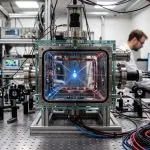
Launched on June 15 within the Translational Research Capability building, Pathfinder joins Quoll, the 6-qubit Quantum Brilliance cluster installed last September, expanding ORNL’s capacity for advanced research. IQM Quantum Computers views this deployment as a pivotal moment in its expansion, with CEO Jan Goetz noting that ORNL has been at the forefront of American science for decades and that bringing IQM’s first U.S. on-premises quantum computer here represents a significant milestone as the company continues to expand its global footprint and provide quantum capability to institutions that can advance quantum adoption. Pathfinder’s superconducting qubits require extreme cooling, maintained by a Bluefors cryosystem capable of reaching temperatures below 10 millikelvin, which demonstrates the complex engineering required to sustain quantum states.
Researchers at the Quantum Science Center will leverage Pathfinder to develop a hardware-agnostic software architecture, aiming to create a scalable, hybrid HPC ecosystem. Quantum Science Center director Travis Humble explained that on-premises systems enable them to demonstrate quantum computing concepts that realize their goal of building a scalable, hybrid HPC ecosystem, while HPC systems software engineer Amir Shehata added that their idea is to formalize the interfaces for QHPC so applications can run more uniformly and integrate different types of hardware without requiring a complete infrastructure overhaul. This integration will allow teams to move beyond simulations and test their architectures on physical quantum hardware, accelerating progress in materials science, chemistry, and artificial intelligence.
By adding Pathfinder to the array of cutting-edge systems available to our computational scientists, ORNL deepens its commitment to making the U.S. a leader in quantum science and technology.
Beyond the recently launched 20-qubit IQM Radiance system, “Pathfinder”, Oak Ridge National Laboratory is actively building a diverse quantum computing infrastructure to accelerate research into quantum-centric high-performance computing, or QHPC. Complementing Pathfinder is Quoll, a 6-qubit Quantum Brilliance cluster installed at the Oak Ridge Leadership Computing Facility last September, providing researchers with multiple platforms for experimentation. This dual approach allows the Quantum Science Center to develop new applications, algorithms, and architectures leveraging the QHPC paradigm, positioning ORNL as a central hub for this emerging field. IQM is a member of the Quantum Science Center and is supporting the center’s mission to build the next generation of quantum computing capabilities. Researchers across ORNL are focused on establishing a hardware-agnostic software architecture, aiming to seamlessly merge the strengths of both quantum and classical computing technologies. Crucially, the system is connected to HPC resources in the National Center for Computational Sciences test bed, enabling researchers to test integrated workflows.
On-premises systems enable us to demonstrate quantum computing concepts that realize our goal of building a scalable, hybrid HPC ecosystem.
The deployment of the 20-qubit IQM Radiance system, dubbed “Pathfinder,” at Oak Ridge National Laboratory relies on sophisticated cryogenic engineering to maintain the delicate quantum states essential for computation. Pathfinder is chilled by a Bluefors cryosystem, employing helium compressors to reach 4 kelvin, while a dedicated gas-handling system further reduces the internal temperature to below 10 millikelvin. This extreme cooling is not merely a technical detail; it’s fundamental to preserving qubit coherence and minimizing errors. Unlike classical bits, qubits leverage quantum superposition, potentially unlocking exponential increases in processing power for specific problems, such as simulating molecular interactions. However, these qubits are exceptionally sensitive to environmental disturbances, including temperature fluctuations and electromagnetic noise. The Translational Research Capability building, completed in 2025, was intentionally designed to mitigate these issues, featuring ground-floor sensitive-equipment laboratories with vibration control down to 250 microinches. Integrating Pathfinder with ORNL’s high-performance computing resources is a key objective.
The integration of quantum computing at Oak Ridge National Laboratory extends beyond hardware; a core goal is the development of an open software stack to facilitate hybrid computing across diverse systems. Researchers are actively working to establish a hardware-agnostic software architecture, enabling seamless merging of quantum and classical capabilities, a necessity given the proprietary nature of software typically bundled with quantum computers. This push for standardization is being demonstrated with both the newly installed 20-qubit IQM Radiance system, “Pathfinder,” and Quoll, the 6-qubit Quantum Brilliance cluster installed last September. Previously, development relied heavily on simulations; however, with two physical quantum machines now operational, the Quantum Science Center researchers can validate their designs against real-world performance.
The work we’ve been doing here so far has been using simulators to take the place of the quantum computers. But now that we have two quantum machines, including the IQM system, we can start trying to see if those architectures that we developed actually work when we couple them to a physical machine.



See today’s quantum computing news on Quantum Zeitgeist for the latest breakthroughs in qubits, hardware, algorithms, and industry deals.