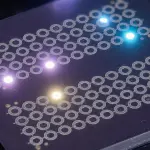
NVision Quantum Technologies and Ulm University researchers have designed a single molecule capable of functioning as a qubit, individually connected by light, a first for this type of quantum bit. The molecule, di(-4-yl)carbene, offers four key properties for addressability and stability, potentially challenging the scalability of existing 6100-qubit superconducting systems.
“We can tune its properties with synthetic chemistry and deposit it as a thin film on photonic integrated circuits made with existing foundry processes,” says Ilai Schwartz, chief technology officer at NVision, adding this “opens a manufacturable route towards large-scale quantum computers.” This advance offers a new pathway for linking small quantum computing units with light to control errors and reach the hundreds of thousands of qubits needed for practical applications.
Light-Connected Molecule Achieves Individual Qubit Addressability
The molecule di(-4-yl)carbene fluoresces only when its electrons are in one of three specific spin states, a key characteristic enabling individual qubit addressability recently demonstrated by researchers at NVision Quantum Technologies and Ulm University. Prior to this work, reading information from molecular qubits required averaging values across groups of molecules, hindering precise quantum computation; this new design allows for the interrogation of a single molecule’s spin.
Stability is also central to the molecule’s function, as the relevant spin states persist long enough to perform calculations, a critical requirement for practical quantum devices. NVision Quantum Technologies intends to integrate these molecular qubits into photonic integrated circuits, where light will be the primary means of connection and control between individual qubits.
Light interaction with electron spins will facilitate this connectivity, enabling the creation of more complex quantum processors, the company says. Danna Freedman states that this achievement “propels molecules forward as core elements of quantum technologies,” recognizing the significance of achieving single-molecule addressability and spin control. This achievement represents a departure from conventional qubit construction, which typically relies on more complex systems, and offers a potential pathway towards scalable quantum computing.
According to the research team, the molecule’s properties can be tuned through synthetic chemistry, allowing for optimization and customization. The development of this light-connected molecular qubit marks a step toward building quantum computers with increased precision and connectivity.
NVision’s Photonic Integrated Quantum Circuits (PIQC) for Scalability
Light will not only connect the qubits via interactions with their electron spins, but also facilitate communication between them, potentially creating more complex quantum networks. This approach aims to address a critical limitation of current quantum computing platforms, which, while achieving impressive qubit counts, up to 6100 in superconducting systems, struggle with error correction at scale. Existing technologies have only successfully detected and corrected errors on a maximum of eight qubits, a barrier to practical quantum computation.
NVision Quantum Technologies’ approach to molecular qubits yields a fluorescence response dependent on only three electron spin states. This selective fluorescence, achieved with the di(-4-yl)carbene molecule, allows for individual qubit addressability, a feat previously unattainable with similar systems. The design of this molecule directly addresses a key challenge in scaling quantum computers, as it allows NVision to precisely position qubits within their quantum computing chips, according to NVision Quantum Technologies.
David Awschalom describes the result as a “high-quality molecular qubit architecture,” noting it “enables a spin–photon interface at the single-molecule level.”
The ability to create a stable, brightly fluorescing molecule with defined spin states, and then integrate it into photonic integrated circuits, could provide a route to building large-scale quantum computers. Awschalom states that this development “is a significant step towards integrating molecular qubits with scalable optical communication platforms, with applications in quantum sensing and communication.” The team’s work demonstrates a departure from traditional qubit construction, potentially opening new avenues for quantum technology development.


See today’s quantum computing news on Quantum Zeitgeist for the latest breakthroughs in qubits, hardware, algorithms, and industry deals.