Researchers at École Polytechnique Fédérale de Lausanne (EPFL) have developed a method to visualize the fields inside compact superconducting resonator arrays, an important step towards improving quantum information processing. The team applied laser scanning microscopy and nitrogen-vacancy center magnetometry to a two-dimensional array of 33 lumped-element resonators arranged in a honeycomb lattice.
This combined approach images the resonators’ eigenmodes and maps the local microwave magnetic field amplitude, allowing validation of the lattice design and measurement of a relative on-site frequency disorder of approximately 0.3%. This work establishes a new spatial characterization approach for these arrays with applications in hybrid spin-superconducting quantum systems.
Lumped-Element Resonator Array for Quantum Applications
The fabrication of a 33-resonator array from high-kinetic-inductance NbTiN allows for detailed spatial characterization of microwave fields, a capability previously limited by conventional spectroscopy techniques. This array, arranged in a honeycomb lattice with zigzag edges, exhibits topological edge states, localized modes at the boundary, proposed for use in cavity quantum electrodynamics with coupled emitters. Researchers used this design to validate the lattice structure and measure the properties of these edge states with high precision.
This approach enabled the imaging of the topological edge state and a measurement of its sublattice polarization, a key characteristic for understanding its quantum behavior. The team’s analysis placed an upper bound of approximately 0.3% on the relative on-site frequency disorder within the lattice, indicating a high degree of uniformity in the resonator fabrication process. This level of control helps maintain coherence in quantum systems.
The demonstrated technique differs from prior methods by capturing the device’s response under normal operating conditions, making it particularly well-suited for driven-dissipative systems. This is a significant advantage, as many quantum devices operate in regimes where energy is constantly being added and removed. The ability to characterize these systems without perturbing their behavior is essential for accurate modeling and optimization. This method’s success stems from the complementarity of the two imaging techniques employed.
Laser scanning microscopy visualizes the eigenmodes, the natural resonant frequencies, of the resonators, providing a direct view of their energy distribution. This combined information provides a comprehensive understanding of the resonator’s behavior and its interaction with potential quantum emitters. The researchers integrated spins with the superconducting resonators by placing a diamond slab on top, allowing the NV centers near the diamond surface to couple to the near-field RF magnetic field of the inductors.
The implications of this work extend beyond the specific array studied. By providing a detailed understanding of the electromagnetic environment within these devices, researchers can optimize their performance and explore new possibilities for quantum information processing. The ability to precisely control and characterize the photonic environment is a critical step towards realizing practical quantum technologies.
Honeycomb Lattice Design and Fabrication Details
Ground connections between each resonator were implemented to equalize ground potential across the two-dimensional lattice, an important step for consistent performance. The design prioritized kinetic inductance, which ultimately dominates over conventional inductance in these resonators, introducing a Kerr-type nonlinearity to the resonances. Measurements were conducted at drive powers ensuring the induced frequency shift remained below the linewidth, maintaining a linear regime for accurate analysis.
This configuration allows for the study of edge state behavior and potential applications in quantum systems. The lattice’s geometry and material properties were carefully chosen to support these edge modes and minimize disorder, as evidenced by the absence of localized defect-like profiles observed in the reconstructed mode shapes.
Laser Scanning Microscopy Maps Eigenmode Amplitudes
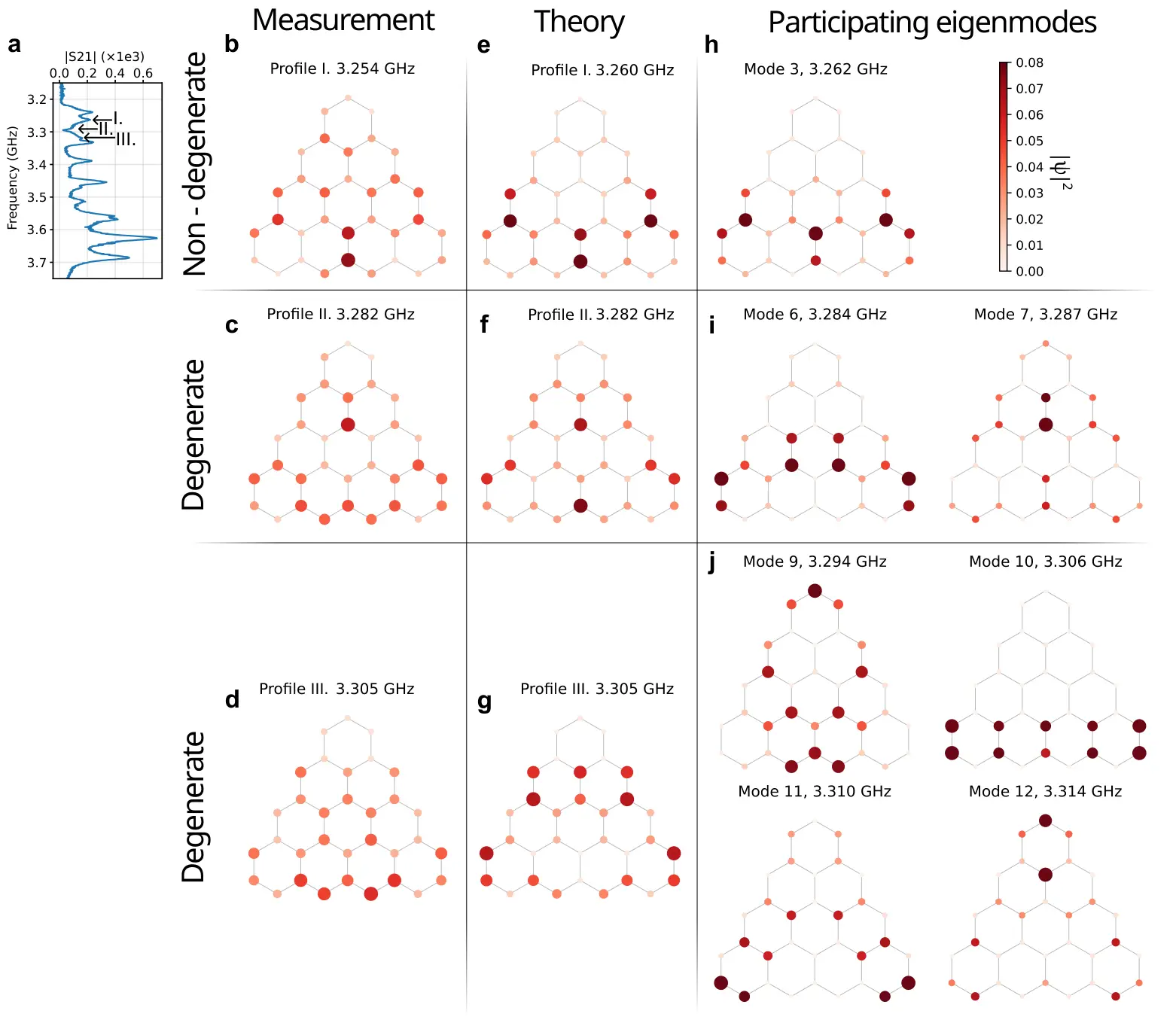
Laser scanning microscopy reveals the spatial distribution of energy within superconducting resonator arrays, a technique important for validating designs and quantifying imperfections that impact quantum system performance. The method reconstructs squared eigenmode amplitudes by exploiting a localized increase in surface resistance induced by a focused laser, allowing researchers to map the contribution of each resonator to the overall mode structure. A weak focused laser, 1.2 µW with a 30 µm spot and 520 nm wavelength, locally alters the transmission spectrum, providing a signal proportional to the squared mode amplitude at each lattice site.
This approach allows for the identification of 14 port-coupled modes within a 33-resonator array. The team modeled the laser’s effect by introducing loss at the illuminated site, using a single-mode approximation to analyze the resulting changes in the scattering matrix.
By scanning the laser across the honeycomb lattice, they generated a map of the differential signal at each location, integrating this signal over a 16.5 MHz frequency window to construct the LSM response. This detailed mapping not only confirms the realized lattice structure aligns with the intended design but also enables the visualization of topological edge states, localized modes predicted to exist at the array’s boundaries.
The ability to spatially resolve these states is critical for harnessing their potential in hybrid spin-superconducting quantum systems. Further analysis focused on quantifying disorder within the lattice, a factor known to degrade the performance of quantum devices. Researchers compared measured mode asymmetries and participation ratios with simulations, systematically varying the standard deviation of on-site frequency disorder and the degree of measurement non-locality.
They experimentally validated that the realized lattice matches the design. Similarly, the participation ratio (PR) was calculated to assess the spatial extent of each mode. These metrics allowed for an assessment of how disorder impacts the mode profiles and a determination of an upper bound of approximately 0. “Separates the respective impact of the on-site frequency disorder from the measurement non-locality,” the researchers note, emphasizing the precision of their approach.
NV Center Magnetometry Detects Microwave Fields
This technique complements laser scanning microscopy (LSM), which images the spatial structure of the resonators’ eigenmodes, offering a complete spatial characterization of these compact quantum systems. The combined approach allows for validation of the fabricated lattice structure against its intended design, an important step in optimizing performance for quantum information processing. The EPFL team used NV centers in diamond as optically addressable probes of microwave magnetic fields, using the spin-dependent fluorescence of these defects to detect resonant transitions.
By scanning a diamond slab containing NV centers across the two-dimensional superconducting resonator array, they created maps of the microwave field amplitude with nanoscale resolution. This method circumvents limitations of previous perturbative approaches, which modify the device under test and provide only indirect field information.
This precise measurement was achieved through comparison with simulations, allowing for separation of the impact of frequency disorder from measurement non-locality. The ability to resolve the local microwave magnetic-field amplitude is particularly valuable for understanding and optimizing the interaction between the superconducting resonators and coupled quantum systems. By mapping the field distribution, researchers can fine-tune the photonic environment to enhance qubit coherence and control.
The team notes that a detuning of approximately 11 MHz from the edge mode’s frequency was present in the experiment due to limitations in tuning the bias magnetic field with a permanent magnet, a factor that will be addressed in future iterations of the experiment. The study demonstrates the power of combining LSM and NV magnetometry for comprehensive characterization of complex superconducting resonator arrays.
Validation of Lattice Structure and Edge States
The superconducting resonator array’s structure was experimentally confirmed to align with its intended design through spatial characterization techniques, demonstrating an important validation step for these quantum systems. Researchers used laser scanning microscopy (LSM) to image individual eigenmodes of the 33-resonator honeycomb lattice, achieving site-level resolution and direct access to the mode structure. Complementing the LSM data, nitrogen-vacancy (NV) center magnetometry mapped the local microwave magnetic-field amplitude across the lattice, offering a non-perturbative probe of the driven system.
Measurements of this edge state revealed its sublattice polarization, confirming the expected behavior of the “artificial graphene” flake created by the lattice structure. The lattice’s band structure, mirroring that of natural graphene, exhibits bands touching at Dirac points and supports dispersionless edge modes localized at zigzag boundaries. Analysis of bulk modes driven into resonance with the NV centers reproduced simulated field profiles, further validating the accuracy of the imaging process.
“The two techniques studied here probe complementary observables of the array: LSM images the spatial structure of the eigenmodes, while NV magnetometry maps the local microwave magnetic-field amplitude of the driven lattice,” highlighting the connection between the two methods. The ability to quantify this disorder is essential for refining the design and fabrication of future superconducting resonator arrays.
Spatial Characterization of Frequency Disorder
LSM measurements revealed an edge-type mode polarized on the sublattice forming the zigzag boundary of the superconducting resonator array, a detail important for validating the lattice’s intended design. This observation, coupled with the ability to extract an upper bound of 0.3% on-site frequency disorder, demonstrates a new level of spatial control over these compact superconducting circuits. The team achieved this precision by combining laser scanning microscopy with nitrogen-vacancy center magnetometry, a pairing that allows for complementary characterization of the array’s properties.
The approach not only validates the fabricated lattice but also provides a means to assess the impact of imperfections, a critical step towards building more reliable quantum systems. Analysis of the microwave magnetic field amplitude, performed using NV centers, confirmed a sublattice polarization of approximately 0.75 for the simulated edge mode, aligning closely with theoretical predictions.
This agreement supports the successful emulation of two-dimensional Hamiltonians within the superconducting resonator array, a key milestone for hybrid spin-superconducting quantum systems. The observed polarization of 0.75 contrasts with a value of approximately 0.28 obtained through LSM, revealing that the lower reading stemmed from the measurement technique’s inherent non-locality rather than a flaw in the lattice itself. The team’s work demonstrates that LSM can image the eigenmodes of the compact array with site-level resolution, offering direct spatial access to the mode structure.
This level of disorder is comparable to that observed in niobium nitride resonators on silicon, suggesting a consistent fabrication process. The researchers report, highlighting the high quality of the fabricated array. The combined characterization approach established in this work is important for scaling such arrays to larger resonator numbers and more complex geometries. The validation of the target tight-binding Hamiltonian with the fabricated array confirms the potential of these compact superconducting resonator arrays for emulating complex quantum systems and exploring novel quantum phenomena.
👉 More information
🗞 Eigenmode and field imaging of a compact superconducting resonator array
✍️ Benedek Gaál, Vincent Jouanny, Christophe Galland, Pasquale Scarlino and Valentin Goblot (Institute of Physics, École Polytechnique Fédérale de Lausanne (EPFL), Lausanne, Switzerland); Simone Frasca (Also at: Department of Physics, ETH Zurich, Zurich, Switzerland)
🧠 ArXiv: https://arxiv.org/html/2611.13791v1
See today’s quantum computing news on Quantum Zeitgeist for the latest breakthroughs in qubits, hardware, algorithms, and industry deals.