Norbert Wiener founded cybernetics, the science of how systems steer themselves by sensing their own errors and correcting them. In the same year that Claude Shannon defined information, Wiener defined control, and between them the two MIT mathematicians laid the foundations of the information age from opposite sides of the same problem, which is how to act well when everything you measure is corrupted by noise.
His idea matters to quantum computing more directly than it first appears. A quantum computer is not a machine you switch on and leave alone. It is continuously measured, checked against a target and corrected, thousands of times a second, which is precisely the feedback loop Wiener described in 1948. Quantum error correction and quantum control are cybernetics with a quantum system inside the loop.
Wiener founded cybernetics. His 1948 book defined the study of feedback and control in machines and living things, coining the term from the Greek word for a steersman.
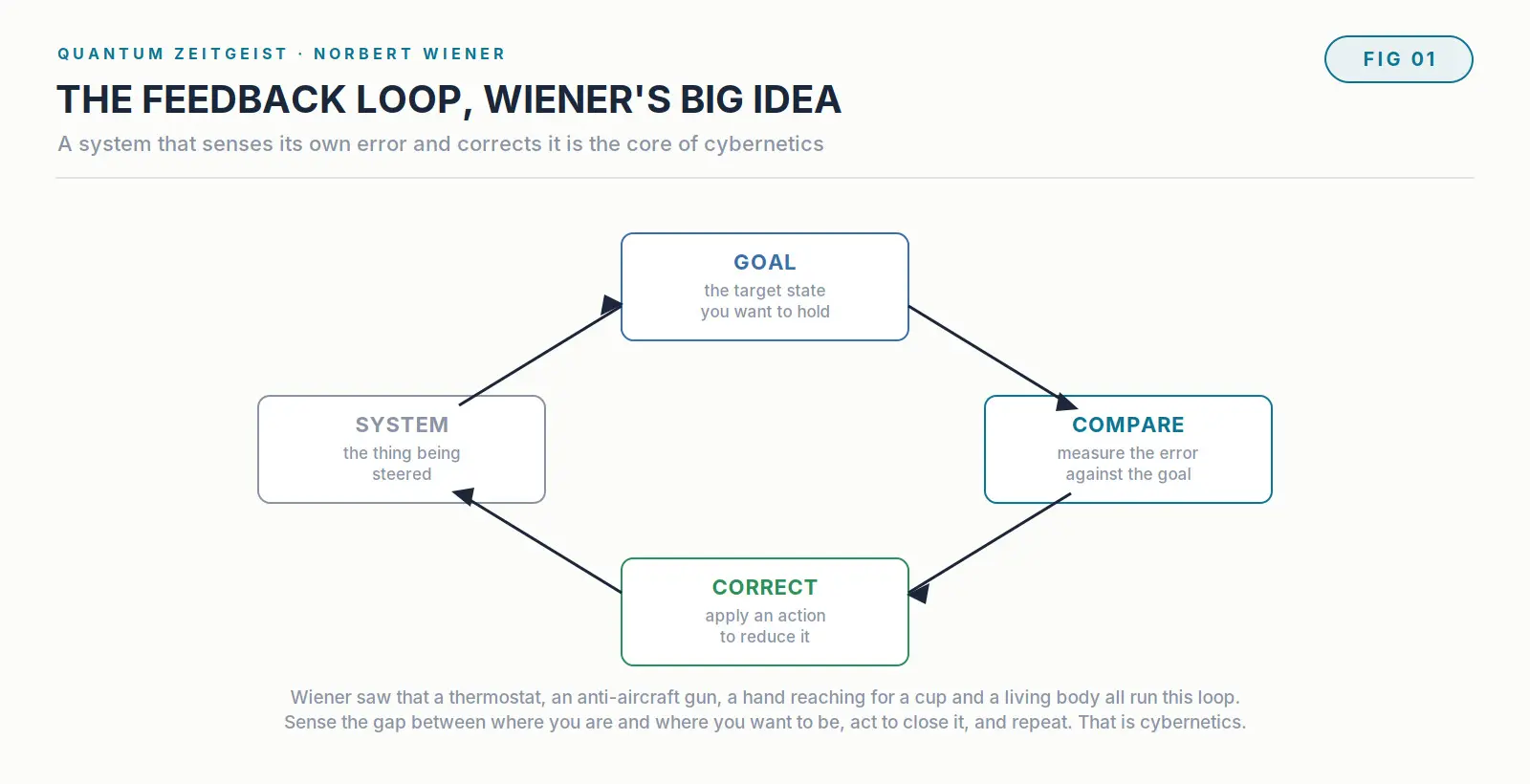
The feedback loop is the core idea. A system that senses the gap between where it is and its goal, acts to close it, and repeats can hold a target state despite constant noise.
His work is the twin of Shannon’s. Both published in 1948 on how to separate signal from noise, and the two are usually read as the joint foundation of the information age.
Quantum error correction is a feedback loop. Measuring a syndrome, decoding the error and applying a correction every cycle is exactly Wiener’s control loop applied to a qubit.
He was a child prodigy with a hard early life. He finished a degree at fourteen and a doctorate at eighteen, under a father whose intensity he later wrote about with pain.
He worried early about automation. Wiener foresaw that machines which regulate themselves would reshape work and warned about it decades before the debate became mainstream.
- Who Norbert Wiener was
- The prodigy
- Anti-aircraft fire and the birth of an idea
- The feedback loop
- What cybernetics is
- The twin of Shannon’s 1948
- Filtering signal from noise
- Why quantum error correction is cybernetics
- Quantum control theory
- Spreading the idea
- His warning about automation
- The pure mathematician
- What he left behind
- Frequently asked questions
Who Norbert Wiener was
Norbert Wiener was born in Columbia, Missouri, on 26 November 1894 and died in Stockholm in 1964. He spent almost his entire career as a professor of mathematics at the Massachusetts Institute of Technology, where he did foundational work in pure mathematics before turning, in his fifties, to the study of control and communication that would make his name beyond his own field.
He is remembered above all as the founder of cybernetics, a word he coined and a field he defined in a single influential book. The idea at its centre is simple enough to draw and deep enough to have reshaped engineering, biology and, indirectly, the way we now think about controlling a quantum computer.
The prodigy
Norbert Wiener was one of the most famous child prodigies of his era. His father Leo, a Harvard professor of Slavic languages, educated him at home with a relentlessness that Wiener later described as bordering on cruelty, and the results were extraordinary and costly in equal measure. He graduated from Tufts College at fourteen and earned his doctorate from Harvard at eighteen.
The early brilliance came with a lasting difficulty, and Wiener wrote with unusual honesty about the anxiety and self-doubt that trailed him through life. It is worth recording because it complicates the tidy image of the genius, and because his later interest in how systems regulate themselves was, some have suggested, not entirely separate from a lifelong preoccupation with control and stability.
Anti-aircraft fire and the birth of an idea
The cybernetics of Norbert Wiener grew out of a wartime problem. During the Second World War Wiener worked on the automatic aiming of anti-aircraft guns, a genuinely hard task because a fast aircraft would be somewhere else by the time a shell arrived, so the gun had to be aimed not at the plane but at where the plane was going to be.
Solving it meant predicting a moving target’s path from noisy, incomplete radar data, and then feeding that prediction back into the aiming mechanism continuously as new observations arrived. Wiener developed the mathematics of that prediction, and in doing so he noticed something general. The gun, the radar and the operator together formed a single system that sensed its own error and corrected it, and that same pattern seemed to appear everywhere he looked.
The feedback loop
The pattern is the feedback loop, and it is the beating heart of everything Norbert Wiener did. A system has a goal, it measures the difference between its current state and that goal, it takes an action to reduce the difference, and then it measures again, going round the loop continuously.
Once you see it, the loop is everywhere. A thermostat senses the temperature, compares it to the setting, switches the heating on or off, and repeats. A hand reaching for a cup makes constant small corrections as it closes in. A body holds its temperature and chemistry steady against a changing world. Wiener’s insight was that these are not loose analogies but the same mathematical structure, and that the structure could be studied on its own terms.
What makes the loop powerful is that it works despite noise and disturbance. The system does not need a perfect model or a calm environment, it only needs to keep measuring its error and acting to reduce it, and the loop drives it toward the goal anyway. That robustness against noise is exactly why the idea matters for quantum computing.
What cybernetics is
In 1948 Norbert Wiener gathered these ideas into a book, Cybernetics, or Control and Communication in the Animal and the Machine, and gave the field its name, taking it from the Greek kybernetes, meaning steersman or governor. The same root gives us the word governor, both the political office and the mechanical device that holds an engine’s speed steady.
Cybernetics is the study of control and communication considered together, in machines and living things alike, with feedback as the unifying principle. It was an unusually ambitious claim, that the same mathematics of goal, error and correction describes a servomechanism, a nervous system and an economy, and it made the book a sensation well beyond engineering.
The field’s direct descendants are control theory, robotics and automation, and its influence runs through computing, neuroscience and even management. For a quantum audience its importance is specific and concrete, since keeping a fragile quantum state on target against relentless noise is a control problem of exactly the kind cybernetics was built to describe.
The twin of Shannon’s 1948
The cybernetics of Norbert Wiener and Claude Shannon’s information theory appeared in the same year, from two mathematicians who knew each other and worked in the same intellectual world around MIT. The pairing is not a coincidence but two views of one problem.

Shannon asked how much information a source contains and how fast it can be sent reliably through a noisy channel. Wiener asked how a system can act well when its measurements are corrupted by noise, and how to extract a true signal from a noisy one. The measures of information the two men used were closely related, and they corresponded about the connection.
The reason both belong on a quantum site is that their two theories became the two halves of quantum engineering. Shannon’s information theory grew into quantum information theory, the account of what can be stored and sent. Wiener’s control theory grew into quantum control, the account of how a quantum system is actively steered and stabilised. Storing information and controlling the system that holds it are the two problems a quantum computer must solve at once.
Filtering signal from noise
One concrete tool from Wiener’s wartime work deserves its own mention, because it is still in daily use. The Wiener filter is the mathematically optimal way to estimate a true signal from a noisy measurement of it, given some statistical knowledge of both the signal and the noise.
The idea is everywhere that a clean estimate must be pulled out of dirty data, from audio processing to image restoration to financial time series. It is the same problem as the anti-aircraft predictor, generalised, and it captures Wiener’s characteristic move of turning a specific engineering task into a general mathematical method.
In quantum computing the descendants of this thinking appear in how qubit measurements are interpreted, since a real measurement is noisy and the true state must be estimated from it, and in the filtering and estimation that underlie quantum feedback control. Wiener’s filtering and Shannon’s coding are the two classical roots of how quantum machines cope with imperfect information.
Why quantum error correction is cybernetics
The clearest quantum application of Wiener’s idea is quantum error correction, which is a feedback loop in the strictest sense. A quantum computer runs the cybernetic cycle continuously to keep its qubits alive against noise that would otherwise destroy them in a fraction of a second.
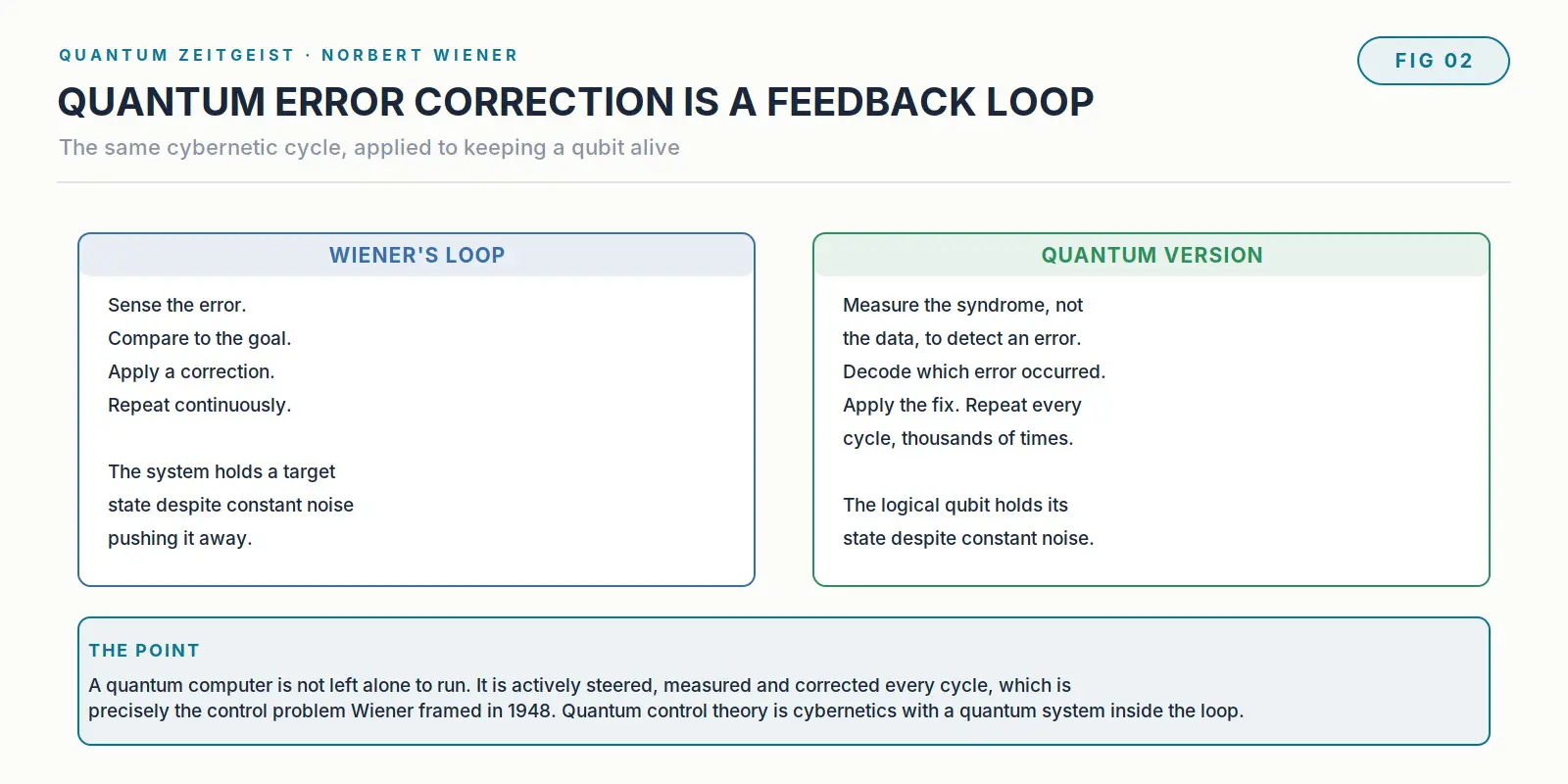
The loop runs like this. The machine measures a syndrome, a set of checks that reveal whether an error has occurred without revealing the protected data itself. It decodes that syndrome to work out which error most likely happened. It applies a correction. Then it measures again, round and round, thousands of times, exactly as Wiener’s gun re-aimed itself with every new radar return.
The parallel is not decorative. The engineers who design surface-code decoders and real-time control systems for quantum computers are solving a feedback and estimation problem that Wiener would have recognised immediately, using the descendants of the mathematics he developed. A quantum computer is a cybernetic machine whose controlled system happens to be quantum.
Quantum control theory
Beyond error correction, there is an entire field of quantum control that is cybernetics applied to quantum systems directly. Steering a qubit into a desired state, shaping the pulses that implement a quantum gate, and stabilising a system against drift are all control problems, and they use tools with clear classical ancestors.
Some of this control is done in real time with measurement and feedback, which is Wiener’s loop almost literally. Some is done in advance by designing control sequences that are robust to noise, which is the same goal reached by a different route. Either way, the discipline of getting a noisy physical system to do what you want, reliably, is the discipline Wiener founded, now carrying a quantum payload.
Spreading the idea
Cybernetics did not stay within mathematics, and much of its reach came from a remarkable series of meetings. Between 1946 and 1953 the Macy Conferences brought together mathematicians, engineers, neuroscientists, psychologists and anthropologists to work out the implications of feedback and control across every field at once, with Wiener a central figure.
The result was that cybernetic thinking spread far beyond servomechanisms, shaping early work in neuroscience on how the brain regulates itself, in computing on how machines might learn, and in the social sciences on how groups and economies self-correct. That breadth is part of why Wiener is a foundational figure rather than a narrow specialist, and it is the same interdisciplinary spread that quantum information theory has shown in its own reach across physics, computer science and mathematics.
His warning about automation
Norbert Wiener was among the first to think seriously about what self-regulating machines would mean for people, and his view was notably uneasy. He saw that machines which could sense and correct their own behaviour would be able to take over tasks previously reserved for humans, and he wrote about the social consequences with concern rather than triumph.
His worry was concrete. Automation would displace workers, and Wiener argued that the resulting disruption needed to be faced honestly rather than left to sort itself out, a position that reads as strikingly current. He also raised early questions about the ethics of building systems whose behaviour their makers could not fully predict, a theme that has returned in force in the debate over artificial intelligence.
The relevance to quantum computing is a matter of temperament as much as content. Wiener modelled a way of being a technologist that took the consequences of the technology seriously, neither dismissing the risks nor inflating the promises, which is the same balance a sober assessment of quantum computing requires.
The pure mathematician
It is easy to forget, given the fame of cybernetics, that Wiener was a mathematician of the first rank whose pure work would have secured his reputation on its own. The Wiener process, his rigorous mathematical model of Brownian motion, is a cornerstone of probability theory and underlies the mathematics of everything from diffusion to option pricing.
His name is attached to a string of deep results, including the Wiener-Khinchin theorem relating a signal’s frequency content to its correlations, and the Paley-Wiener theorems in analysis. This mathematical depth is what let him turn engineering problems into general theories rather than one-off solutions, and it is the same combination of abstract power and practical aim that characterises the best work in quantum information today.
What he left behind
Wiener’s legacy is a way of seeing. Once you understand feedback, you notice it everywhere, in machines, bodies, markets and now quantum computers, and you stop treating control as an afterthought to be bolted on and start treating it as central to whether a system works at all.
For quantum computing that shift is exactly the right one. The field spent its early years focused on qubits and gates, the storage and processing of quantum information, and has increasingly recognised that control, the continuous business of measuring and correcting, is just as fundamental to whether a machine computes anything useful. That is Wiener’s insight arriving in a new domain.
He and Shannon are best read together, the two founders of the information age who split the problem of noise between them. Shannon told us what can be known and sent; Wiener told us how to act on it. A quantum computer needs both answers at once, which is why both men belong in any honest account of where the technology comes from.
Frequently asked questions
Who was Norbert Wiener?
Norbert Wiener was an American mathematician, born in 1894 and died in 1964, who founded cybernetics, the science of control and communication in machines and living things. He was a child prodigy and a professor at MIT for most of his career, known for the feedback loop, the Wiener process and the Wiener filter.
What is cybernetics?
Cybernetics is the study of control and communication through feedback, in machines and living systems alike. Wiener defined it in his 1948 book and named it from the Greek word for a steersman. Its central idea is the feedback loop, in which a system senses the gap between its state and a goal, acts to close it, and repeats.
How is Norbert Wiener connected to quantum computing?
Through control. Quantum error correction and quantum control are feedback loops of exactly the kind Wiener described, in which a quantum computer measures an error, works out what happened and applies a correction, thousands of times a second. Quantum control theory is cybernetics applied to a quantum system.
What is the connection between Wiener and Claude Shannon?
They were contemporaries in the same intellectual world around MIT, and both published foundational works in 1948 on separating signal from noise. Shannon’s information theory measures information and its limits, while Wiener’s cybernetics uses feedback to act despite noise. Their information measures were closely related and they corresponded about it.
What is the Wiener filter?
The Wiener filter is the mathematically optimal method for estimating a true signal from a noisy measurement, given statistical knowledge of the signal and the noise. It grew out of Wiener’s wartime work on predicting aircraft paths and is still used across signal and image processing.
Did Wiener warn about automation?
Yes. He was among the first to argue that self-regulating machines would displace human workers and reshape society, and he urged that the disruption be faced honestly. He also raised early ethical questions about building systems whose behaviour could not be fully predicted, a theme now central to the debate over artificial intelligence.
What is the Wiener process?
The Wiener process is Wiener’s rigorous mathematical model of Brownian motion, the random jittering of a particle. It is a foundational object in probability theory and underlies the mathematics of diffusion and of financial models such as option pricing.
Why are Wiener and Shannon called the founders of the information age?
Because their two 1948 theories became its twin foundations. Shannon’s information theory grew into the modern account of storing and transmitting information, including quantum information theory, and Wiener’s cybernetics grew into control theory, including the quantum control that keeps quantum computers stable.




See today’s quantum computing news on Quantum Zeitgeist for the latest breakthroughs in qubits, hardware, algorithms, and industry deals.