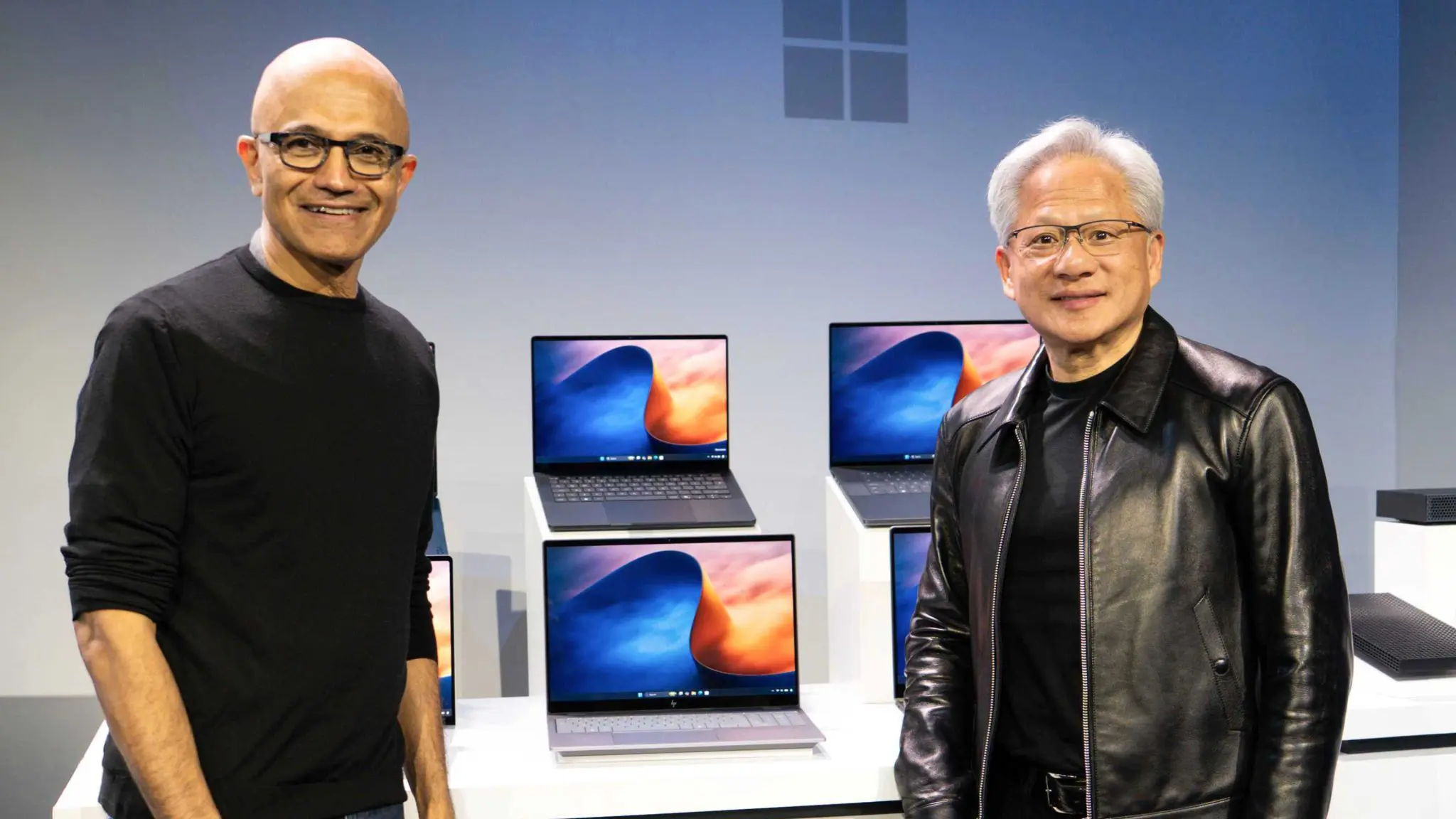
NVIDIA founder and CEO Jensen Huang revealed a core tenet of his company’s success at a Microsoft event Wednesday: “If not for Windows there would be no GeForce.” Huang made the statement alongside Microsoft CEO Satya Nadella, outlining a co-engineering effort to bring AI agents to Windows PCs. October 7, 2026 marks the opening of preorders for RTX Spark, alongside a preview of the NVIDIA DGX Station for Windows, the first deskside AI supercomputer built for the Windows enterprise desktop. “The thing that I really give Jensen all the credit for,” Nadella said.
RTX Spark Enables Local AI on Windows PCs
RTX Spark combines an NVIDIA Blackwell RTX GPU with up to 6,144 cores and an up to 20-core NVIDIA Grace CPU connected at 600 GB/s, delivering one petaflop of FP4 AI performance and up to 128GB unified memory for effective local AI. This configuration allows RTX Spark to run large language models, such as Qwen 3.8 Flash Next, a 125B model with 51B n-gram, directly on the device, bypassing the need for cloud connectivity and associated data transfer concerns. One petaflop of FP4 AI performance and up to 128GB unified memory makes RTX Spark effective for local AI.
Introducing Surface Laptop Ultra, Pavan Davuluri tied that vision to NVIDIA RTX Spark. With up to 128 gigs of unified memory and up to a petaflop of AI compute, you can run models on this laptop that simply don’t fit on a traditional machine,” Davuluri said. The DGX Station brings GB300 Grace Blackwell-class AI infrastructure directly into the Windows ecosystem, offering a dedicated local AI system for continuous agent operation.
Microsoft is also integrating security features directly into Windows to manage these agents, stating, “We are building these primitives directly into Windows, so agents can be secured, observed and governed.” The company intends to provide full functionality for agents on Windows with MXC, Microsoft Security, and Agent 365, and envisions a future where agents function as personal assistants. Microsoft anticipates that “What happens in the era of agents, when the agent is on your computer? It is now your personal assistant.”
We built Surface Laptop Ultra around NVIDIA RTX Spark. With up to 128 gigs of unified memory and up to a petaflop of AI compute, you can run models on this laptop that simply don’t fit on a traditional machine.
Pavan Davuluri, Microsoft’s EVP of Windows and Devices
Microsoft Execution Containers Secure Agent Functionality
Microsoft Execution Containers establish a new security paradigm for AI agents operating directly within the Windows operating system. General availability of the technology, announced at a recent Microsoft event, provides operating system-level control over agent execution, addressing concerns about persistent background processes. Pavan Davuluri, Microsoft’s EVP of Windows and Devices, explained that the infrastructure allows agents to run safely and persistently under direct OS supervision, the company says.
This approach moves beyond traditional application sandboxing, integrating security features at a foundational level to manage agent behavior. The design prioritizes observation and governance of these agents, features critical for enterprise deployment. This layered security model aims to provide a trusted environment for increasingly autonomous software.
According to Satya Nadella, the impetus for this level of security stemmed from a need to establish the desktop as a secure execution environment. “We needed to make the desktop the most secure place for agents to execute,” Nadella said, framing the development as a fundamental shift in how AI is deployed.
Jensen Huang, NVIDIA’s CEO, echoed the significance of the move, stating, “Just as Windows and DirectX revolutionized how applications were built, MXC is going to revolutionize how agents are built and deployed.” He further positioned this development as the foundation for the next generation of IT infrastructure, suggesting a broad impact beyond individual user experience. Capabilities previously requiring rented cluster resources are now available on a shift enabled by this co-engineering effort between NVIDIA and Microsoft.
If you look at the entire journey of our company, Windows was at the core of it.
Jensen Huang, NVIDIA Founder and CEO
DGX Station for Windows Delivers Frontier AI Compute
NVIDIA DGX Station for Windows delivers up to 20 petaFLOPS of FP4 AI compute, bringing GB300 Grace Blackwell Ultra Desktop Superchip infrastructure directly to the Windows ecosystem. Until now, DGX Station operated on Linux, requiring developers to maintain separate environments for AI workloads and standard Windows applications. This new iteration addresses a gap impacting the majority of Fortune 500 companies standardized on Windows, eliminating the need to switch operating systems for demanding model development.
The system features 748GB of coherent memory, enabling local execution of models up to a trillion-parameter scale, according to Microsoft. Microsoft’s Pavan Davuluri highlighted the shift in accessibility, stating, “This unlocks the power to run frontier-class models locally,” and further explained, “Capabilities that once required renting a cluster are now in a deskside supercomputer.” Teams can now build and run continuously operating AI agents directly connected to existing Windows applications and infrastructure, streamlining the process of fine-tuning and inference.
NVIDIA maintains compatibility with Linux AI toolchains through Windows Subsystem for Linux, providing flexibility for developers. “If you look at the entire journey of our company, Windows was at the core of it,” said Huang, tracing back NVIDIA’s support for Windows and Microsoft over several decades. “If not for Windows there would be no GeForce.”
We are building these primitives directly into Windows, so agents can be secured, observed and governed.
Pavan Davuluri, Microsoft’s EVP of Windows and Devices




See today’s quantum computing news on Quantum Zeitgeist for the latest breakthroughs in qubits, hardware, algorithms, and industry deals.