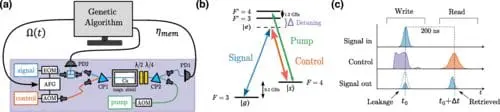
Optical quantum memories are crucial components in various quantum technologies, including repeater-based quantum key distribution and on-demand multiphoton generation. To improve their performance, researchers have been exploring machine learning techniques to optimize control pulses and reduce energy consumption. A recent study by scientists from the Deutsches Zentrum für Luft und Raumfahrt eV (DLR) and the Technische Universität Berlin demonstrated a 37-fold improvement in memory efficiency using optimized freeform pulses. This breakthrough has significant implications for the development of quantum technologies, highlighting the potential of machine learning to optimize complex systems.
Can Machine Learning Optimize Quantum Memories?
In recent years, machine learning has emerged as a powerful tool for optimizing complex systems. In the field of quantum computing, researchers are exploring the potential of machine learning to improve the performance of optical quantum memories. These memories are essential components in various quantum technologies, including repeater-based quantum key distribution and on-demand multiphoton generation.
Optical quantum memories have been recognized as a crucial technology for implementing different quantum protocols. For instance, on-demand multiphoton generation requires highly efficient operation, which is often limited by the memory efficiency. Similarly, repeater-based quantum key distribution has logarithmic scaling in time required for entanglement distribution, making memory efficiency a critical factor.
In this context, researchers have been investigating various forms of optical quantum memories, including single atoms and solid-state devices. These systems provide a wide range of efficiencies, with the most efficient ones operating at ultracold regimes. However, solid-state devices also boast high efficiencies, achieving rates of 75-85%.
Optimizing Control Pulses in Optical Quantum Memories
To improve the performance of optical quantum memories, researchers have been exploring the use of machine learning to optimize control pulses. In a recent study, scientists from the Deutsches Zentrum für Luft und Raumfahrt eV (DLR) and the Technische Universität Berlin used a genetic algorithm to optimize the control pulse in an optical electromagnetically induced transparency (EIT) memory experiment.
The researchers represented the control pulse as either a Gaussian or freeform pulse and analyzed the resulting waveforms. They found that using optimized freeform pulses resulted in an improvement factor of 37 compared to traditional Gaussian pulses. This significant improvement demonstrates the potential of machine learning to optimize quantum memories.
Energy-Based Optimization
In addition to optimizing the shape of the control pulse, researchers have also explored energy-based optimization techniques. By limiting the allowed pulse energy, scientists can reduce the energy required for the memory experiment while minimizing efficiency loss. In this study, the researchers achieved a 30% reduction in energy using an energy-based optimization approach.
The Role of Machine Learning in Quantum Computing
Machine learning is playing an increasingly important role in quantum computing, as it has the potential to optimize complex systems and improve their performance. In the context of optical quantum memories, machine learning can be used to optimize control pulses, reduce energy consumption, and improve memory efficiency.
As researchers continue to explore the applications of machine learning in quantum computing, we can expect to see significant advancements in the field. With the potential to optimize complex systems and improve their performance, machine learning is poised to play a critical role in the development of quantum technologies.
The Future of Optical Quantum Memories
The future of optical quantum memories looks promising, with researchers continuing to explore new techniques and approaches to improve their performance. As machine learning becomes increasingly important in quantum computing, we can expect to see more studies on optimizing control pulses and reducing energy consumption.
In addition, the development of new materials and technologies will continue to push the boundaries of what is possible with optical quantum memories. With the potential to achieve high efficiencies and reduce energy consumption, these memories are poised to play a critical role in various quantum technologies.
Conclusion
Optical quantum memories are essential components in various quantum technologies, including repeater-based quantum key distribution and on-demand multiphoton generation. By optimizing control pulses using machine learning, researchers can improve the performance of optical quantum memories and reduce energy consumption. As we continue to explore the applications of machine learning in quantum computing, we can expect to see significant advancements in the field.
Publication Date: 2024-08-08
Authors: Elizabeth Robertson, Luisa Esguerra, Leon Meßner, Guillermo Gallego, et al.
Source: Physical Review Applied
DOI: https://doi.org/10.1103/physrevapplied.22.024026



See today’s quantum computing news on Quantum Zeitgeist for the latest breakthroughs in qubits, hardware, algorithms, and industry deals.