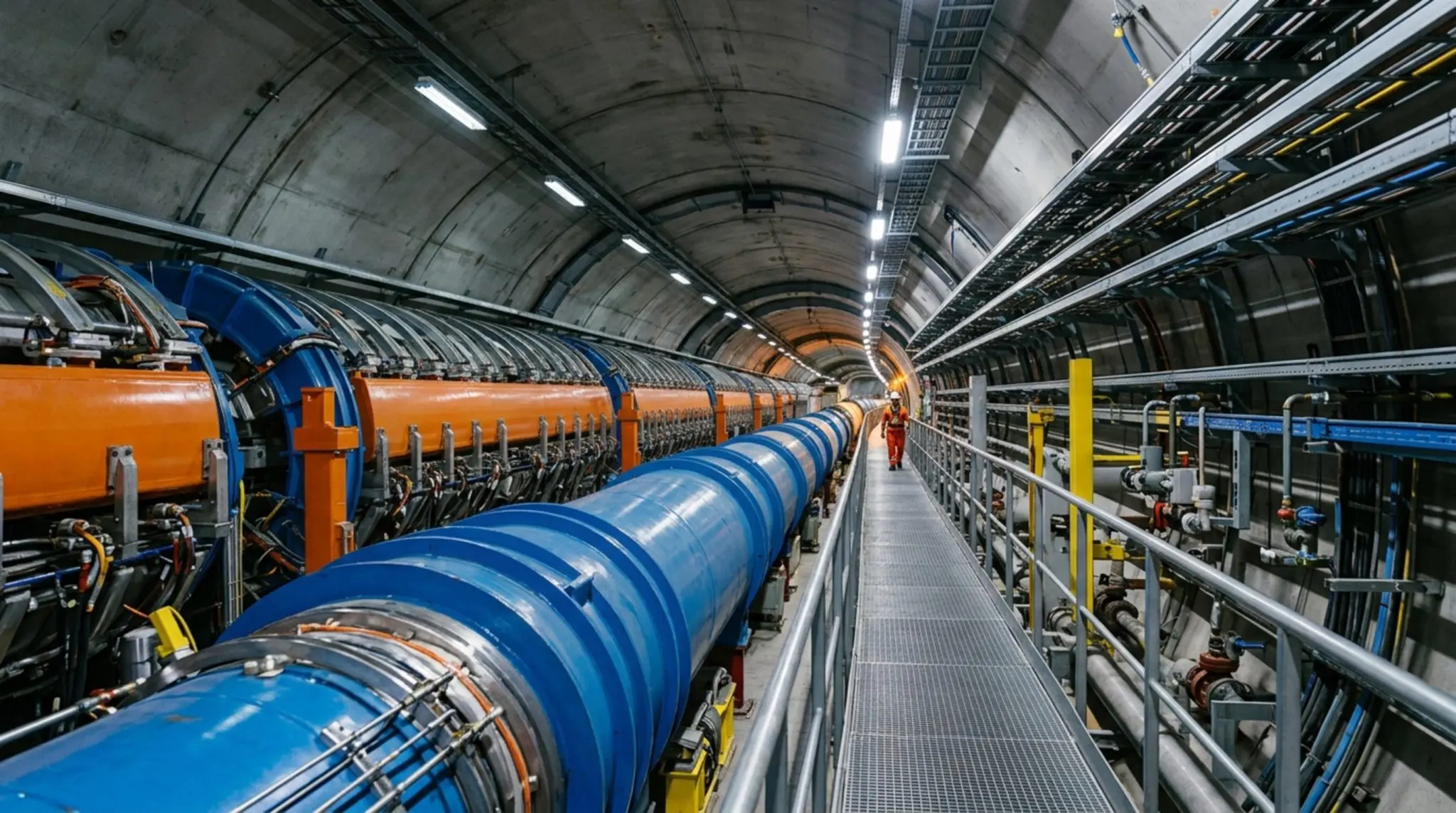
After more than half a century of studying interactions within protons, the CMS experiment has directly observed evidence of these particles emitting leptons, electrons, muons, and taus, as predicted by the Standard Model. Analyzing 440 inverse femtobarns of data collected between 2016 and 2026, researchers identified lepton-lepton scattering events distinguished by a clean signature of no more than four tracks emerging from each interaction.
“This result clarifies the lepton content of the proton and is a step toward searches for physics processes beyond the standard model,” says Cécile Caillol, a researcher at CERN and part of the analysis team. This observation also provides the first strong evidence of muon-muon scattering.
CMS Observes Lepton Emission from Protons After 50-Year Search
This clarity allowed researchers to isolate the lepton-lepton scattering from background noise within the Large Hadron Collider environment. The team examined the ratio of vectorial to scalar sums of the transverse momenta of the leptons, revealing a clear enhancement at low values consistent with theoretical predictions.
Jian Wang, a researcher at the University of Florida and also part of the analysis team, adds that the findings open new avenues for investigation. The methodology and results of this study are detailed in “Observation of lepton-lepton scattering in proton-proton collisions at 13 and 13.6 TeV,” furthering our understanding of proton structure and the fundamental forces governing particle interactions.
This result sheds light on the lepton content of the proton and is a steppingstone towards searches for the lepton-induced production of physics processes beyond the standard model.
Cécile Caillol, a researcher at CERN and part of the analysis team


See today’s quantum computing news on Quantum Zeitgeist for the latest breakthroughs in qubits, hardware, algorithms, and industry deals.