

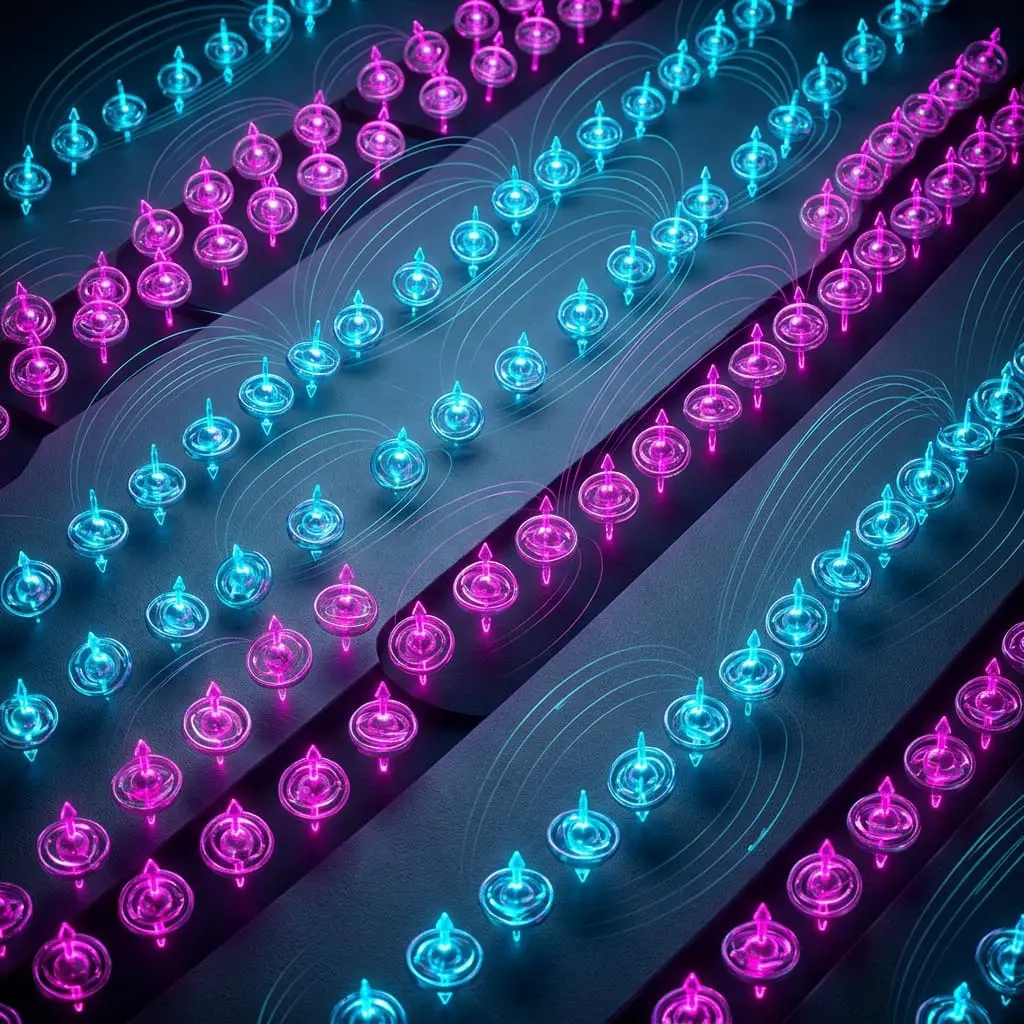
The dynamics of massive quantum vortices within a spherical superfluid shell are yielding an unexpected result: an emergent framework mirroring the behavior of Dirac magnetic monopoles. Researchers Andrea Richaud of the Departament de Física, Universitat Politècnica de Catalunya, and Marianna Sorba of CNR-INO demonstrate that the monopole charge within this system is automatically fixed by the superfluid density and satisfies Dirac’s quantization condition. Their work reveals a formal equivalence between the vortex dynamics and interacting charged particles confined to a sphere within a magnetic field, confirmed by Gross-Pitaevskii simulations. They built upon a stereographic projection to map the problem into a complex-potential formulation. This framework also predicts the formation of a dynamic configuration reminiscent of the polygonal cyclone clusters observed at Jupiter’s poles, before its breakup via a Kelvin, Helmholtz-like instability; the necklace may be viewed as a quantized analogue of Wu, Yang gauge patching. Topological frustration gives rise to the formation of this configuration. Within this framework, spherical superfluids establish a versatile platform for realizing and exploring fundamental aspects of Dirac-monopole physics.
A sphere packed with superfluid can mimic the behavior of magnetic monopoles, theorized since Dirac’s seminal work. This unexpected connection offers a novel platform for exploring fundamental physics previously confined to theoretical models. The team, led by Marianna Sorba at CNR-INO in Italy and Andrea Richaud at the Universitat Politècnica de Catalunya in Spain, used a stereographic projection to map the problem into a complex-potential formulation. The vortices are massive, but the method by which that mass is achieved is not detailed. This mass introduces inertial effects, allowing for a Lagrangian description mirroring the motion of charged particles. “The dynamics of massive vortices on the sphere is formally analogous to that of charged particles constrained to a spherical surface and subject to a magnetic monopole field,” the authors write, highlighting the core of their discovery. Crucially, the emergent monopole charge is directly linked to the superfluid density, and “automatically satisfies Dirac’s quantization condition,” a key requirement for a valid monopole description. Gross-Pitaevskii simulations confirmed predictions, validating the analogy.
The pursuit of magnetic monopoles, theoretical particles possessing isolated north or south magnetic poles, has long captivated physicists, yet direct observation remains elusive. This approach leverages the unique dynamics of these vortices to effectively create an emergent Dirac monopole, offering a novel platform for exploring fundamental concepts in quantum mechanics. This correspondence strengthens the analogy and provides a verifiable prediction for experimental tests. Further investigation reveals complex vortex interactions. The necklace is not stable, however, undergoing subsequent breakup through a Kelvin, Helmholtz-like instability, a process mirroring fluid dynamics observed in planetary atmospheres. These findings establish spherical superfluids as a promising system for investigating Dirac-monopole physics, offering a controllable environment to explore these elusive phenomena.
Specifically, Gross-Pitaevskii simulations confirm a phenomenon formally equivalent to charged particles moving under the influence of a magnetic monopole confined to a spherical surface. This is not merely a mathematical analogy; the simulations reveal a direct correspondence between the predicted vortex dynamics and the behavior observed within the modeled system. The team’s approach extended beyond simply verifying the motion; they investigated how topological constraints influence vortex arrangements. This unexpected connection arises from topological frustration, giving rise to the formation of an equatorial vortex necklace. The necklace is not stable, however, undergoing subsequent breakup through a Kelvin, Helmholtz-like instability. Crucially, the emergent Dirac-monopole framework is not an imposed construct but arises naturally from the system’s parameters. This self-regulating aspect, combined with the agreement between simulations and theoretical predictions, establishes spherical superfluids as a versatile platform for realizing and exploring fundamental aspects of Dirac-monopole physics.
The surprising emergence of stable, yet transient, vortex structures within spherical superfluids offers a new avenue for exploring fundamental physics, with potential implications for understanding atmospheric phenomena on distant gas giants. This phenomenon arises from topological frustration, which gives rise to the formation of an equatorial vortex necklace, a configuration reminiscent of the polygonal cyclone clusters observed around Jupiter’s poles, before its subsequent breakup through a Kelvin, Helmholtz-like instability. This instability, coupled with the initial formation, provides a unique setting for examining how topological defects interact and decay in curved spaces. Crucially, the underlying framework connects these dynamics to the concept of Dirac monopoles, theoretical particles possessing a single magnetic pole. This connection is not merely mathematical; it suggests that spherical superfluids can serve as a controllable platform for investigating aspects of Dirac-monopole physics previously confined to theoretical models.
The expectation that fundamental particles like magnetic monopoles remain elusive clashes with their surprising emergence within the seemingly disparate realm of quantum fluids. This work establishes spherical superfluids as a platform for realizing and exploring fundamental aspects of Dirac-monopole physics. Gross-Pitaevskii simulations confirmed the predictions. Beyond the monopole itself, the researchers observed a configuration reminiscent of the polygonal cyclone clusters observed around Jupiter’s poles.
Investigations into superfluids confined to spherical shells are revealing unexpected connections between vortex dynamics and fundamental concepts in quantum field theory. Building on earlier work establishing these systems as platforms for exploring curvature-induced effects, researchers are now demonstrating a surprising link to Dirac monopoles, hypothetical particles possessing a single magnetic pole. This analogy is not merely qualitative; the emergent Dirac-monopole framework arises directly from the vortex dynamics. Gross-Pitaevskii simulations corroborate these theoretical predictions. They further show that topological frustration induced by two like-charged polar vortices gives rise to the formation of an equatorial vortex necklace, a configuration reminiscent of the polygonal cyclone clusters observed around Jupiter’s poles, before its subsequent breakup through a Kelvin, Helmholtz-like instability. This level of agreement validates the model and opens avenues for experimental verification. Further complicating, and enriching, the picture is the behavior of multiple vortices.
Researchers are increasingly turning to tabletop experiments to model phenomena observed across the cosmos, and a recent investigation into superfluid dynamics reveals a surprising connection to Jupiter’s atmospheric patterns. This is not merely a visual analogy; the underlying physics is deeply connected. Gross-Pitaevskii simulations support the predictions.
Source: https://arxiv.org/abs/2607.15093
See today’s quantum computing news on Quantum Zeitgeist for the latest breakthroughs in qubits, hardware, algorithms, and industry deals.



