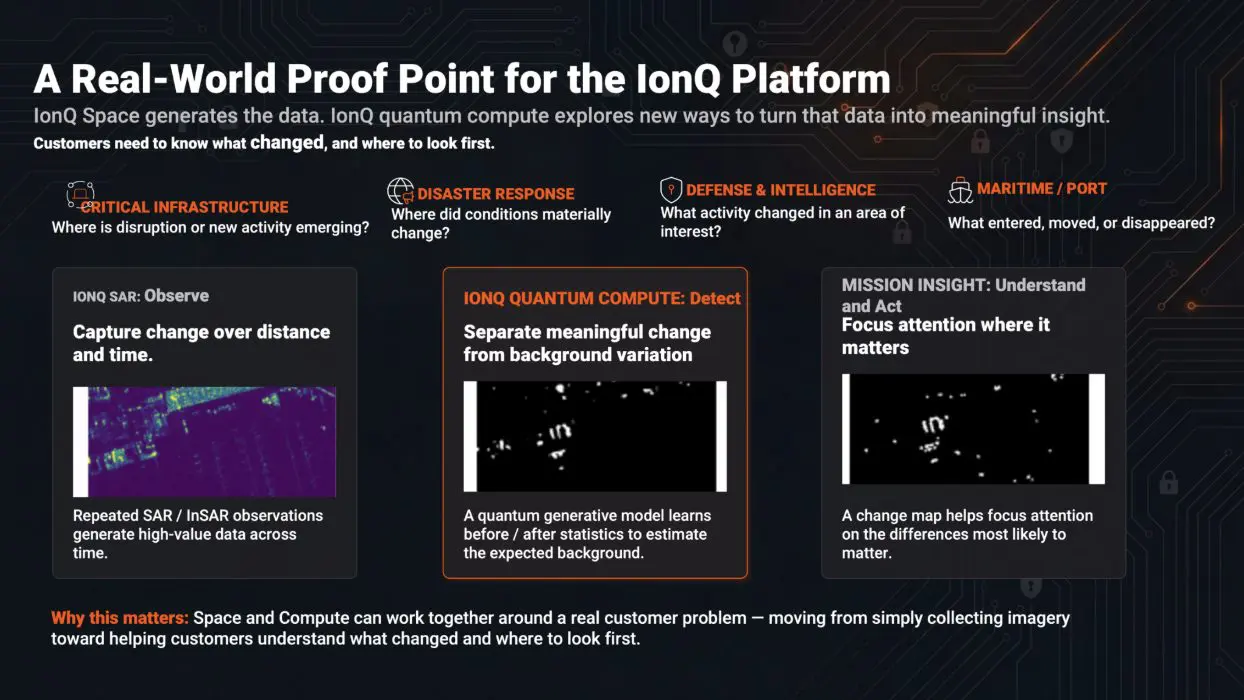
More than 18,000 active-payload satellites are currently in orbit, with more than 3,100 of those having launched just this year, creating a stream of petabytes of images daily. IonQ researchers are now applying quantum machine learning to this immense stream of information, specifically using a quantum generative model to analyze complex Synthetic Aperture Radar (SAR) data where classical methods struggle.
The work, executed on an IonQ trapped-ion QPU, represents an early milestone for quantum’s ability to extract insights from satellite imagery, according to the company, and explores how the technology can address real-world business challenges. This research demonstrates a potential path toward turning raw satellite data into actionable intelligence.
Quantum Generative Models Evaluate Change Detection in Satellite Imagery
Synthetic aperture radar (SAR) data, gathered by Capella Space satellites, served as the testing ground for a quantum generative machine learning model developed by IonQ researchers. The team’s work, detailed in a recent publication, demonstrated the model’s ability to detect changes in sparse image data, a challenge for traditional, classical methods, IonQ says.
This capability is particularly relevant given the increasing volume of Earth Observation data. Researchers evaluated the QCBM using real high-resolution SAR and InSAR image pairs collected by Capella Space satellites, including data from Marine Corps Air Station Miramar and the Piton de la Fournaise volcano on Réunion Island.
The selection of these specific locations and data types highlights a focus on scenarios where subtle changes are critical, such as monitoring volcanic activity or assessing infrastructure integrity. IonQ acquired Capella Space in 2025 and operates a constellation of satellites that collect SAR data. Even when data sparsity wasn’t a limiting factor, the quantum model achieved performance comparable to classical approaches.
This parity is significant, demonstrating that quantum machine learning isn’t solely reliant on overcoming limitations of classical methods, but can also compete effectively in scenarios where classical algorithms already perform well. IonQ is developing 256-qubit systems for delivery in 2026, with the launch of the Forte Enterprise quantum computer at the EPB Quantum Center, alongside $4.03 billion in total funding.
This research contributes to a developing blueprint for hybrid quantum-classical pipelines within the space sector, according to the company. As IonQ continues to demonstrate the ability of quantum algorithms to match or exceed the performance of classical tools, the integration of these hybrid approaches becomes more feasible, the firm reports. The company’s ongoing development of 256-qubit quantum processing units on its Superion 256 platform are milestones supporting this progression.
IonQ’s partnerships with Qollab and FormationQ, providing compute credits and collaborative research opportunities, signal a broader effort to foster innovation in quantum computing applications. The team reports that as they continue to prove the ability of quantum algorithms and models to perform better or in parity with classical tools, hybrid approaches will be more likely to be implemented in more aspects of the sector.
IonQ views space as one of many frontiers where quantum technology could have near-term applicability, alongside other areas of exploration. The company’s ongoing exploration of these frontiers is supported by a growing network of commercial and research partners, including Horizon Quantum Computing.
IonQ Trapped-Ion QPU Tests QCBM Against Classical Baselines
IonQ’s recent experiments demonstrated parity with classical methods in detecting changes within sparse satellite imagery, a result achieved using a quantum generative model tested on a trapped-ion quantum processing unit. Researchers compared the performance of their quantum change detection model (QCBM) against a classical non-linear background estimator (NLBE), establishing a direct benchmark for quantum’s capabilities in this domain.
The QCBM operates by replacing a core component of the NLBE, the empirical conditional expectation, with a value sampled from a quantum generative model trained on image data, specifically focusing on the joint distribution of before-and-after image intensities.
Tests were conducted using three distinct methods: classical models, simulations of quantum models, and execution on an actual IonQ trapped-ion QPU, allowing for a comprehensive assessment of the quantum approach. This research builds on IonQ’s broader strategy of developing hybrid quantum-classical pipelines for real-world applications and contributes to a growing understanding of where quantum computing can offer advantages.
The company’s recent collaborations with institutions like the Korea Institute of Science and Technology Information and ARLIS demonstrate a commitment to exploring quantum-high performance computing hybrids and quantum computing security, respectively, IonQ reports. The successful application of the QCBM to satellite imagery represents an early milestone in realizing the potential of quantum technology for Earth observation analysis, and the team plans to continue refining the approach to identify optimal use cases.
SAR and InSAR Data Present Challenges for Classical Analysis
Interferometric SAR (InSAR) techniques, used to measure surface deformation and elevation change to millimeter scale, add complexity to satellite image analysis, demanding substantial processing and computation. The work explores how quantum computing might augment existing classical workflows in Earth Observation (EO). The increasing volume of satellite data doesn’t automatically equate to more intelligence; turning raw imagery into actionable insights requires increasingly sophisticated analysis.
The degree of improvement varied between experiments, with the quantum method showing the most promise on image configurations with strongly skewed pixel distributions. On a volcanic InSAR dataset, the quantum change detection model (QCBM) and classical methods achieved similar peak filtered F1 scores, but the QCBM demonstrated robustness across a broad operating range. The researchers report that what all that means from a workflow perspective is that quantum outperformed classical methods, indicating a potential advantage in specific scenarios.
These results support QCBM as a competitive generative model for image change detection, performing well in both simulated and actual quantum processing unit (QPU) inference settings. IonQ is developing 256-qubit systems for delivery in 2026, not that they have already been fabricated. The company, founded in 2015 and now publicly listed as IONQ on NYSE, has raised $4.03 billion in total funding. A recent partnership with Qollab provides compute credits and funding for open-source quantum experiments, while FormationQ and the University of Cambridge’s Cavendish Laboratory will deploy IonQ’s quantum systems.
Capella Space Data Enables Quantum Earth Observation Research
This strategic move positions IonQ to not only develop quantum computing hardware but also to integrate it with vertically integrated spacecraft design and manufacturing capabilities. Beyond hardware, the company is actively exploring how quantum technology can address real-world business challenges and application workflows within the burgeoning space sector, the company’s account states. With over 18,000 active-payload satellites currently orbiting Earth and more than 3,100 of those launched just this year, the sheer volume of satellite data presents a significant analytical hurdle.




See today’s quantum computing news on Quantum Zeitgeist for the latest breakthroughs in qubits, hardware, algorithms, and industry deals.