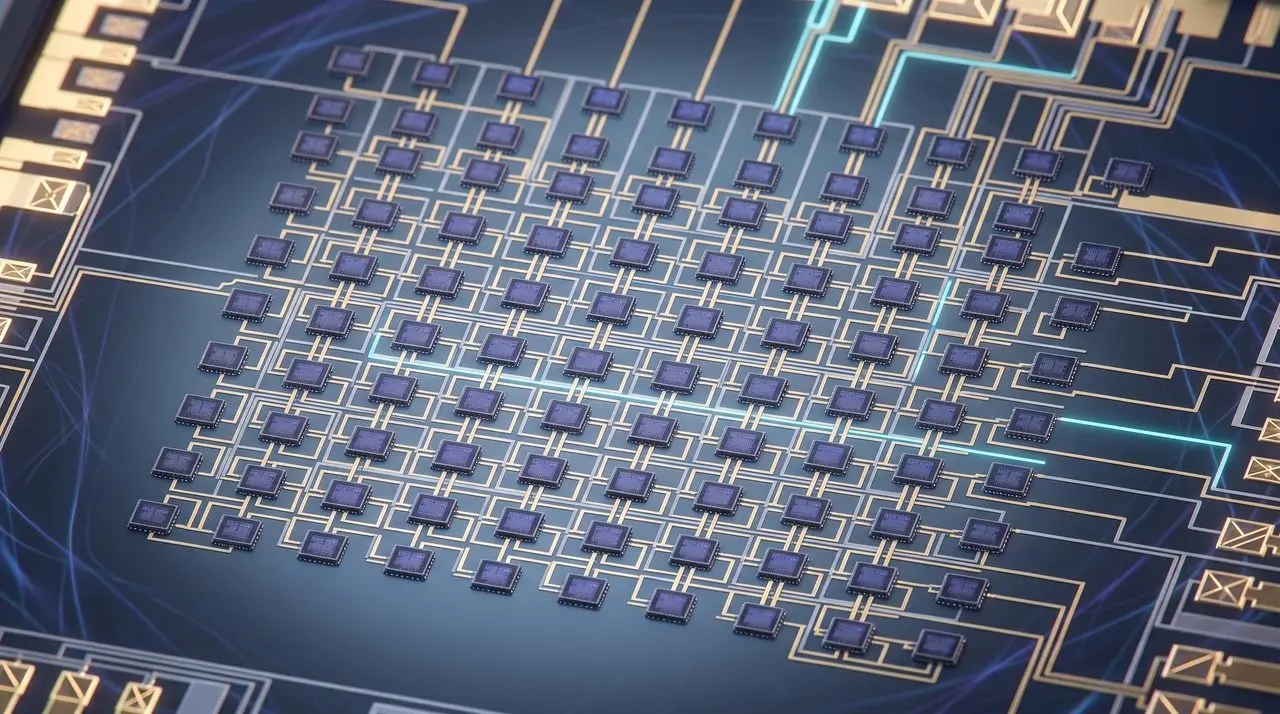
Vimal Sreekanth, Chandrima B. Pushpan and Amit Kumar Pal at the Indian Institute of Technology Palakkad demonstrate that a two-qubit battery achieves peak capacity not at complete nonreciprocity, but at a coupling strength determined by the balance between local and collective dissipation rates. Their work reveals that the optimal design of interacting qubit batteries relies on a complex interplay between coherent coupling and dissipation, challenging previous assumptions about maximizing energy storage. The researchers prove the Dzyaloshinskii-Moriya interaction is optimal for weakly driven batteries, and show a shared engineered reservoir can increase extractable work even when it reduces overall capacity.
Driven-Dissipative Many-Body Batteries & Complete Nonreciprocity
The team proved the Dzyaloshinskii-Moriya interaction functions as the optimal coupling method for weakly driven two-qubit batteries, identifying a specific physical mechanism for maximizing energy storage within this system. Battery capacity is maximized when coupling strength is fixed by both local and collective dissipation rates, a finding that diverges from the expectation that complete nonreciprocity always yields the best results. This suggests that tailoring dissipation rates, rather than simply achieving balance, is important for optimizing battery performance.
The study considered a many-body battery charged by a driven many-body charger, with each qubit connected to a local bath and the entire system immersed in this shared reservoir. This shared reservoir’s effect is particularly pronounced for coupling strengths weaker or stronger than the local dissipation rates, demonstrating a benefit beyond simply maximizing storage.
The researchers also explored the conditions for complete nonreciprocity, defining it as the point where coherent and reservoir-mediated couplings balance. Future investigations will focus on incorporating intra-species interactions within both the charger and the battery, as well as exploring the effects of inhomogeneous drives, couplings and dissipation rates. The team’s findings open new avenues for designing more efficient and powerful quantum batteries, moving beyond simplistic models of nonreciprocity and embracing a more detailed understanding of dissipation and coupling.
Dzyaloshinskii-Moriya Interaction Optimizes Two-Qubit Battery Capacity
For a single-qubit battery charged by a single-qubit charger, the steady-state capacity and its advantage over a collective-reservoir-free system, maximizes when the charger and battery interact via this Dzyaloshinskii-Moriya interaction, provided certain conditions regarding dissipation rates are met. In a star network arrangement with a central battery qubit, these findings remain consistent, while the maximum capacity of a battery charged by weakly driven charger qubits saturates with in the presence of the shared reservoir, approaching a limit of 1/N_A.
The study quantified battery capacity using energy, ergotropy and daemonic ergotropy, introducing the concept of bound capacity, energy stored but unusable as work, and confirmed the uniqueness of the battery-charger setup’s steady state, ensuring performance independence from initial conditions.
Shared Reservoir Enhances Battery Capacity Beyond Nonreciprocity
This challenges earlier proposals identifying complete nonreciprocity as the sole operating point for enhanced charging in quantum batteries. This interaction’s effectiveness is particularly notable because the shared reservoir enhances battery capacity when coupling strengths fall outside the range of local dissipation rates. For a two-qubit setup under strong drive, the battery capacity is bounded by 1/2, and the shared reservoir is only beneficial at weak coupling.
Capacity Limits with Strong Drive & Dzyaloshinskii-Moriya Coupling
While previous work suggested peak performance at complete nonreciprocity, this study demonstrates that condition is only optimal under specific circumstances, and a more detailed interplay of factors determines the maximum achievable energy storage. The shared engineered reservoir, a key component of the battery design, can even boost work extraction when it simultaneously reduces overall capacity, a counterintuitive result.
Analysis of a star network, where multiple charger qubits interact with a single central battery qubit, shows that the maximum capacity of the battery scales inversely with the number of charger qubits, approaching its limit as approaches infinity. “The maximum capacity of the battery grows with and saturates,” the study notes, indicating a point of diminishing returns as more chargers are added.
The steady state of this battery-charger setup is unique, regardless of the initial state, meaning the battery’s performance is predictable and consistent. The Dzyaloshinskii-Moriya interaction remains the optimal coupling method even when scaling up to a network of qubits.
Star Network Topology Maintains Battery Capacity Qualitatively
A star network configuration does not fundamentally alter the qualitative behavior of multi-qubit batteries, even as the number of charger qubits increases. Specifically, the study demonstrates that for a star network using NA charger qubits, the maximum capacity saturates as NA increases, ultimately becoming proportional to the inverse of NA. The shared reservoir enhances capacity for both weaker and stronger coupling strengths relative to local dissipation rates, demonstrating its versatility in optimizing performance.
At high drive strengths, the battery’s capacity is fundamentally limited, reaching an upper bound of 1/2. The researchers found that for NA qubits acting as chargers and one central battery qubit arranged in a star network, the battery capacity is maximized at a coupling strength fixed by the local and collective dissipation rates.
Scaling of Capacity with Weakly Driven Charger Qubits
The work demonstrates that maximizing stored energy and the ability to use that energy, extractable work, do not necessarily coincide, and that a balance must be struck to optimize performance. At strong drive, with the Dzyaloshinskii-Moriya interaction between the charger and the battery, the capacity is bounded by 1/2. The researchers extended their analysis to explore scenarios with multiple battery qubits charged by a single central charger, revealing a different scaling behavior.
Analysis further revealed that the couplings maximizing stored energy and extractable work are distinct, and that the shared reservoir can reduce the fraction of stored energy locked within the battery even as it reduces the total amount stored. This suggests a trade-off between energy accessibility and overall storage capacity, a nuance previously unappreciated in battery design.
Capacity Decay in N-Qubit Batteries with Single-Qubit Charger
The capacity of a single-qubit battery, when charged by a weakly-driven single-qubit charger, varies depending on the interplay between real and imaginary components of the coupling strength. The shared reservoir enhances the capacity for couplings weaker or stronger than both local dissipation rates, and can increase the extractable work even where it reduces the capacity.
👉 More information
🗞 Optimal performance of driven-dissipative many-body quantum batteries beyond complete nonreciprocity
✍️ Vimal Sreekanth, Chandrima B. Pushpan and Amit Kumar Pal
🧠 ArXiv: https://arxiv.org/abs/2611.09434v1


See today’s quantum computing news on Quantum Zeitgeist for the latest breakthroughs in qubits, hardware, algorithms, and industry deals.