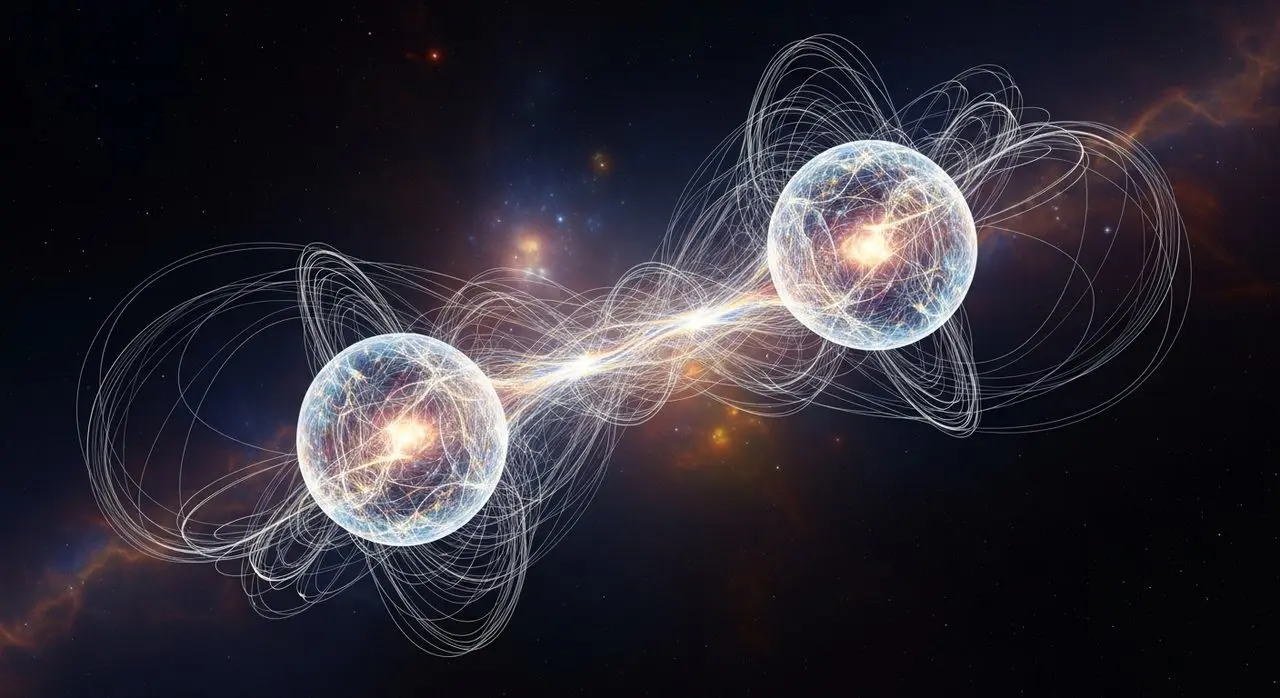
A qutrit Bell correlation, a quantum link exceeding the standard limits of qubit-based entanglement, has been observed by researchers led by Li You of Tsinghua University and collaborating institutions. The team demonstrated this beyond-qubit correlation within a many-body system using a spin-1 Bose-Einstein condensate, a state of matter created by cooling atoms to near absolute zero. Exploiting spin-exchange collisions in an ensemble of approximately 3.1 x 10^4 atoms, the work provides “direct evidence of genuine multipartite qutrit Bell correlations” and establishes these condensates as a platform for exploring complex quantum connections at macroscopic scales.
Spin-1 Rubidium-87 Condensate as a Qutrit System
Spin-nematic squeezing reaching -11.8(7) dB enabled the observation of qutrit Bell correlations within a spin-1 rubidium-87 Bose-Einstein condensate, a result that surpasses the limits achievable with qubit-based systems. This level of squeezing, generated through spin-exchange collisions involving approximately 3.1 x atoms, is critical for accessing higher-dimensional quantum resources and exploring applications beyond standard quantum computation. The team’s experimental setup relied on collective spin observables to demonstrate the violation of a Bell witness, a key indicator of non-classical correlations.
Their derivation of the Bell witness, detailed in the supporting information, establishes a threshold of W < 2 to confirm Bell correlations and W < 1 to definitively exceed the qubit bound, certifying the presence of genuine qudits. The unique properties of the spin-1 condensate allow for the creation of correlations that are fundamentally impossible to replicate with systems limited to two-dimensional qubits.
The experimental system itself, as illustrated in the published work, carefully manipulates the rubidium-87 atoms to achieve the necessary quantum state. A notable aspect of the measurement process involved a shuffling technique, which, while effective, may introduce a slight overestimation due to long-term drift in the offset. The team acknowledges this and suggests future experiments could mitigate this effect by directly implementing a four-point measurement scheme.
“Observing Bell Inequality Violation Beyond the Qubit Bound in a Spinor Bose-Einstein Condensate,” summarizes the core achievement of this work. To further validate their findings, the team also constructed an effective two-level qubit system from the spin-1 qutrit manifold, selectively depleting the population of a specific superposition state.
This allowed them to compare the observed correlations with the theoretical limits of a qubit system, confirming that the observed violation of the Bell witness genuinely originates from the higher-dimensional qutrit correlations. The ability to create and measure these correlations within a many-body system establishes spinor Bose-Einstein condensates as a promising platform for investigating high-dimensional quantum phenomena at macroscopic scales.
Bell Nonlocality and its Role in Quantum Physics
The violation of a Bell inequality, a hallmark of quantum nonlocality, has now been demonstrated using a system that surpasses the limitations of standard qubit-based entanglement. This work establishes the condensate as a platform for exploring high-dimensional quantum correlations within complex, many-body systems, and confirms that collective measurements can reveal quantum dimensionality at scales previously inaccessible.
Observing Qutrit Bell Correlations via Spin-Nematic Squeezing
Spin-nematic squeezing reached -11.8(7) dB. This surpasses the sensitivity needed to detect entanglement using only collective measurements, a technique that simplifies the experimental demands of observing these quantum links.
The achievement moves beyond the limitations of qubit-based systems by demonstrating correlations in qutrits, quantum units capable of representing three distinct states rather than the binary zero or one of qubits. “In this work, we introduce a multipartite high-dimensional Bell correlation witness that is directly accessible with collective spin and nematic observables,” the researchers state, “and use it to observe genuinely three-level Bell correlations in a spin-1 87Rb BEC”.
Collective Spin Observables and Bell Witness Violation
Researchers have demonstrated this by constructing a Bell witness, a mathematical tool designed to detect entanglement, based solely on collective spin measurements. This approach bypasses the need for individual particle measurements, simplifying the experimental setup and enhancing its robustness. This squeezing, a reduction in quantum fluctuations, amplifies the signal and allows for a clearer demonstration of non-classical correlations.
Beyond Qubit Bounds: Demonstrating Higher-Dimensional Correlations
The demonstration of Bell correlations exceeding qubit limitations relied on a spin-1 Bose-Einstein condensate containing approximately 3.1 x rubidium-87 atoms, a scale previously limiting observations to qubit ensembles. This achievement moves beyond the two-dimensional local Hilbert spaces inherent to qubits, unlocking access to higher-dimensional quantum systems and their unique correlation structures. Researchers anticipate these systems will enable stronger violations of specific Bell inequalities and facilitate the certification of genuinely high-dimensional entanglement.
The experimental setup exploited spin-nematic squeezing, a phenomenon generated through collision-based interaction dynamics, to produce strongly correlated states. These states allowed for the observation of correlations inaccessible to qubits, opening possibilities for applications like entanglement-enhanced sensing of electromagnetic fields and the development of more precise atomic gravimeters.
The team’s approach defines a Bell witness, a mathematical expression, where a value below two confirms the presence of Bell correlations. A value below one specifically certifies the involvement of qudits, quantum systems with dimensions greater than two. The researchers constructed this witness using a collective nematic tensor operator, a mathematical tool combining measurements of atomic spin, and demonstrated a violation exceeding the bounds achievable with an equivalent number of qubits.
“Despite these advances, existing many-body demonstrations of Bell correlations have been limited to two-level (qubit) descriptions,” the paper notes, highlighting the significance of this advancement. The approach employed uses coarse-grained collective measurements, simplifying the experimental challenges associated with precise individual atom measurements.
Quantifying Bell Violation: -11.8(7) dB Result
A spin-nematic squeezing of -11.8(7) dB, achieved in a Bose-Einstein condensate, demonstrates a Bell correlation exceeding the limits of qubit-based entanglement. Defining collective projector operators, researchers constructed a Bell operator, B, that allows for the quantification of dimensionality in quantum correlations. The observed value of B indicates that the observed statistics require quantum systems with at least three levels, qutrits, to be reproduced. This approach moves beyond simply demonstrating a new type of correlation. It provides a method for determining the minimum number of qutrits necessary to explain the observed quantum behavior.
The researchers explain that if the Bell expectation value falls below a certain threshold, it implies a minimum number of high-dimensional quantum resources are present. Specifically, the paper details that a violation of their inequality implies that at least n′ = N-n_d + 1 parties must have dimension greater than d, where N is the total number of particles and represents those with dimension at most d. The team’s work introduces a Bell dimension witness valid regardless of measurement implementation, relying instead on collective operators.
Spinor BECs: A Platform for Many-Body Bell Correlations
Spinor Bose-Einstein condensates is a viable platform for investigating high-dimensional Bell correlations within many-body systems, a demonstration of coarse-grained collective measurements certifying quantum correlations at macroscopic scales. The work, detailed in a recent publication, moves beyond qubit-based entanglement by observing correlations in a system of approximately 3.1 x 87Rb atoms, establishing a new avenue for exploring quantum mechanics at larger scales.
This approach relies on the unique properties of spinor condensates, where atoms possess multiple internal spin states that can be coherently coupled and entangled through controlled interactions. “Our results establish spinor condensates as a scalable platform for exploring high-dimensional Bell correlations in the many-body regime,” the researchers state, highlighting the potential for future investigations into the limits of quantum theory in large, interacting systems.
👉 More information
🗞 Observing Bell inequality violation beyond the qubit bound in a spinor Bose-Einstein condensate
✍️ Wenxin Xu, Junshuang Hu, Guillem Müller-Rigat, Xinwei Li, Qi Liu, Matteo Fadel and Li You
🧠 DOI: http://link.aps.org/doi/10.1103/13wt-lzjm


See today’s quantum computing news on Quantum Zeitgeist for the latest breakthroughs in qubits, hardware, algorithms, and industry deals.