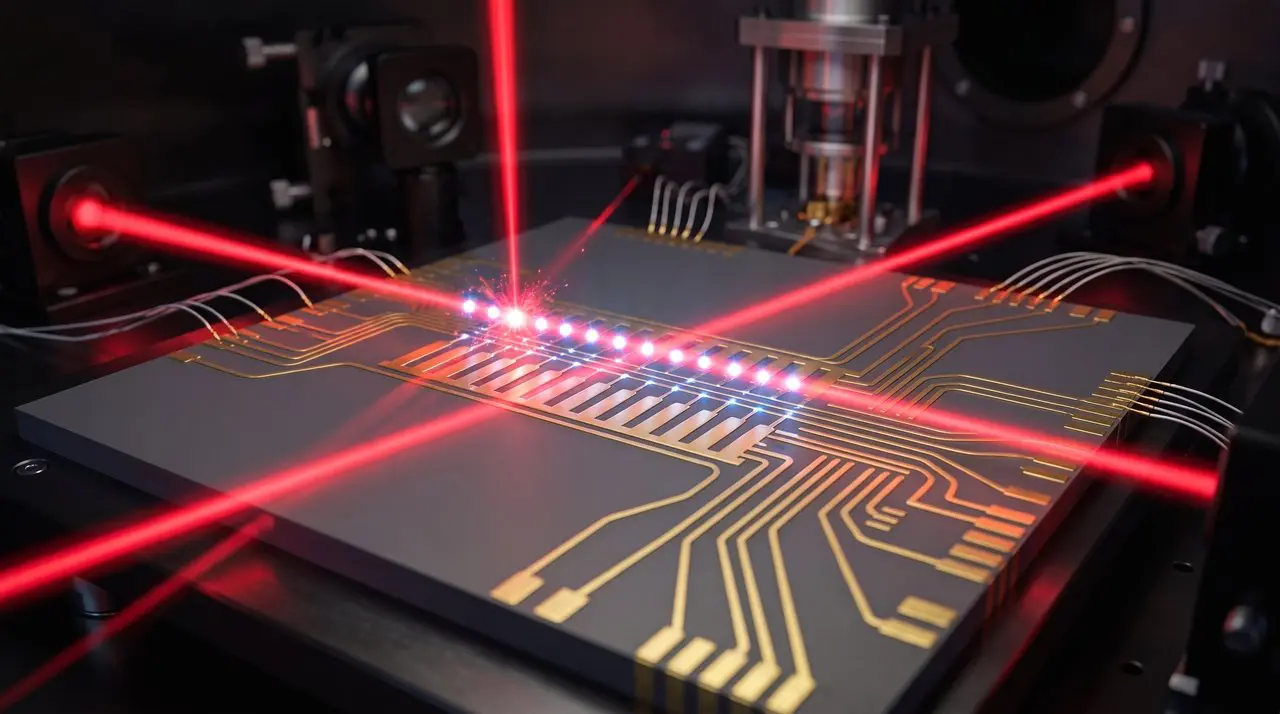
Researchers have successfully mapped noise characteristics with experiments up to 92 qubits and validation on up to 21 qubits (GHZ state). The team, spanning IBM Quantum research centers in Research Triangle Park, San Jose, and Yorktown Heights, as well as the University of Chicago and École Polytechnique Fédérale de Lausanne, demonstrated that previously considered limitations, “unlearnable (gauge) degrees of freedom”, do not hinder accurate predictions of noisy quantum dynamics or error mitigation when using learnable parameters. This work utilizes gate set Pauli noise learning to characterize and mitigate noise across a complete gate set, from state preparation to multi-qubit operations, while a consistent set of parameters reduces sampling overhead.
Pauli Noise Learning Framework for Scalable Characterization
Experiments demonstrate that self-consistent characterization of learnable parameters eliminates inconsistencies arising from unlearnable aspects of quantum noise, even as the number of qubits increases. This work extends beyond theoretical considerations, providing experimental evidence quantifying the magnitude of these gauge-induced inconsistencies in practical error mitigation protocols.
The framework enables learning a set of noise channels, representing the impact of errors on quantum states, that are mathematically equivalent to the true, but uniquely unidentifiable, noise channels present in the hardware. This equivalence means the learned channels contain equivalent information to the actual noise, and can be effectively applied to post-selection error correction (PEC).
Researchers identified and unambiguously characterized learnable parameters of Pauli noise channels through these experiments, moving beyond the limitations of previous approaches like gate set tomography (GST) which becomes impractical beyond a few qubits due to its complexity and resource demands. A key aspect of the method involves restricting learning to three specific Pauli terms, IZ, ZZ, and ZI, which represent particular types of quantum errors. The experiments utilized circuits prepared in the |11⟩ state, focusing on the -IZ and +ZZ eigenstates, differing from the learning circuits prepared in the |00⟩ state with +IZ and +ZZ eigenstates.
Self-Consistent Gauge Parameters Enable Unbiased Mitigation
A consistent approach to characterizing quantum noise allows for unbiased error mitigation, resolving a long-standing issue with identifying the complete noise model within quantum systems. Previous experiments unknowingly employed differing gauge parameters, essentially, different reference points, when analyzing noise across state preparation, measurement, and two-qubit gates, introducing inconsistencies. Researchers demonstrated that establishing a self-consistent set of these gauge parameters is important for accurate error mitigation, as evidenced by reduced bias in experiments involving a 21-qubit Greenberger-Horne-Zeilinger (GHZ) state. This consistency ensures that the learned noise model accurately reflects the system’s behavior without introducing artificial distortions.
Applying this framework to a quasi-local noise model, they showed that self-consistent error mitigation, using a technique called probabilistic error cancellation (PEC), yields unbiased estimates of observable outcomes. PEC applies inverse channels to correct for noise, but the efficiency of this process is typically limited by the exponential increase in sampling overhead with higher noise levels.
Theorem 1 within the study suggests that any gauge-equivalent noise model, parameterized by the gauge parameters η, can produce the same observable outcomes when used with PEC, but differing parameters impact sampling efficiency. Interestingly, the choice of gauge parameters does not affect the final, mitigated results, but optimizing them demonstrably reduces the computational cost of error mitigation.
Impact of Gauge Ambiguities on Error Mitigation Performance
This finding addresses a fundamental question regarding the impact of noise model ambiguity on the reliability of quantum computations, demonstrating that even without uniquely identifying the noise, accurate results are attainable. The research team used a gate set Pauli noise learning framework to achieve efficient characterization and mitigation across a complete set of operations, including state preparation, measurements, and both single- and multi-qubit gates.
Beyond simply demonstrating that these gauge ambiguities are not detrimental, the study reveals a surprising connection to computational efficiency. This optimization is particularly important as quantum computers scale, where the demand for resources increases exponentially with qubit count.
The team’s approach builds on the assumption that predominant noise sources impact only the qubit subspace and are localized to neighboring qubits on the device, simplifying the learning task without sacrificing accuracy. Experiments were analyzed with up to 92 qubits, and validation was performed on up to 21 qubits using the GHZ state, showing a reduction in bias within mitigated expectation values compared to prior error mitigation techniques. The results provide direct evidence that optimizing gauge parameters can improve the practical performance of error mitigation, lowering both bias and the associated sampling overhead.
Experimental Validation with Up to 92 Qubits
Experiments validated our approach with up to 92 qubits and showed that, while the gauge choice does not affect error-mitigated observables, optimizing it reduces sampling overhead. Initial validation utilized experiments with the GHZ state, building on earlier work limited to one and two-qubit systems due to computational demands; even characterizing three qubits with previous methods required substantial experimental effort.
These expanded tests assessed the impact of a learning approach that accounts for gauge degrees of freedom in noise description. A statistically significant improvement in predicted outcomes using this self-consistent learning approach was reproduced across six qubit pairs on the same device, as detailed in the supplementary data.
Greenberger-Horne-Zeilinger State Mitigation Bias Analysis
Experiments with up to 92 qubits demonstrated that a self-consistent approach to characterizing noise reduces mitigation bias, shifting from a median error of 4.9% to 3.1%. This improvement is observed when employing a consistent set of gauge parameters for state preparation, measurement, and two-qubit entangling gates, a departure from previous methods that implicitly used inconsistent parameters.
The team’s methodology involved a restricted circuit designed for both learning and targeted mitigation, utilizing initial states with differing measurement settings to assess bias. While the non-degenerate cycle involving the observable showed no bias difference between learning approaches at even or odd depths, the overall reduction in error highlights the importance of consistent parameterization.
Remaining bias, though reduced, can largely be attributed to errors outside the scope of the two-local Pauli-Lindblad noise model used in the analysis. These out-of-model errors represent physically relevant noise sources not fully captured by the current framework, suggesting avenues for further refinement. The analysis applied to all 92 qubits validated the benefits of self-consistent learning at scale, showing improvements in error mitigation bias on systems with up to 21 qubits using the GHZ state.
Unified SPAM and Gate Noise Characterization
Experiments now extend noise characterization to 92 qubits using a framework treating state preparation, measurement, and gate errors within a unified model, similar in spirit to generalized randomized benchmarking but specialized for Pauli noise and scalability. This approach uses a Pauli gate set learning method to identify and efficiently characterize learnable parameters within noise channels, resolving inconsistencies arising from disparate treatments of noise components across an experiment.
Researchers detail how inconsistencies stem from differing gauges applied to state preparation and measurement errors, a problem addressed through self-consistent learning. The framework assumes a quasi-local noise model where noise factors into channels acting on nearest neighbor qubits, resulting in 28n parameters for n qubits on a ring, 27n learnable and n gauge parameters linked to single-qubit depolarization maps.
This methodology enables a self-consistent and unbiased error mitigation strategy; probabilistic error cancellation, when implemented with these learned models, yields estimates of observables independent of the previously problematic gauge degrees of freedom. The work builds upon earlier findings, demonstrating that while a true, unobservable gauge remains, consistent learning eliminates its impact on error mitigation outcomes. Beyond the technical advancements, the team anticipates that combining this approach with deeper understanding of the underlying physics governing quantum operations will further refine noise characterization.
Quasi-Local Noise Modeling for Quantum Hardware
Error mitigation strategies gain efficiency through optimized gauge selection, recent experiments reveal, reducing the computational resources needed for accurate results. Researchers demonstrated a reduction in sampling complexity by focusing on the gauge parameters within a quasi-local noise model, a critical step toward practical applications on current quantum systems. The work moves beyond simply identifying noise to actively using learned parameters for tangible gains in efficiency, a departure from methods that assume complete knowledge of hardware error rates.
Theoretical Proof of Consistent Error Prediction
While previous methods often struggled, this work demonstrates those limitations do not impede accurate prediction or error reduction when learnable parameters are properly aligned. This optimization reduces sampling overhead, but does not directly address the computational overhead associated with obtaining them. The team distinguished between two noise models during their experiments: a model adhering to conventional symmetry assumptions, and a “consistent” model learning all noise channels without pre-defined constraints.
This improvement is notable because it addresses a systematic error source previously unaccounted for in many quantum error mitigation strategies, including PEC, ZNE, and TEM. Further refinement of the consistent model through gauge optimization yielded an even lower median error of 2.4%, bringing the remaining errors largely in line with expected statistical noise.
👉 More information
🗞 Disambiguating Pauli Noise in Quantum Computers
✍️ Edward H. Chen et al.
🧠 DOI: http://link.aps.org/doi/10.1103/69wc-gzl6

See today’s quantum computing news on Quantum Zeitgeist for the latest breakthroughs in qubits, hardware, algorithms, and industry deals.