Researchers are proposing an optical experiment to directly test Hawking’s Chronology Protection Conjecture regarding the fundamental limits of time travel. The work, led by David Bermudez and Ulf Leonhardt, outlines a system where lasing and amplifying vacuum fluctuations above a laser’s threshold become linked to the possibility of sending information back in time. This setup is not about building a DeLorean; it’s a probe of quantum mechanics, designed to determine if the universe truly allows closed timelike curves as predicted by classical general relativity, exemplified by scenarios like Gödel’s universe. “Classical physics would allow time travel, but Hawking conjectured that quantum mechanics will prevent it,” the authors write, framing their experiment as a means to explore the quantum instabilities that might make time travel impossible. The proposed experiment utilizes fiber optics and parametric amplification to create an optical analogue for time travel, establishing quantifiable limits on how far back one could theoretically travel.
The possibility of journeying backward in time, once relegated to science fiction, now faces rigorous theoretical scrutiny, with a newly proposed optical experiment designed to probe the limits of temporal mechanics. The experiment does not aim to build a functional time machine; instead, it constructs an optical analogue to explore the quantum instabilities that would arise from attempting to warp spacetime. The proposed setup leverages the unique properties of photons, which are their own antiparticles, simplifying the annihilation and creation processes necessary to model a time traveler encountering their past self. The researchers envision a light pulse traveling within a fiber loop, effectively moving backward in time, while a parametric amplifier facilitates the necessary particle interactions.
As detailed in their work, the system’s behavior is governed by a series of equations describing the interaction between the light in the fiber and the loop, revealing that under specific conditions, the output pulse can precede the input pulse. The equations demonstrate the potential for temporal displacement with sufficient gain. However, the analysis also reveals a critical constraint: the initial light within the loop must precisely anticipate and cancel the incoming pulse to maintain causality. This requirement highlights a fundamental challenge to time travel; the system must avoid runaway amplification and maintain a consistent quantum state. The experiment’s design is inspired by earlier work on temporal cloaking and analogues of gravity, but differs by its focus on preserving the fidelity of the light pulse.
The team’s calculations show that time travel is possible with good fidelity, but the amplifier must enhance the signal enough to match the incoming light for annihilation. The work demonstrates that while time travel may not be entirely forbidden, it is subject to stringent quantum limitations, potentially confirming Hawking’s conjecture and refining our understanding of the universe’s fundamental laws.
Hawking’s Chronology Protection Conjecture & Time Travel Proposals
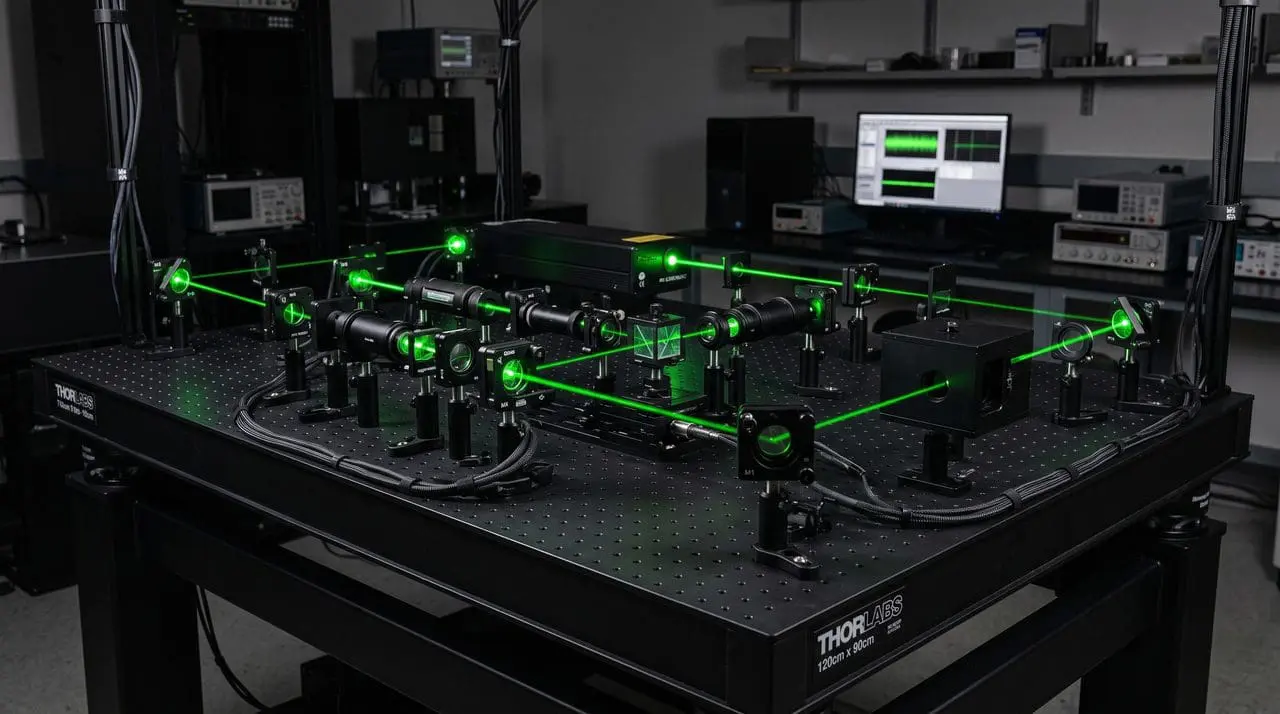
While macroscopic time travel remains firmly in the domain of science fiction, physicists are now constructing analogues, systems that mimic the key physical conditions, to probe the boundaries set by quantum mechanics. Recent work by David Bermudez and Ulf Leonhardt details a proposed optical setup designed to test Hawking’s Chronology Protection Conjecture, referenced in [Phys. Rev. D 46, 603 (1992)]. This is not an attempt to build a “DeLorean” or a functional time machine, but rather to establish whether the universe fundamentally prohibits journeys into the past. The core of the proposed experiment lies in a meticulously crafted fiber optic loop coupled with a parametric amplifier.
This requirement underscores the delicate balance needed to avoid quantum instabilities, as Hawking conjectured that quantum mechanics will prevent it. The team’s calculations show that the system’s behavior shifts dramatically depending on the relationship between gain and loss within the loop; when gain exceeds loss, the possibility of temporal displacement emerges. In the ideal scenario, with no losses, the incident pulse can travel back in time by an amount determined solely by the delay within the loop, without distortion. The amplifier needs to enhance the signal such that, when delayed in the loop, it matches the incoming light for annihilation.
Their approach centers on a fiber loop incorporating parametric amplification, a process linked to the quantum boundaries of temporal displacement. This is not a quest for a physical time machine, but a probe of fundamental physics. However, real-world systems inevitably experience losses. The team’s modelling, using Fourier transformations to analyze pulse propagation, demonstrates that a carefully tuned amplifier can generate a partner pulse advanced in time. Simulations demonstrate that even with moderate gain, a discernible output pulse can emerge before the input pulse arrives, as shown in their modelling.
The persistent allure of time travel often conjures images of complex machinery and paradox-laden scenarios, yet a newly proposed optical experiment suggests a streamlined approach focused not on how to travel through time, but on establishing the quantum boundaries that may prevent it. The core innovation lies in demonstrating the potential for temporal displacement with sufficient gain, and quantifying the limits imposed by quantum mechanics. The setup resembles Yariv’s critical coupling resonator, utilizing a linear amplifier, a departure from earlier electronic analogues, to facilitate the annihilation and creation of photons, essential for simulating the conditions of time travel. The authors write that equations demonstrate a discernible output pulse can emerge before the input pulse arrives. The work is not about building a physical time machine, but about establishing a precise, quantitative understanding of the quantum limits of temporal displacement, and testing whether “quantum mechanics will prevent it,” as Hawking originally conjectured.
Source: https://arxiv.org/abs/2607.22056


See today’s quantum computing news on Quantum Zeitgeist for the latest breakthroughs in qubits, hardware, algorithms, and industry deals.