Italian high school students have, for the first time, performed an authentic Bell test experiment, verifying entanglement and violating Bell’s inequalities through a new curriculum focused on introducing quantum mechanics using two-state systems with light polarization. In Italy, high school students successfully conducted this experiment; it verified that two particles become linked regardless of distance by violating what are known as Bell’s inequalities.
The Liceo Statale Classico Scientifico e Sportivo “M. L. King” in Genoa achieved a first: their high school students successfully performed an authentic Bell test, verifying entanglement by violating what are known as Bell’s inequalities.
This experiment confirms that two particles can become linked regardless of the distance separating them, challenging classical notions about how the world works. The team accomplished this through a new curriculum introducing quantum mechanics via simple systems using light polarization and built a dedicated quantum optics laboratory within the school itself to enable hands-on learning. A qubit, representing information with only two states like a light switch being on or off, forms the key basis for understanding these complex phenomena and is central to modern computing.
Entangled Photons Illuminate Quantum Mechanics for Introductory Students
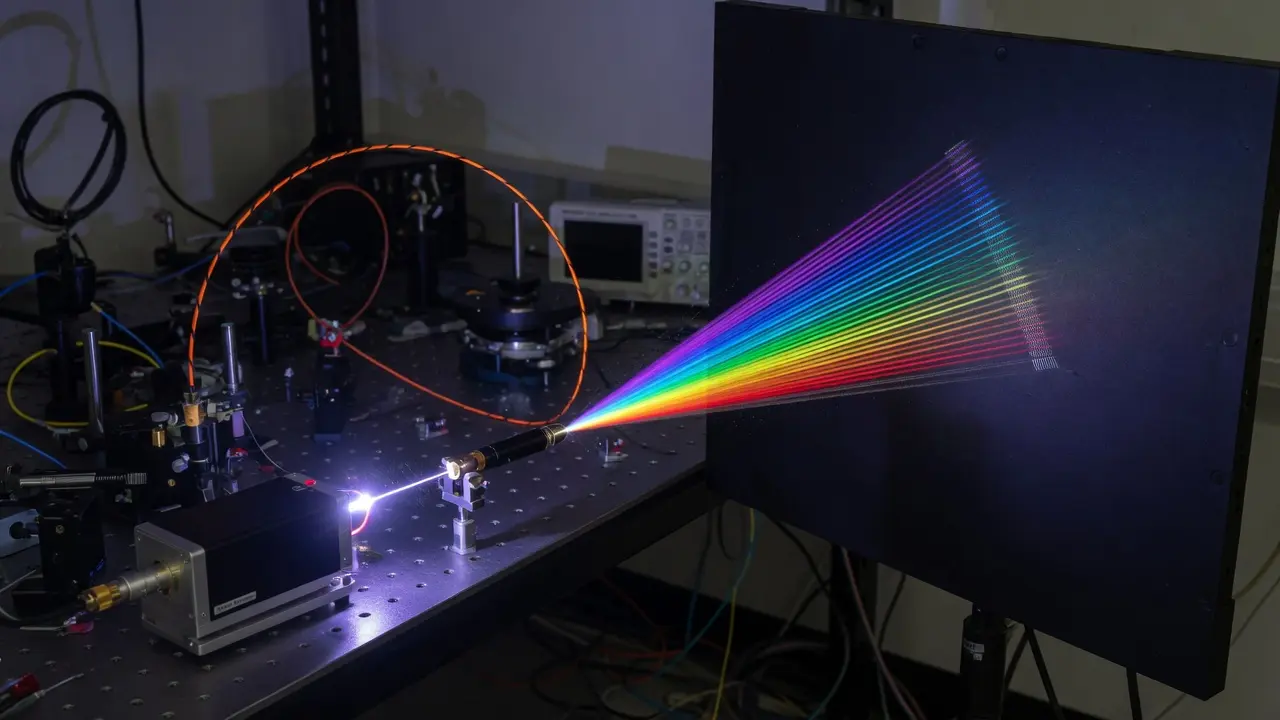
The Liceo Statale Classico Scientifico e Sportivo “M. L. King” team centred its approach on utilising light polarization to demonstrate core quantum principles; this involved creating pairs of *polarization-entangled photons*, where each photon’s wave vibration direction is linked to its partner regardless of distance, akin to having one left and one right glove in separate boxes. This technique enabled students to explore superposition and entanglement using a simplified system before tackling more complex scenarios.
A *qubit first* approach was used, with students beginning with mathematically accessible two-level systems employing light polarization for exploring concepts like superposition and entanglement because it avoids extensive prior classical physics knowledge often required by traditional curricula. Establishing a new quantum optics laboratory allowed an authentic Bell test, a demonstration verifying quantum mechanics, utilising paired, linked photons at the high school level.
Hands-on Quantum Optics and Authentic Bell Tests Enhance High School Learning
Previous methods yielded limited improvements in student comprehension of quantum mechanics; however, preliminary analysis now reveals sharp gains across three key areas: conceptual understanding, confidence using mathematical tools, and appreciation for how theory connects to experimentation. Specifically, pre-and post-test results showed a mean increase of 35 per cent on questions requiring application of superposition and entanglement concepts. Students also successfully completed advanced laboratory work and participated in professional development courses designed for teachers adopting this curriculum framework, expanding its impact beyond initial testing by preparing educators to continue utilising these techniques.
Preliminary Learning Validation Needed Despite Successful Classroom Entanglement Demonstration
While the Italian team’s success bringing a Bell test into the high school lab is strong, verifying entanglement through hands-on experimentation rather than abstract theory, their analysis remains preliminary at this stage, acknowledging that more durable statistical validation of improved learning outcomes is needed beyond initial observations. The question arises whether observed gains stem from genuine deeper understanding or simply represent a temporary boost due to the novelty of building and using entirely new equipment within the classroom environment. Confirming quantum entanglement, where two particles become linked regardless of distance, through such an experiment represents a step forward in physics education.
The Liceo Statale Classico Scientifico e Sportivo “M. L. King” team’s work demonstrates how secondary school students can engage with quantum mechanics through direct experimentation rather than abstract theory alone; constructing a dedicated laboratory facility within the school itself was central to this approach. By beginning with accessible two-state systems, qubits representing information like an on or off switch, and utilising light polarisation, they bypassed traditional prerequisites often hindering early engagement with these concepts. This allowed them to focus immediately on core principles without requiring extensive background knowledge.
This research demonstrated that Italian high school students could successfully perform a Bell test using polarization-entangled photons in a newly established lab setting. Introducing quantum mechanics via two-level systems, starting with fundamental postulates instead of classical physics pre-requisites, improves conceptual understanding for learners. Evaluation through testing showed a mean increase of 35 percent on questions about superposition and entanglement; the curriculum was also used to train teachers. The authors note further analysis is needed to confirm durable improvements in learning outcomes beyond initial observations.
👉 More information
🗞 Teaching quantum mechanics in secondary schools: A qubit-first learning path to Bell’s inequalities
✍️ Alberto Carlini, Andrea Lanza, Dalida Monti and Anna Soso (Affiliation: Liceo Statale Classico); Elena Losero (Affiliation: Istituto Nazionale di Ricerca Metrologica); Maddalena Mari, Matteo Oñate Orozco and Maria Bondani (Università degli Studi dell’Insubria)
🧠 ArXiv: https://arxiv.org/abs/2610.29834



See today’s quantum computing news on Quantum Zeitgeist for the latest breakthroughs in qubits, hardware, algorithms, and industry deals.