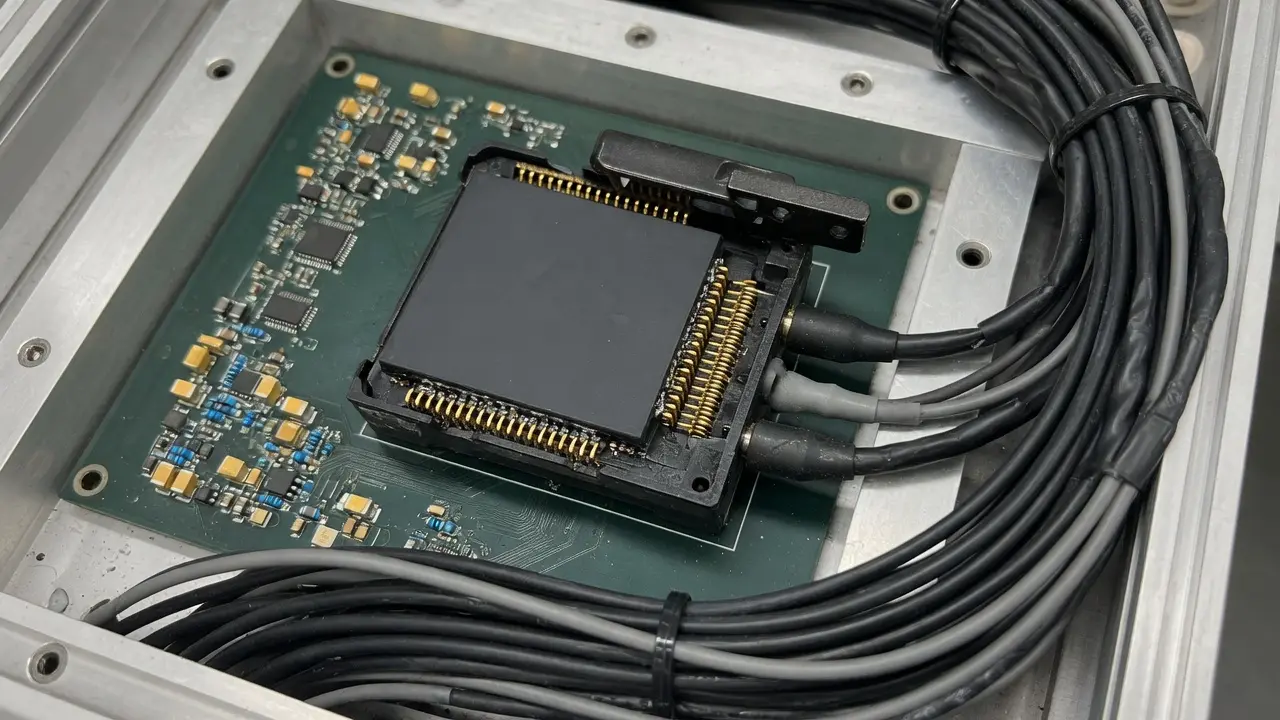
A key leap forward has been made in powering quantum computing; commercially available power inductors now deliver 25x to 58x when cooled to four Kelvin, the temperature near absolute zero. Despite this dramatic reduction in energy loss, inductance falls by only around 5, 5.5%. Standard electronic components used to deliver power within quantum computers maintain strong performance even when supercooled; commercially available power inductors exhibit 25x to 58x at four Kelvin.
This reduction in resistance happens with only around a five percent decrease in inductance, a measure of how effectively they store energy in a magnetic field. The findings mean existing parts can function inside quantum systems without requiring costly redesigns and improve the overall efficiency of power delivery. Researchers from the University of Illinois Chicago and Argonne National Laboratory have demonstrated improvements in powering quantum computers through advances in commercially available components.
As quantum systems grow more complex, efficiently delivering power *within* the freezing environment, four Kelvin, just above absolute zero, becomes vital; traditionally this has been done with external room temperature conversion causing losses via long interconnects. The team found standard power inductors exhibit up to fifty-eight times less electrical resistance when supercooled, think of it like reducing friction within a wire allowing electricity to flow much easier. Importantly, their ability to store energy as part of an electric circuit, known as inductance (similar to how difficult it is to start swinging a heavy pendulum), only decreased slightly by around five percent.
Supercooling boosts power efficiency using standard commercial inductors at 4K
Full converter efficiency improves by up to 22.8 points at 3A when utilising AC-characterised devices operating at 4K; achieving this level of performance once required complex external conversion systems due to limitations within cryostats themselves. Commercially available power inductors reduce electrical resistance between twenty-five and fifty-eight times when supercooled to four Kelvin while maintaining approximately ninety-five percent of their inductance, as discovered by researchers from the University of Illinois Chicago and Argonne National Laboratory. This viable integration allows off-the-shelf components into quantum computing platforms without costly redesigns or significant loss in system performance, a key step towards scalable cryogenic electronics.
Simulations with Cadence software revealed efficiency gains ranging from three point zero to five point two percentage points at just one Ampere, a substantial improvement even at lower current draws. Inductor tests showed a consistent drop of five to five point five percent in inductance upon cooling to four Kelvin; this minimal degradation ensures continued functionality despite supercooling.
While core losses increased during cryogenic operation due to intensified eddy currents within the inductors’ magnetic cores, these increases are manageable given overall performance benefits and frequency-dependent AC resistance also rose alongside them, demonstrating that skin effect becomes more pronounced as temperatures fall and frequencies rise.
Simulated predictions validated by measured low-resistance component behaviour
Ever-more efficient cooling is essential for scaling quantum systems, offering a pathway to reduce power loss *within* those environments using existing components instead of custom designs. Their simulations heavily relied on Cadence software to predict performance at extreme temperatures, a common practice but one introducing uncertainty. Sensibly acknowledging this reliance is important; real-world hardware always presents complexities not fully captured by models.
Nevertheless, the team’s detailed measurements showing substantial reductions in electrical resistance at cryogenic temperatures strongly support their simulated efficiency gains within power converters. This demonstrates commercially available components can perform well under these conditions without costly customization for quantum systems or other deep-cooling applications. Standard power inductors, components storing energy in a magnetic field, function effectively in freezing environments with no bespoke designs and allow more electricity to flow with less loss than previously possible.
This research experimentally characterized five commercial Vishay SMD power inductors at both room temperature and 4 Kelvin, revealing significant reductions in DC resistance, ranging from 25x to 58x, at the lower temperature alongside minimal inductance degradation of approximately 5, 5.5%. These findings demonstrate that existing off-the-shelf inductors can operate efficiently within cryogenic systems like quantum computing platforms by reducing electrical losses. Simulations using Cadence software confirmed an improvement in full converter efficiency between 3.0 and 5.2 percentage points at 1 Ampere, and up to 22.5 points at 3 Amperes when incorporating measured AC characteristics.
👉 More information
🗞 Experimental Characterization of SMD Inductors for Cryogenic Power Conversion at 4 K
✍️ Rami Rasheedi and Inna Partin-Vaisband (University of Illinois Chicago); Umeshkumar Patel, Jonathan Baldwin and Antonino Miceli (Argonne National Laboratory)
🧠 ArXiv: https://arxiv.org/abs/2610.28923

See today’s quantum computing news on Quantum Zeitgeist for the latest breakthroughs in qubits, hardware, algorithms, and industry deals.