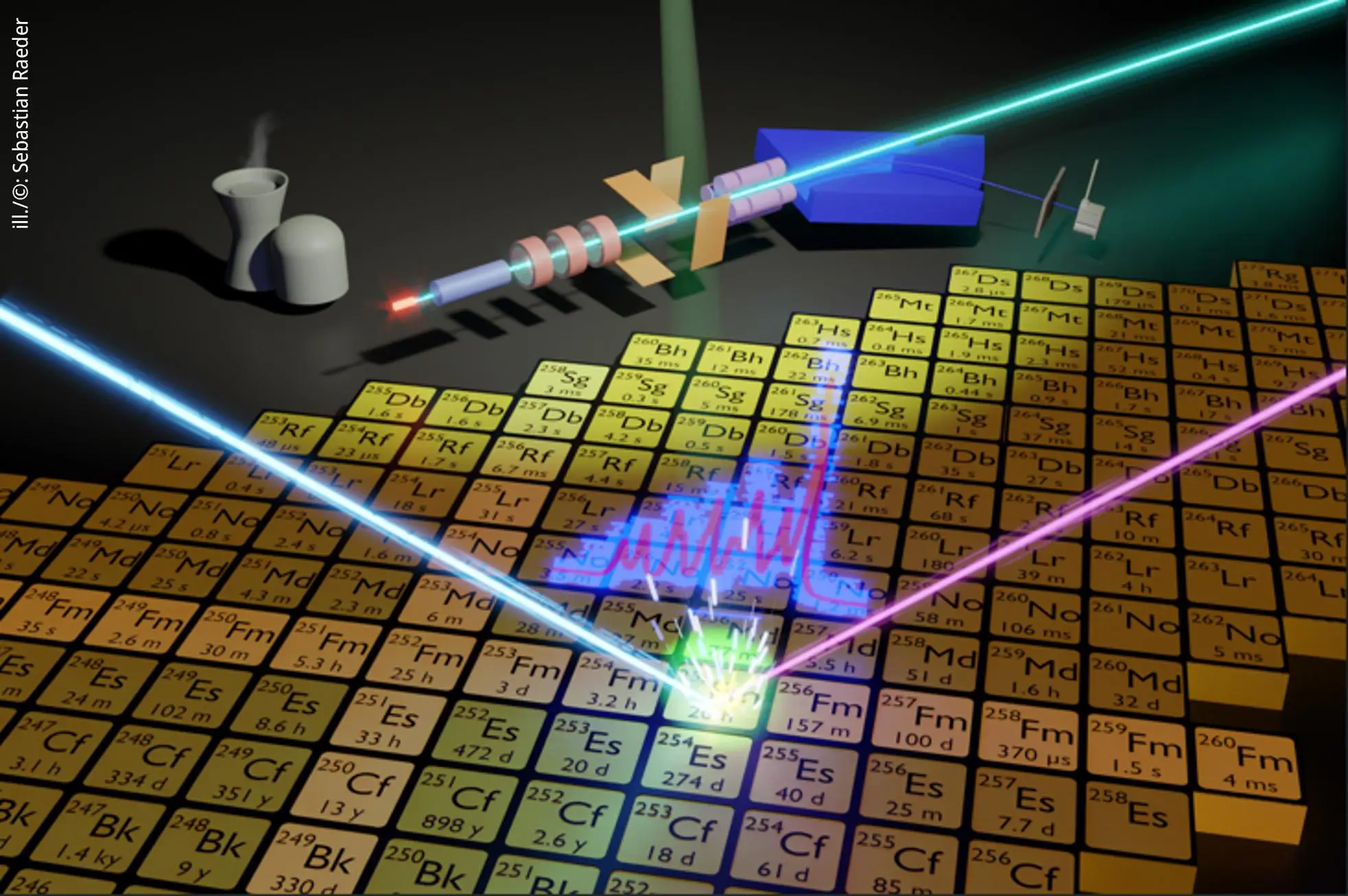
Researchers have determined that the nuclei of neptunium and fermium take the shape of rugby balls using a new laser-based analysis method. The technique, detailed in a thesis from the University of Gothenburg, overcomes longstanding challenges in studying these rare and rapidly decaying actinide elements.
“These elements are difficult to study because they are unstable and only exist in extremely small quantities for a very short period of time,” explains Mitzi Urquiza, doctoral student at the University of Gothenburg and HÜBNER Photonics. This advance, enabled by a pulsed laser and optical parametric oscillator, promises to refine models of atomic nuclei and potentially aid in reducing nuclear waste and improving cancer care.
Pulsed Laser Spectroscopy Reveals Actinide Nuclei Shapes
Actinide nuclei, notoriously difficult to probe, have yielded their shapes to a new spectroscopic technique; neptunium and fermium were found to possess elongated, rugby ball-like forms. Only four of the fourteen actinide elements are naturally occurring; the remaining ten require accelerator production, resulting in extremely limited sample sizes for study.
The newly developed method overcomes longstanding challenges in actinide research by achieving wavelengths and colors conventional laser systems cannot reliably produce with sufficient intensity and precision. Researchers directed laser pulses at the atoms, observing subtle energy shifts in absorbed wavelengths; these shifts reveal crucial information about the size and shape of the atomic nuclei. “Thanks to our new method, I was able to produce the first high-quality description of the atomic nuclei of fermium and neptunium,” Urquiza said.
“Their nuclei are shaped like rugby balls.” This detailed mapping of nuclear shapes is not merely academic; the resulting data will refine theoretical models of atomic nuclei, aiding the identification of new elements and isotopes. A deeper understanding of neptunium’s properties could contribute to advancements in both nuclear waste reduction and the production of radioisotopes for cancer treatment, demonstrating the practical implications of fundamental nuclear physics research. The team reports that the analysis required measurements across multiple European facilities, highlighting the complexity of the undertaking and the need for specialized equipment.
Thanks to our new method, I was able to produce the first high-quality description of the atomic nuclei of fermium and neptunium. Their nuclei are shaped like rugby balls.
Source: https://hubner-photonics.com/news/new-laser-method-gives-insight-into-radioactive-atomic-nuclei/



See today’s quantum computing news on Quantum Zeitgeist for the latest breakthroughs in qubits, hardware, algorithms, and industry deals.