An investment from the U.S. Department of Energy’s Genesis Mission will position Fermilab as a central hub for artificial intelligence-driven scientific advancement, funding a portfolio of initiatives, including the AI/ML project led by Fermilab and eight others in which the lab is a key collaborator. Fermilab scientists will develop AI/ML-based resonance control algorithms designed to enable high-reliability, low-cost operations for particle accelerators, substantially improving performance and driving discovery science. “Fermilab is honored to receive this support for advancing artificial intelligence as part of DOE’s Genesis Mission,” said Fermilab Director Norbert Holtkamp. “This investment strengthens our ability to accelerate scientific discovery, develop technologies, and drive innovation.” The Genesis Mission aims to unite government, industry, and academia to accelerate breakthroughs in energy, science, and national security through AI and advanced technologies.
AI/ML Resonance Control for Accelerator Performance
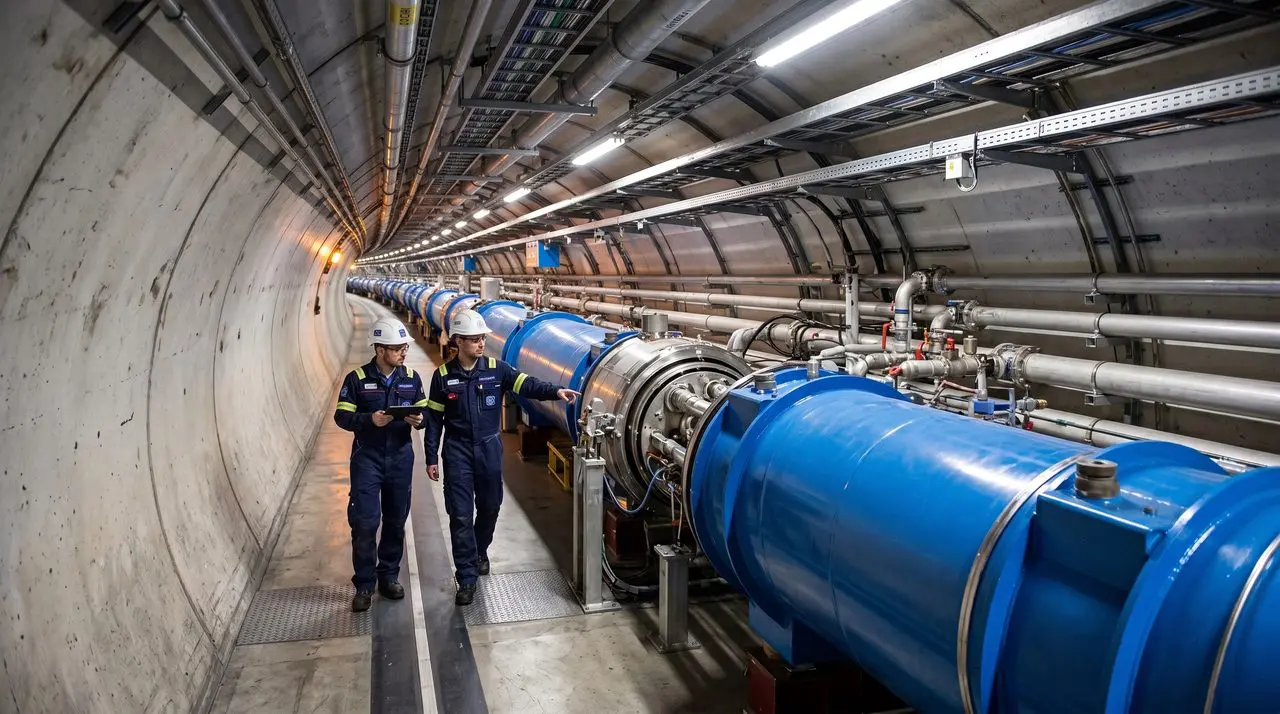
The Genesis Mission is a U.S. Department of Energy initiative. Beyond broad applications of AI, Fermilab is spearheading a focused effort: developing “AI/ML-based resonance control algorithms” designed to improve particle accelerator performance and reduce operational costs. This effort isn’t simply about faster discovery; it’s about achieving high-reliability, low-cost accelerator operations across a range of facilities. The project directly addresses a critical challenge in superconducting radio-frequency (SRF) accelerators, like Fermilab’s Proton Improvement Plan-II (PIP-II). These powerful machines, used to accelerate particles for research, are susceptible to disturbances from vibrations and pressure fluctuations impacting cavity resonant frequency. Precise control of this frequency is critical for current and future accelerators, including those at SLAC National Laboratory’s Linac Coherent Light Source-SC and Brookhaven National Laboratory’s Electron-Ion Collider (EIC). The new algorithms promise to increase science output, extend the lifespan of key components, and streamline operations.
Anna Grassellino, chief technology officer and associate laboratory director for the Technology Directorate at Fermilab, explained the potential impact: “By developing AI-driven control of superconducting RF cavities, we can make future accelerators — such as our own PIP-II — more efficient, reliable, and autonomous, enabling higher scientific performance while reducing operational complexity.” Fermilab’s involvement extends beyond this lead project; the lab is a key collaborator on eight additional Genesis Mission initiatives, spanning neutrino physics, collider research, and advanced computing, amplifying its influence across the national scientific landscape.
This investment strengthens our ability to accelerate scientific discovery, develop next-generation technologies, and drive innovation at the frontiers of particle physics and advanced technology.
Norbert Holtkamp, Fermilab Director
Fermilab is extending its decades-long leadership in particle physics through a series of projects funded by the Department of Energy’s Genesis Mission, an initiative designed to integrate artificial intelligence with scientific discovery. Tracy Marc of Fermilab confirmed the lab’s selection for a portfolio of initiatives, including the AI/ML project led by Fermilab and eight others in which the lab is a key collaborator, positioning the institution as central to the mission’s goals. These algorithms address a critical challenge: maintaining precise control of superconducting radio-frequency (SRF) cavities, essential components in accelerators like Fermilab’s PIP-II, SLAC’s Linac Coherent Light Source-SC, and Brookhaven National Laboratory’s Electron-Ion Collider (EIC). Minute vibrations and pressure fluctuations can disrupt these cavities, and AI-driven control promises to mitigate these issues. These include projects focused on expediting data analysis for the Electron-Ion Collider, detecting anomalies in the CMS experiment, and accelerating discovery within the Deep Underground Neutrino Experiment (DUNE). Fermilab’s extensive data storage infrastructure, the Fermi Data Platform, is also playing a vital role, providing the secure, large-scale data environment needed to support advanced AI research across the American Science Cloud.
These awards recognize the tremendous opportunity to combine artificial intelligence with Fermilab’s world-leading expertise in superconducting accelerator technology.
Anna Grassellino, chief technology officer and associate laboratory director for the Technology Directorate at Fermilab
Beyond simply applying AI to existing workflows, the lab is spearheading projects designed to fundamentally alter how scientific data is collected, analyzed, and utilized, extending its decades-long leadership in neutrino and collider physics. A core focus is improving the reliability and reducing the costs of particle accelerators. The Fermilab-led project will develop AI/ML-based resonance control algorithms to address the delicate balance required within superconducting radio-frequency cavities, which are susceptible to disruption from even minor environmental fluctuations.
Fermilab is honored to receive this support for advancing artificial intelligence as part of DOE’s Genesis Mission.
Norbert Holtkamp, Fermilab Director
By developing AI-driven control of superconducting RF cavities, we can make future accelerators – such as our own PIP-II – more efficient, reliable, and autonomous, enabling higher scientific performance while reducing operational complexity.
See today’s quantum computing news on Quantum Zeitgeist for the latest breakthroughs in qubits, hardware, algorithms, and industry deals.