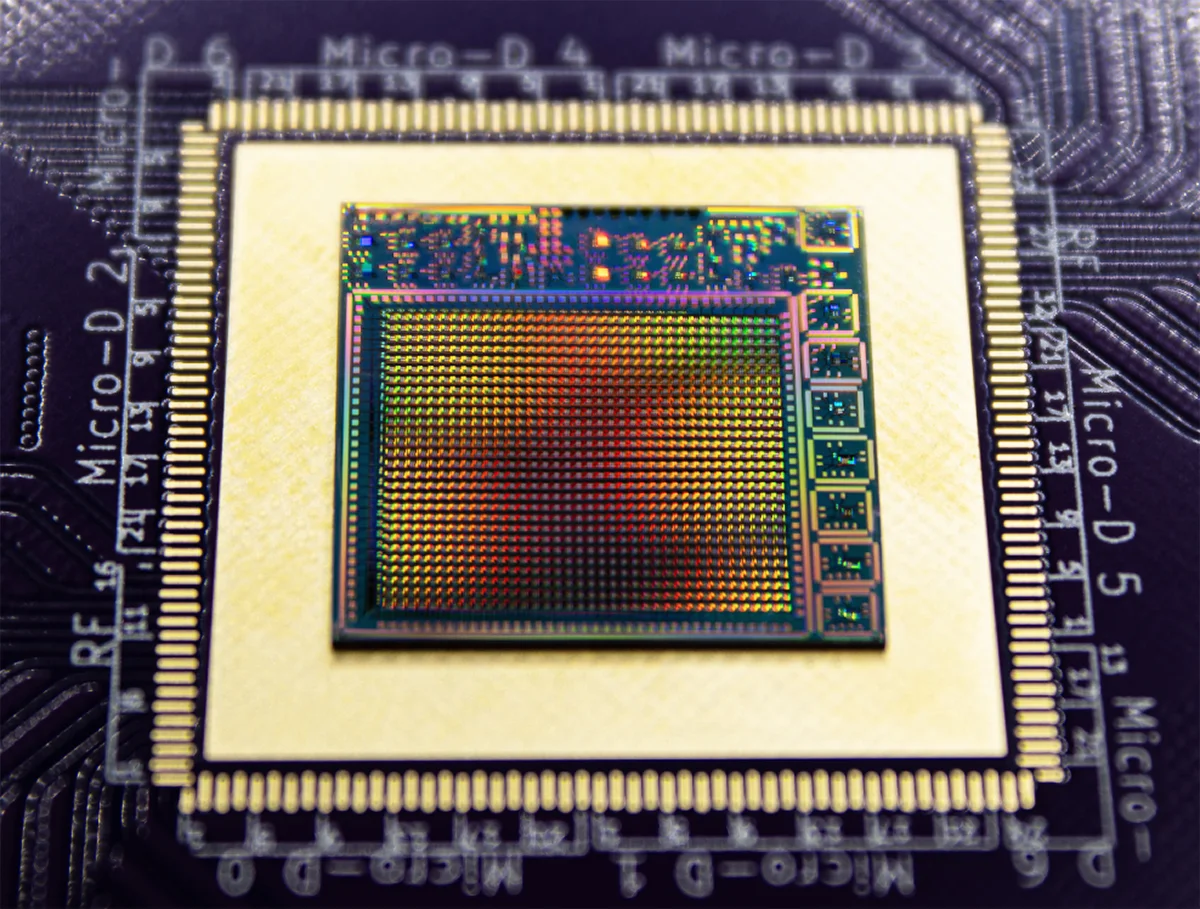
A superconducting chip developed by Brookhaven National Laboratory, alongside other U.S. Department of Energy facilities and the AI hardware start-up Great Sky, is undergoing testing to monitor fusion plasma in real time. The chip uses a neuromorphic neural network, designed to mimic the human brain, to analyze data and potentially predict the instabilities within tokamaks, the doughnut-shaped machines central to proposed fusion power plants.
“Disruptions are something that are kind of existential for tokamaks,” says Michael Churchill, a research scientist at the Princeton Plasma Physics Laboratory, who worked on the project, emphasizing the need for faster control mechanisms. Researchers replayed data from the DIII-D tokamak in San Diego, California, at a rate of one million samples per second, demonstrating the chip’s ability to flag anomalies and predict disruptions.
Superconducting Chip Monitors Fusion Plasma in Real Time
The newly developed chip integrates memory directly onto the superconducting circuit, a feature that distinguishes it from conventional AI systems requiring external data storage. The chip has not been wired to a working tokamak yet. Instead, the team replayed data recorded at the DIII-D tokamak in San Diego, Calif., at its original rate of one million samples per second, and the chip kept up while running algorithms meant to flag anomalies and predict disruptions.
The AI model on the chip is much smaller than today’s large language models, and the team is still writing up its results for publication. The superconducting circuits are intended to enable the AI to operate at gigahertz speeds, a rate that could surpass the response time of existing tokamak control mechanisms.
The current phase of development is demonstrational, with the technology still undergoing testing and refinement. “All of this is very demonstration-stage right now,” notes a representative from the team, acknowledging that significant hurdles remain before the chip can be deployed in a commercial fusion power plant. Carlos Paz-Soldan, an associate professor of applied physics University, says he is personally more excited about the use of AI in the area of materials discovery. The team is focused on demonstrating the chip’s capabilities and preparing for its eventual integration into future fusion facilities.
Disruptions are something that are kind of existential for tokamaks.
Michael Churchill, a research scientist at the Princeton Plasma Physics Laboratory, who worked on the project
DIII-D Data Validates Chip’s Anomaly Detection Capabilities
This demonstration, using recorded data, confirmed the system’s ability to maintain pace with the rapid fluctuations inherent in fusion plasma. While existing tokamak control mechanisms react to instabilities, this chip aims to identify precursors before they escalate, potentially offering an advantage in maintaining stable plasma conditions. The chip’s architecture, built around superconducting circuits, is intended to enable gigahertz-level operation, a speed Shinjae Yoo, chair of Brookhaven’s AI department, believes offers immediate benefit in edge computing.
The team intends to build a successor chip with a neural network ten times larger, with a debut planned for early next year. Yoo stated that he is personally more excited about the use of AI in the area of materials discovery.
I’m personally more excited about the use of AI in the area of materials discovery.
Carlos Paz-Soldan, an associate professor of applied physics at Columbia University
Source: https://www.scientificamerican.com/article/new-superconducting-chip-aims-to-help-tame-fusion-plasma/


See today’s quantum computing news on Quantum Zeitgeist for the latest breakthroughs in qubits, hardware, algorithms, and industry deals.