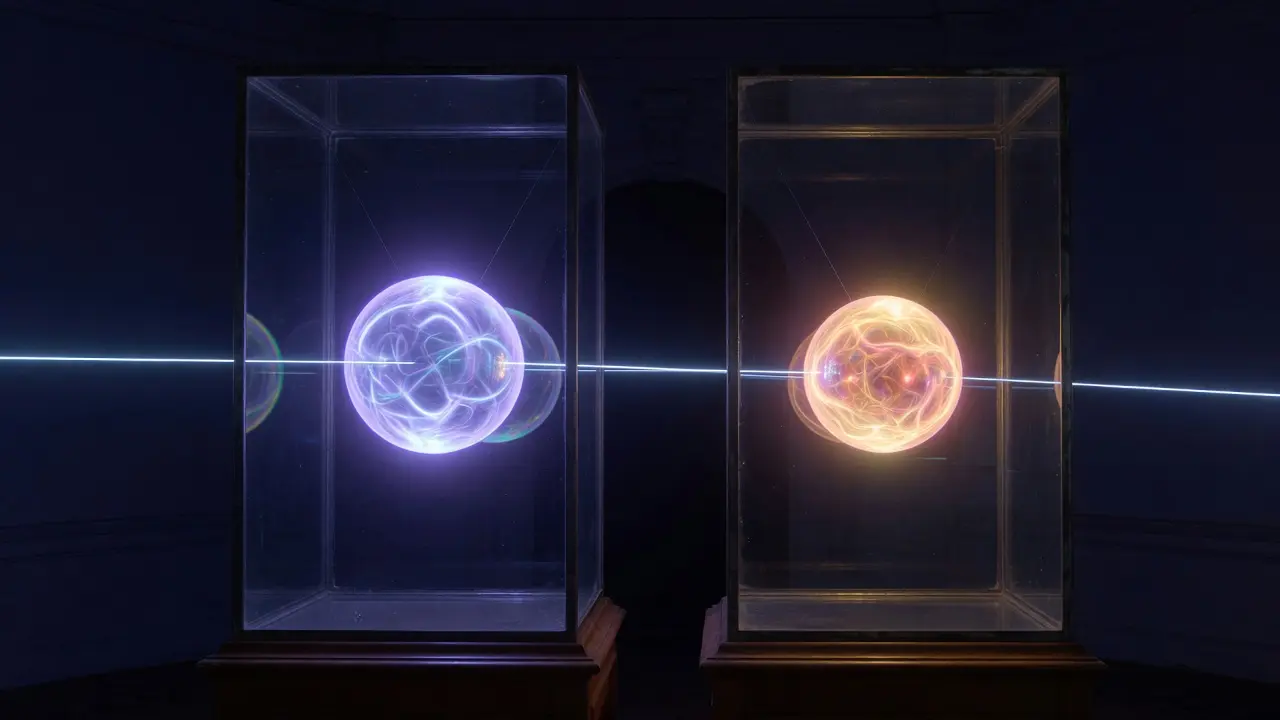
Ivan P. Christov has detailed how electron-photon entanglement manifests in real space using a numerical approach. The work bypasses a common simplification in these calculations, allowing for a higher fidelity simulation of electron behavior when interacting with light. Researchers found local entanglement exhibits opposite spatial patterns. Electron entropy is smallest at the nucleus while photon entropy peaks near the atom where photons are created. The global entanglement is transient, peaking during a laser pulse and then diminishing as the electron returns to its core.
Fermi’s Oscillator Representation Models Electron-Photon Interaction
Calculations of electron-photon entanglement benefited from a numerical approach that bypassed the rotating-wave approximation, a common simplification in quantum electrodynamics. This allowed for a higher fidelity simulation using a one-dimensional model atom situated within a waveguide supporting a single transverse mode. Enhanced coupling was also incorporated into the calculations. The model atom was subjected to a short, off-resonant laser pulse to initiate the entanglement.
The resulting simulations revealed a counterintuitive spatial relationship in local entanglement patterns. Electron entropy reached its minimum at the nucleus, directly mapping the strength of dipole coupling at that location. This spatial distribution of entropy provides insight into how entanglement manifests in real space, linking electron and photon behavior to their respective locations.
Global electron-photon entanglement proved largely transient, peaking in intensity during the laser pulse itself and then decreasing as the electron cloud returned to its core position. Christov explained that the entanglement peaks during the pulse and decreases as the polarized electron cloud returns to the core, describing the fleeting nature of the entanglement and the resulting state, which approached a product of the electron state and a superposition of the field vacuum with a single scattered photon. The work demonstrates that the entanglement is not sustained long after the initial interaction, suggesting a narrow window for observation or potential manipulation of this quantum state.
👉 More information
🗞 Electron-photon entanglement in real space from quantum electrodynamics
✍️ Ivan P. Christov
🧠 ArXiv: https://arxiv.org/abs/2610.35467

See today’s quantum computing news on Quantum Zeitgeist for the latest breakthroughs in qubits, hardware, algorithms, and industry deals.