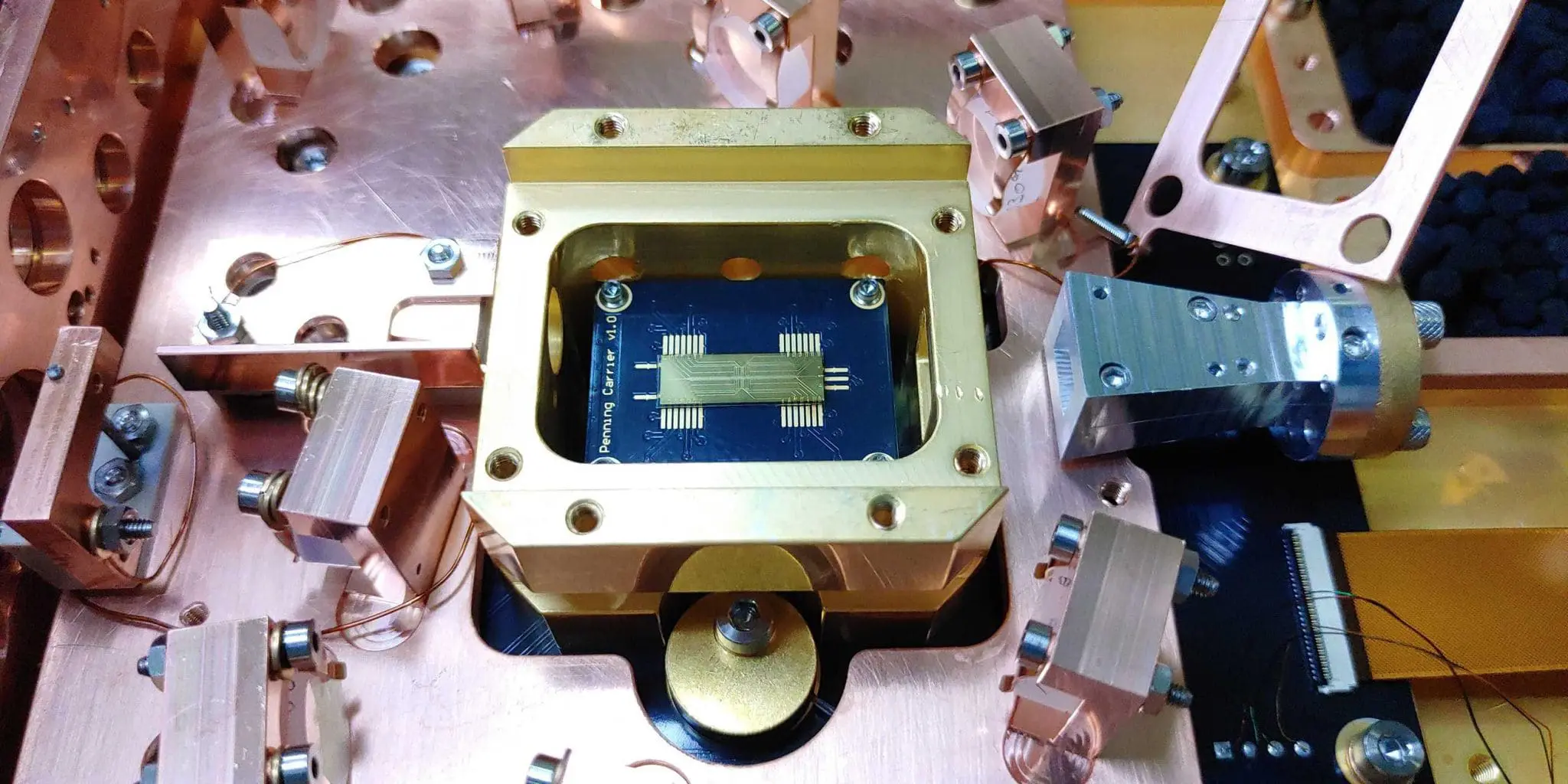
Researchers at ETH Zurich have achieved a new level of precision in mapping electromagnetic fields, utilizing a single ion as a sensor positioned just a hair’s breadth above the surface of microchips. This technique addresses a surprising challenge in miniaturized ion trap technology: stray electromagnetic fields that can disrupt sensitive quantum states. The team led by Jonathan Home, a professor at the Institute for Quantum Electronics, developed a method to create a three-dimensional map of these fields, potentially optimizing materials and manufacturing processes for quantum computers and sensors. “Two years ago, we developed a chip trap that allowed movement of an ion arbitrarily in three dimensions,” explains doctoral student Tobias Sägesser, detailing the foundation for this advancement recently published in Science Advances.
Penning Trap Enables 3D Ion Positioning
The ability to map electromagnetic fields with single-atom precision has moved closer to reality, thanks to a novel application of Penning traps developed at ETH Zurich. Researchers have demonstrated a technique utilizing a solitary ion as a sensor, capable of creating three-dimensional maps of electromagnetic fields directly above a microchip’s surface. This represents a significant leap forward in characterizing materials crucial for advanced quantum technologies. Unlike previous methods relying on arrays of sensors, this approach employs a single electrically charged atom, highlighting the incredible sensitivity and miniaturization now achievable. “For more than thirty years, researchers have tried to find out where the electric field noise close to a chip comes from,” Home explains, emphasizing the long-standing challenge of internal interference. The innovation centers around a Penning trap, which utilizes static electric and magnetic fields, a departure from conventional traps employing oscillating radio frequencies.
The ion’s response to these fields, oscillations induced by even minute disturbances, is measured using laser pulses, enabling the calculation of field strength with unprecedented accuracy. The researchers report detecting oscillating fields as small as 10 nanovolts per meter within one second, a sensitivity level dwarfing the electromagnetic field of a mobile phone at several kilometers distance. This new method promises to refine chip manufacturing processes and optimize surface materials for quantum applications, offering a powerful tool for material characterization and a better understanding of the sources of interference.
For more than thirty years, researchers have tried to find out where the electric field noise close to a chip comes from”, says Home.
Beryllium Ion Oscillation Measures Electric Fields
The pursuit of stable quantum computing and sensing platforms increasingly relies on miniaturized ion traps, yet a persistent challenge has plagued these systems: stray electromagnetic interference. While earlier approaches demanded complex arrays of sensors to map these fields, a team at ETH Zurich has demonstrated a simplified method utilizing a single, trapped beryllium ion as a remarkably sensitive probe. This innovation doesn’t merely detect interference, but constructs a three-dimensional map of electromagnetic fields directly on the chip surface, offering a better understanding of the sources of interference. This freedom of movement, combined with the absence of oscillating fields inherent in the Penning trap design, allows for precise positioning of the ion a mere above the chip surface, between 50 and 450 micrometres, to scan an area of 200 by 200 micrometres.
In doing so, we can vary the height above the chip from 50 micrometres up to 450 micrometres and scan an area of 200 by 200 micrometres”, says Sägesser.
ETH Zurich Team Achieves 10 nV/m Sensitivity
This development offers a pathway to improving the performance of quantum computers and sensors, which are acutely susceptible to interference from stray electromagnetic noise. The innovation relies on a Penning trap, allowing for precise three-dimensional positioning of a single beryllium ion just a hair’s breadth above the chip’s surface. By cooling the ion to its lowest quantum mechanical oscillation state, researchers can then measure changes induced by external electric fields. They were able to scan an area of 200 by 200 micrometres during the experiment. This precise mapping allows for material characterization and optimization of chip manufacturing processes, ultimately leading to more stable and reliable quantum technologies.
Two years ago, we developed a novel chip trap that allowed to move an ion arbitrarily in three dimensions”, explains doctoral student Tobias Sägesser.
Optimized Chips via Surface Material Characterization
The pursuit of more stable and performant quantum devices has led researchers at ETH Zurich to develop a novel technique for characterizing the surfaces upon which these technologies are built. Rather than relying on broad assessments of electromagnetic interference, the team has pioneered a method employing a single ion as a remarkably sensitive probe, capable of mapping electric and magnetic fields with unprecedented precision directly above a chip’s surface. Unlike previous methods, this system utilizes static electric and magnetic fields, offering a significant advantage; it enables precise positioning of the ion and minimizes interference from oscillating fields that plague conventional traps. By measuring the ion’s response to these fields, researchers can calculate the strength of the interfering electric field, achieving a sensitivity of 10 nanovolts per meter within a one-second measurement window.
This new technique allows for detailed 3-dimensional mapping of these fields, enabling comparison with model calculations and a better understanding of the sources of interference. The method extends beyond simply detecting noise; it provides a tool for evaluating surface materials, potentially identifying those that generate the fewest electric fields and optimizing manufacturing processes for quantum applications. This detailed analysis will help create more robust quantum technologies.
This has two significant advantages”, says Shreyans Jain, also a doctoral student in Home’s group: “On the one hand, this allows us to position the ions in three dimensions, which isn’t possible using radio-frequency traps.
Source: https://ethz.ch/en/news-and-events/eth-news/news/2026/07/3d-scanner-for-electromagnetic-fields.html

See today’s quantum computing news on Quantum Zeitgeist for the latest breakthroughs in qubits, hardware, algorithms, and industry deals.