

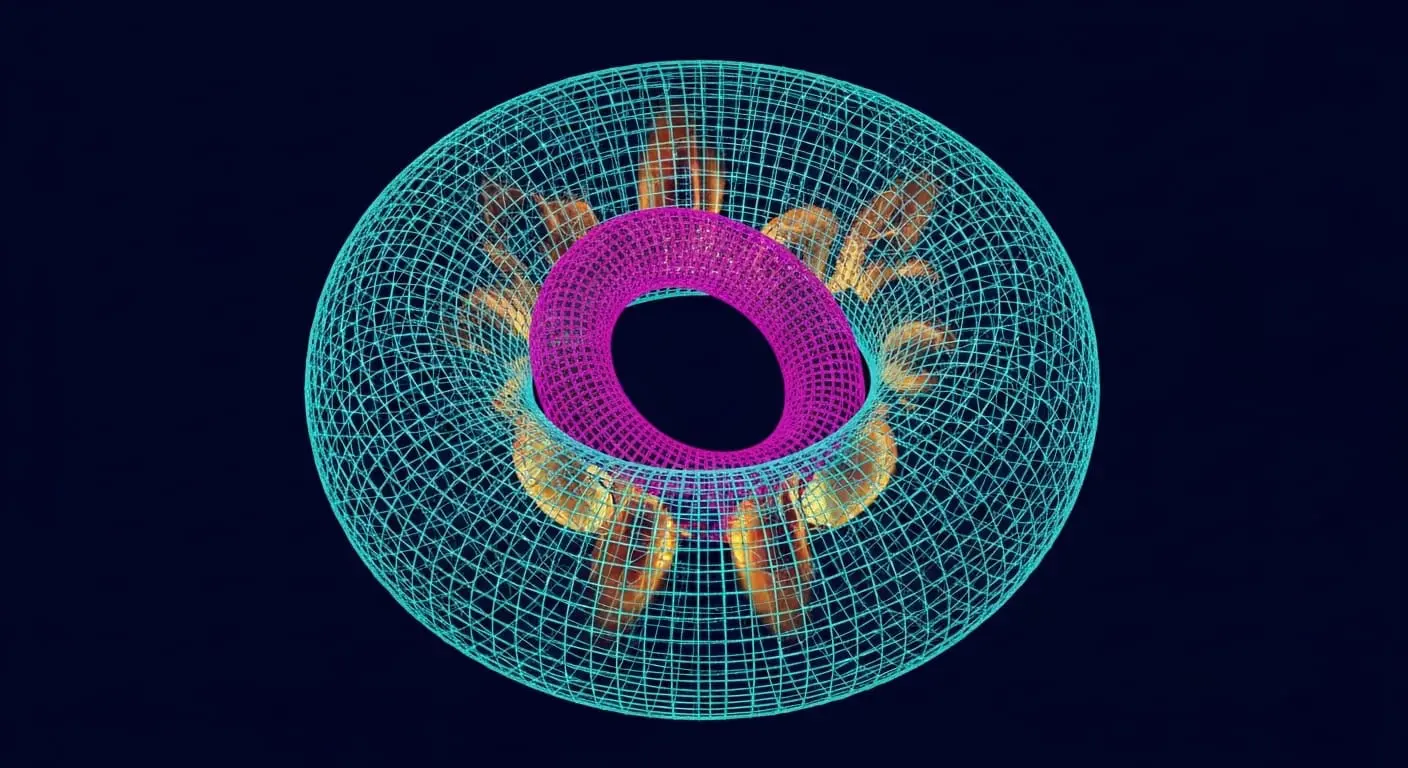
Researchers have demonstrated that sufficiently light Majorana modes can retain enhanced bipartite quantumness even after exiting the cosmological horizon during inflation. Previously, horizon exit alone was assumed sufficient to erase quantum signatures, but this study identifies a Pauli-bounded matter sector where this is not the case. The calculations show quantum links are not immediately lost as the universe expands rapidly in its earliest moments, challenging earlier ideas about the swift disappearance of quantum effects.
Ai-chen Li of Ningbo University, Beijing University of Technology, and colleagues fromUniversity of Barcelona focused on the Majorana fermion and a limited system to examine how quantum entanglement can endure even after particles move beyond the observable horizon. The team investigated how quantum connections persist during the rapid expansion of the very early universe, exploring this by examining the unique Majorana fermion, which acts as its own antiparticle. Focusing on a limited system enabled tracking of entanglement, a strong link between particles, even after these particles moved beyond the observable horizon during inflation. Their calculations reveal that sufficiently light Majorana modes can retain a surprising degree of quantum connection, challenging the assumption that horizon exit automatically erases all quantum signatures.
Sustained entanglement of Majorana modes challenges early universe decoherence predictions
Logarithmic negativity, a measure of entanglement, reached 0.23 for light Majorana modes exiting the cosmological horizon. This represents a substantial increase from previous analyses predicting near-instantaneous loss of quantum correlations. Values above 0.1 demonstrate strong entanglement despite super-horizon expansion, signifying a clear departure from classical behaviour. Calculations, utilising a finite Hilbert space dictated by Fermi statistics, reveal the Pauli bound on the matter sector allows for sustained quantumness, opening new avenues for exploring the preservation of quantum information in the early universe.
The Pauli exclusion principle, a fundamental tenet of quantum mechanics, limits the number of identical fermions that can occupy the same quantum state. In this context, restricting the system to vacuum and one-pair states, a finite Hilbert space, plays a crucial role in preserving entanglement. This restriction doesn’t immediately destroy quantum correlations during the universe’s rapid expansion because it limits the available phase space for particle interactions and decoherence. The team employed a torsion-free Friedmann, Lemaître, Robertson, Walker (FLRW) spacetime as the cosmological background, a standard model for describing the expansion of the universe. Within this framework, they derived the two-component Majorana mode equations, specifically within an axion-inflation background. Axion inflation is a theoretical model proposing that the inflationary epoch was driven by the dynamics of a scalar field known as the axion, a hypothetical particle proposed to solve the strong CP problem in particle physics.
The derived Majorana mode equations were then used to construct the corresponding quadratic Hamiltonian in the paired momentum basis. This Hamiltonian describes the energy of the Majorana modes and their interactions. Hamiltonian diagonalization, a mathematical technique used to find the energy eigenvalues and eigenvectors of the system, proved equivalent to the fermionic squeezing formalism, a method used to reduce quantum fluctuations in a system. This equivalence confirms the accuracy of the calculations through two independent approaches, bolstering the reliability of the findings. Earlier findings demonstrated entanglement could persist, but only at sharply lower levels; this result builds upon that work by demonstrating a significantly higher degree of sustained entanglement under specific conditions.
A compelling glimpse into the preservation of quantum information during the universe’s earliest moments is offered by this work, potentially reshaping our understanding of how classical structures emerged from quantum fluctuations. The significance lies in challenging the conventional wisdom that quantum correlations are rapidly lost due to cosmological expansion. Instead of a thorough exploration of decoherence, the process by which quantum systems lose their coherence and transition to classical behaviour, the analysis focuses on the conditions before complete classicality is assured. This allows for a detailed examination of the factors that can sustain quantum entanglement in the extreme environment of the early universe. Details are provided on how the finite Hilbert space, constrained by Fermi statistics, influences the longevity of entanglement, specifically highlighting the ‘Pauli-bounded matter sector’ where this preservation is most pronounced.
The researchers employed the fermionic squeezing formalism and Hamiltonian diagonalization to obtain the Bogoliubov transformation, which maps the Majorana mode functions to the instantaneous vacuum state. This transformation is crucial for understanding how quantum correlations evolve during inflation. The Bogoliubov transformation effectively describes the creation and annihilation of particles in different modes, allowing the team to track the entanglement between them. The logarithmic negativity, used as a quantitative measure of entanglement, provides a robust indicator of the degree of quantum correlation between the Majorana modes. A value of 0.23 signifies a substantial level of entanglement, indicating that the quantum connection between the particles is not immediately destroyed by the expansion of the universe.
Further investigation will be needed to determine the precise point at which decoherence becomes dominant and the implications for the emergence of classicality. Understanding the transition from quantum to classical behaviour is a fundamental challenge in cosmology. This research provides valuable insights into the conditions that can delay this transition, potentially extending the period during which quantum effects play a significant role in the evolution of the universe. Quantum links between particles are more durable during the universe’s inflationary period than previously thought, as demonstrated by the team from Ningbo University and Beijing University of Technology. Examining Majorana fermions, particles functioning as their own antiparticles, they revealed a ‘Pauli-bounded matter sector’ where the expansion of space does not immediately destroy quantum correlations. This finding highlights the importance of considering the finite nature of the system governed by identical particle behaviour, and suggests scientists may need to reassess the timescale for the loss of quantum behaviour in the extreme environment immediately after the Big Bang. The implications extend to our understanding of the initial conditions of the universe and the potential for observing signatures of primordial quantum entanglement in the cosmic microwave background.
The research demonstrated that quantum links between particles can be more durable during the universe’s inflationary period than previously understood. By examining Majorana fermions, the team identified a ‘Pauli-bounded matter sector’ where expansion does not immediately destroy quantum correlations, as evidenced by a logarithmic negativity value of 0.23. This suggests the timescale for the loss of quantum behaviour in the early universe may require reassessment. The authors intend to further investigate the point at which decoherence becomes dominant and the emergence of classicality.
👉 More information
🗞 Bipartite entanglement of the primordial Majorana during inflation
✍️ Ai-chen Li, Han-Qing Shi and Keyun Wu
🧠 ArXiv: https://arxiv.org/abs/2606.26869



See today’s quantum computing news on Quantum Zeitgeist for the latest breakthroughs in qubits, hardware, algorithms, and industry deals.



