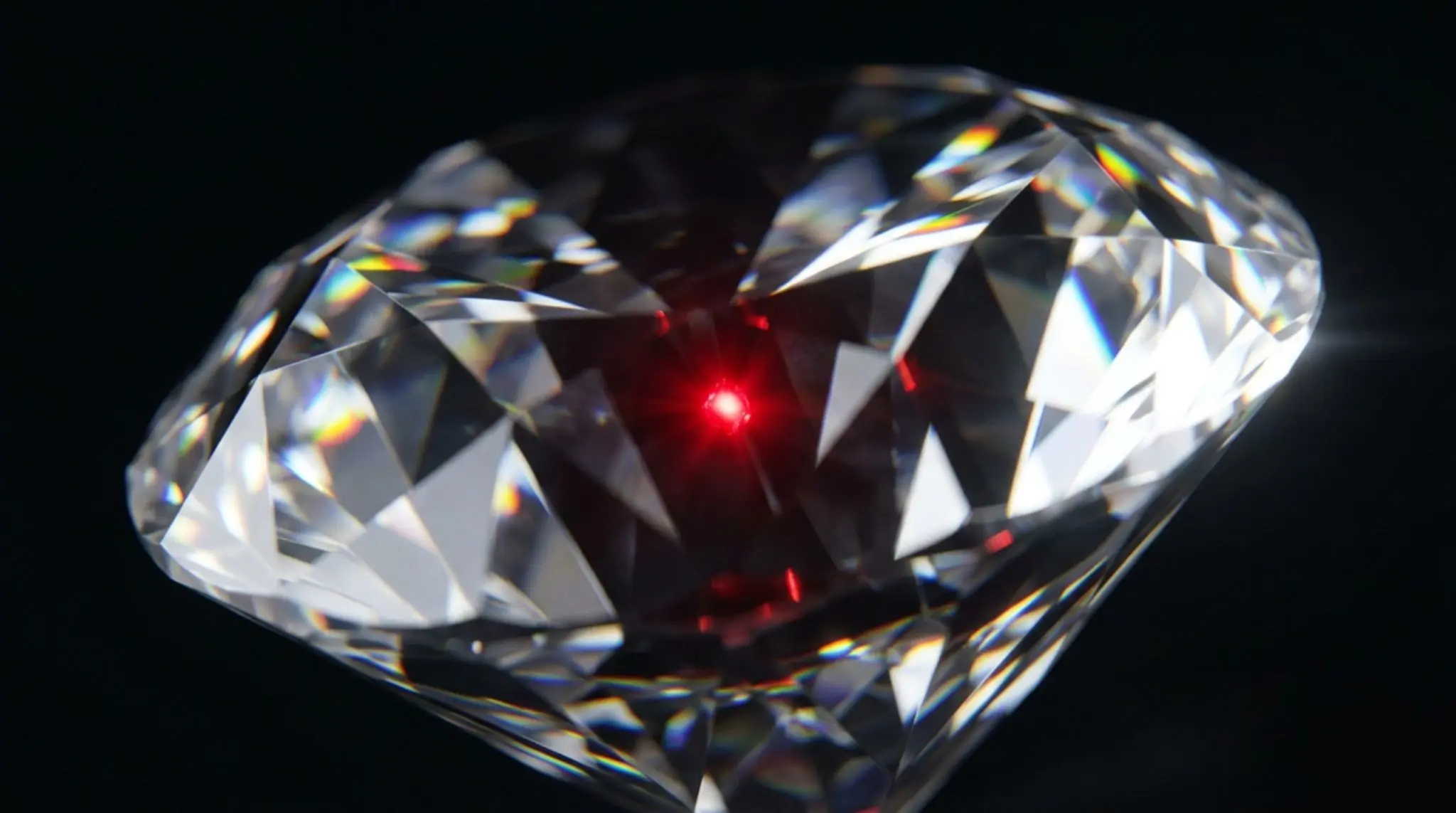
Enhanced light extraction from nitrogen-vacancy centres in diamond is achieved through additive solid immersion lenses at Felix Bloch Institute and SaxonQ. Previously limited by low photon collection efficiency due to internal reflection, a scalable method for fabricating these lenses from yttria-stabilised-zirconia via pulsed laser deposition and photolithography now exists.
The team developed tiny lenses, known as solid immersion lenses, fabricated from yttria-stabilised-zirconia to improve signal collection from defects within diamonds used for quantum computing. These additive lenses overcome limitations caused by light reflecting inside the diamond; this phenomenon stems from differences in how easily light travels through air versus diamond itself.
Consequently, saturation intensity increased on average by 63 per cent and laser power needed for detection decreased by 33 per cent, enhancing information extraction efficiency. A method has been developed and SaxonQ to boost light capture from nitrogen-vacancy (NV-) defects within diamonds; these imperfections act as artificial atoms capable of storing quantum information. Currently, reading signals from these NV centres is hampered by strong internal reflection, a phenomenon akin to how light bends differently when moving between air and water, reducing the amount of emitted light available for detection.
To overcome this limitation, the team fabricated tiny lenses, termed solid immersion lenses, using yttria-stabilised-zirconia via a process similar to building microscopic circuits layer by layer with stencils and lasers: pulsed laser deposition and photolithography. This new approach increased saturation intensity by an average of 63 per cent and reduced necessary laser power by 33 per cent.
Enhanced nitrogen-vacancy centre readout using high refractive index solid immersion lenses
Nitrogen-vacancy (NV^-) centres in diamond exhibited a 63 per cent increase in saturation intensity when paired with newly developed additive solid immersion lenses (SILs). This improvement surpasses previous methods that required deep placement of NV centres, typically hundreds of nanometers or micrometers below the surface.
Fabricated from yttria-stabilised-zirconia via pulsed laser deposition and photolithography, these SILs provide a scalable solution for enhancing light extraction from shallow NV centres implanted just ten to twenty nanometres beneath the diamond’s surface; this enables more efficient readout of their quantum state. Furthermore, this approach reduces the necessary laser intensity needed for saturation by 33 per cent, improving signal collection efficiency.
Simulations predicted a sixty-three percent enhancement in saturation intensity using solid immersion lenses with refractive indices exceeding 2·1 when compared against bare diamond surfaces. This improvement stems from reducing total internal reflection, where light remains within the material instead of escaping. Modelling also revealed that offsets greater than one micrometre can diminish outcoupling efficiency for higher refractive index materials, limiting increases below threefold.
However, even lenses with diameters larger than two and a half micrometres still maintained gains while utilising lower refractive index dielectrics; aspect ratio changes up to twenty per cent had minimal impact on performance. Yttria-stabilised-zirconia lenses offer an innovative application aimed at improving photon extraction from nitrogen-vacancy centres, which are key components in developing quantum computers. Current approaches rely on relatively shallowly implanted colour centres, presenting challenges when scaling production processes.
Pulsed laser deposition and photolithography enabled a scalable process that increased saturation intensity by 63% without requiring deep implantation, simplifying device fabrication significantly. Solid immersion lenses address limitations caused by internal light reflection rather than emission for detection through the addition of minuscule structures to diamond surfaces; this represents a step towards more effective quantum computing components. These defects function as artificial atoms storing information, while yttria-stabilised-zirconia lens fabrication offers a pathway toward improving efficiency within nitrogen-vacancy centre based quantum technologies. A sixty-three percent increase in saturation intensity was achieved using these scalable manufacturing techniques, directly addressing a key limitation when reading signals from NV centres and paving the way for brighter data acquisition even with shallowly implanted colour centres.
The research demonstrated a 63% enhancement in saturation intensity by employing solid immersion lenses made of yttria-stabilized-zirconia on diamond surfaces. This improvement matters because it increases the amount of light emitted from nitrogen-vacancy centres, which are used to store and process information in emerging quantum computing systems. By reducing internal reflection losses, researchers were able to achieve this gain without requiring deeply embedded defects, simplifying device fabrication processes. The study indicates that these lens structures offer a route towards more efficient readout of signals from these crucial components within quantum technologies.
👉 More information
🗞 Additive solid immersion lenses for enhanced collection efficiency of shallow NV centers by pulsed laser deposition and structurization of high-k amorphous oxides
✍️ Michael S. Bar, Andreas Koenig, Marius Grundmann and Holger von Wenckstern (Leipzig University); Nicole Raatz and Max Kneiss (Affiliation: SaxonQ)
🧠 ArXiv: https://arxiv.org/abs/2610.01183
See today’s quantum computing news on Quantum Zeitgeist for the latest breakthroughs in qubits, hardware, algorithms, and industry deals.