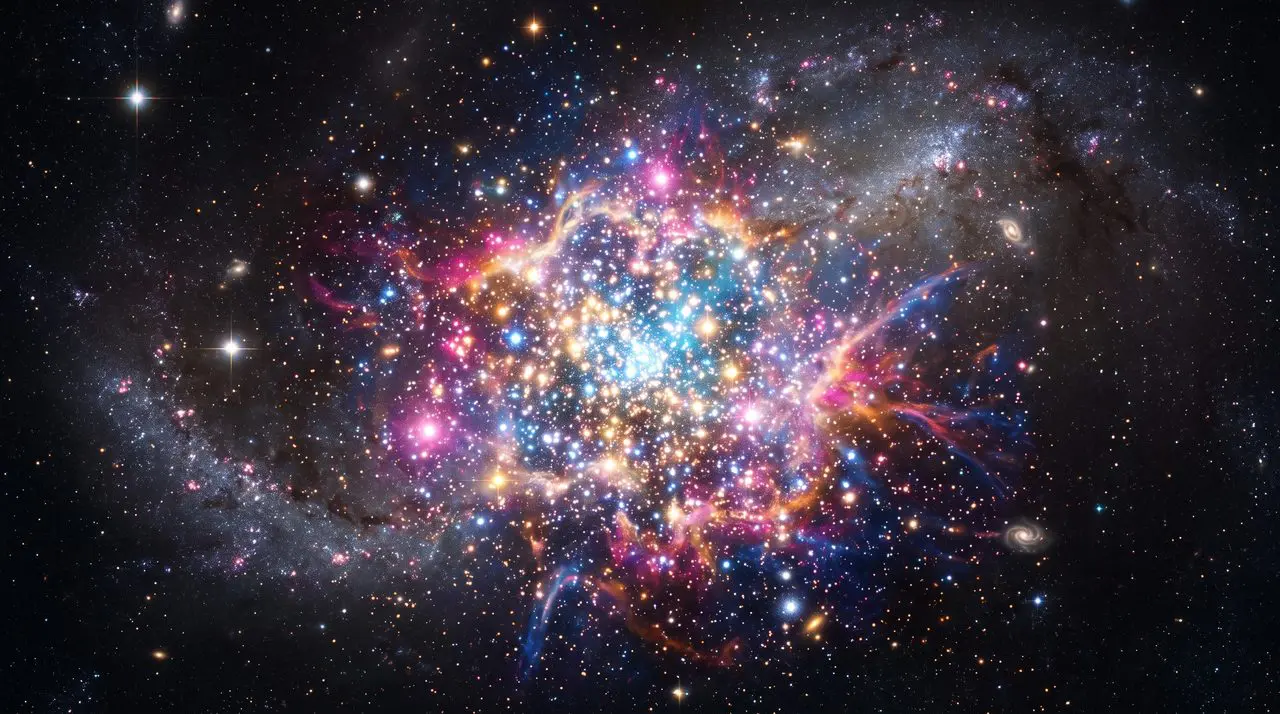
The largest-ever 2D color map of the universe, comprising 5.6 trillion pixels, is now available to astronomers and the public thanks to the DESI Legacy Imaging Surveys team. This expansive map details nearly 4 billion celestial objects, offering unprecedented detail in observations of the extragalactic universe across 75% of the sky.
“It’s part of the fabric of astronomy research now,” said David Schlegel, a scientist at the Department of Energy’s Lawrence Berkeley National Laboratory; the Legacy Surveys data has already been cited in over 1,800 published science papers. Researchers expect this updated map will serve as a foundational resource for years to come, aiding investigations into dark matter and dark energy.
DESI Legacy Surveys Produce 5.6-Trillion-Pixel Universe Map
The newly released 5.6-trillion-pixel map of the universe, created by the DESI Legacy Imaging Surveys team, covers 75% of the sky, offering astronomers a detailed view of the cosmos beyond our Milky Way. This expansive survey, built from 263,407 telescope exposures gathered over years, is a foundational resource for current astronomical research, with over 1,800 scientific papers already referencing data from earlier versions of the Legacy Surveys. The map’s scale allows for detailed investigations into phenomena like gravitational lenses and supernovae, while also probing the mysteries of dark matter and dark energy.
The creation of this map was linked to the goals of the Dark Energy Spectroscopic Instrument (DESI) survey, serving as a crucial preparatory step for DESI’s 3D mapping project. “For our team, these data are fundamental to our investigation of the expansion history of the universe and the formation of our galaxy,” said Arjun Dey, an astronomer at NSF NOIRLab.
The 2D map functions as a deep photographic record, pinpointing the locations and brightness of billions of stars and galaxies, enabling DESI to efficiently select targets for spectroscopic analysis. This process allows scientists to measure the distances to these objects and ultimately track the influence of dark energy over cosmic time.
Processing this immense dataset required significant computational power; the team utilized the Perlmutter supercomputer at the National Energy Research Scientific Computing Center (NERSC) at Berkeley Lab, dedicating eight weeks to process the images after a year of code development. Beyond its immediate support of DESI, the Legacy Surveys data will prove invaluable for future telescopes like the NSF-DOE Vera C. Rubin Observatory and NASA’s Nancy Grace Roman Space Telescope, providing a baseline for comparison with their observations.
Dey added, “But the skies belong to everyone, and this survey gives everyone the chance to explore the sky and marvel at its wonders,” highlighting the public accessibility of the data through the Legacy Survey Sky Viewer. The dataset will be used to train artificial intelligence tools, accelerating the analysis of the vast quantities of data generated by modern astronomical surveys and potentially unlocking new discoveries in the years to come.
For our team, these data are fundamental to our investigation of the expansion history of the universe and the formation of our galaxy.
Arjun Dey, astronomer at NSF NOIRLab
DECaLS, MzLS, and BASS Data Fuel 2D Map Creation
The resulting map, encompassing approximately 75% of the sky, represents a substantial leap in extragalactic survey coverage, extending beyond previous efforts and providing a detailed view unobstructed by the dense star fields of the Milky Way.
Built from 263,407 individual exposures, the project combined data from three ground-based surveys: the Dark Energy Camera Legacy Survey (DECaLS) at NSF Cerro Tololo Inter-American Observatory, the Mayall z-band Legacy Survey (MzLS) at NSF Kitt Peak National Observatory, and the Beijing-Arizona Sky Survey (BASS) at the University of Arizona’s Steward Observatory, along with years of archived observations from NASA’s Wide-field Infrared Survey Explorer (WISE). The scale of the dataset, comprising 5.6 trillion pixels, prompted researchers to anticipate a potential shortage of targets and available sky as DESI proved remarkably efficient at observing galaxies.
Schlegel noted that early in the project, “it became clear we might run out of galaxies to look at and run out of sky, so we better start doing something about that.” Consequently, the updated Legacy Surveys map has been actively used to select targets for DESI since June 2026, ensuring the continued operation and success of the 3D mapping endeavor.
DESI’s 3D Mapping & Legacy Surveys Guide Dark Energy Research
More than 160 scientists contributed to the data collection, with a dedicated team of 20 assembling the final dataset using 263,407 telescope exposures from three ground-based surveys: DECaLS, MzLS, and BASS. The Legacy Surveys were initially designed to prepare for DESI, creating a detailed view of the sky to identify targets for DESI’s spectroscopic analysis. The map’s creation addressed a practical challenge encountered by the DESI team, and will also benefit the Rubin Observatory and the Nancy Grace Roman Space Telescope, enabling accelerated discovery in the years to come.
it became clear we might run out of galaxies to look at and run out of sky, and we better start doing something about that.
David Schlegel, scientist at the Department of Energy’s Lawrence Berkeley National Laboratory (Berkeley Lab)




See today’s quantum computing news on Quantum Zeitgeist for the latest breakthroughs in qubits, hardware, algorithms, and industry deals.