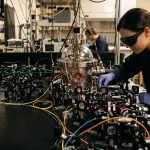
Ujjwal Gautam, Nasser Gohari Kamel, Sourabh Kumar, and Daniel Oblak of the University of Calgary have demonstrated on-demand retrieval of signals in a microwave-to-optical quantum transducer with only 0.4 noise photons in the detection window. This achievement utilizes a quantum memory integrated with transduction in a three-level atomic system, addressing a key challenge in connecting distant superconducting quantum devices.
The researchers achieved this signal storage for 460 microseconds using a low-doping concentration crystal maintained at 30 mK, and demonstrated the protocol’s coherent nature through observed interference patterns. This work represents the first demonstration of an on-demand microwave-to-optical transducer assisted by memory.
Memory-Assisted Multimode Microwave-to-Optical Transduction Demonstrated
Utilizing spin and optical inhomogeneous broadening, researchers at the University of Calgary demonstrated multimode transduction, expanding the capacity for entanglement generation in quantum networks. This achievement employed a low 5 parts per million doping concentration in a Yb:YSO crystal, enabling on-demand retrieval of transduced signals and circumventing the need for complex spectral filtering of pump signals. The experimental setup featured the Yb:YSO crystal positioned within a 3D loop-gap resonator, coupled with an optical cavity, to optimize conditions for both transduction efficiency and memory performance.
While a 1% efficiency was previously achieved using a 340 parts per million doped Yb:YVO crystal with a planar microwave resonator, the University of Calgary team prioritized memory coherence times for their approach. The team achieved on-demand transduction assisted by memory with 0.4 (and 0.3) noise photons in the detection window at a storage duration of 460 (and 620) μs.
To demonstrate the coherent nature of the protocol, they show interference patterns resulting from transduced signals due to varying phase or frequency of the input microwave pulses. The on-demand capability of the protocol allows synchronizing qubits in a quantum repeater protocol, while multimode capacity increases the entanglement generation rate. The team anticipates an internal transduction efficiency of 4× (10)^(-8).
“The unique memory functionality not only enables on-demand retrieval of the transduced signal but also eliminates the need for lossy spectral filtering of the pump,” the researchers state in their published work. This advancement builds on existing research aimed at coherently interconnecting distant superconducting quantum devices.
Zero-Field Yb:YSO Enables Coherent Signal Retrieval
The ability to reliably retrieve transduced signals on-demand circumvents a longstanding obstacle in quantum transduction, eliminating the need for complex filtering systems typically used to suppress noise from intense pump pulses. Researchers employed a 5 parts per million doped Yb:YSO crystal, operating at 30 mK, to demonstrate this memory-assisted microwave-to-optical transduction across ten multiplexed modes without an applied magnetic field. Experimental results reveal a clear temporal separation between the transduced signal and control pulses, a key feature that avoids spectral filtering requirements.
A pump pulse initiates the process, followed by a weak coherent microwave pulse after a time . Retrieval pulses (RAP1 and RAP2) are applied with precise timing, after and from the pump pulse and RAP1, respectively. The transduced optical signal is emitted at from RAP2, with a total storage time of 2( + τ_R).
During these retrieval pulses, the detector is intentionally gated off to prevent damage and saturation, allowing for accurate measurement of the coherent signal. Characterizations showed a linear relationship between the number of input microwave photons per pulse and the resulting transduced counts, confirming signal amplification. Further evidence of coherent information transfer comes from observed interference patterns, described as a Lorentzian modulated cosine function, demonstrating that phase information encoded in the microwave field is faithfully preserved and transferred to the optical mode.
This preservation of phase coherence is critical for protocols like quadrature phase-shift keying, essential for quantum information processing. Homodyne interference with an optical local oscillator further validated this coherent transfer, confirming the ability to map phase information accurately. This work builds upon a previously demonstrated 1% efficiency using a different crystal, establishing a benchmark for research in this area.
Pulse Sequence Design for On-Demand Transduction
Multimode transduction capacity expands the potential of this system, using spin and optical inhomogeneous broadening to increase entanglement generation rates within a quantum repeater protocol. This on-demand capability allows for synchronization of qubits, a critical step toward scalable quantum networks, and represents, to the researchers’ knowledge, the first demonstration of a memory-assisted microwave-to-optical transducer.
The experimental setup utilizes a Yb:YSO crystal positioned in a 3D loop-gap resonator, coupled to microwave signals via an SMA antenna and optical fields through GRIN lenses. This process relies on a three-level system within the Yb:YSO crystal, exploiting transitions coupled by free-space optical fields and detected by an avalanche photodiode.
The researchers achieved on-demand transduction assisted by memory with 0.4 (and 0.3) noise photons in the detection window at a storage duration of 460 (and 620) μs. The pulse sequence timings are defined in relation to τ₀, τ₁, τ₂, and , with a total storage time of 2(τ₂ + τ_R). Visualizing the evolution of relevant collective ensemble coherences reveals how the intense pump pulse establishes optical coherence at time zero, while the subsequent microwave pulse generates spin coherence.
After the transduction protocol concludes, a wait period allows the excited state population to decay before the sequence restarts. Temporal shaping of optical pulses is achieved using acousto-optic modulators, with coarse and fine frequency adjustments managed by phase modulators and AOM1, respectively. A delay is incorporated for AOM2 to account for signal propagation time, ensuring precise control over the pulse sequence and maximizing the efficiency of the on-demand transduction process. The researchers state.
Experimental Setup: Integrating Quantum Memory and Resonators
The system employs a Yb:YSO crystal positioned three-dimensional loop-gap resonator, a configuration important for efficient coupling between microwave and optical signals. This arrangement allows for the manipulation of quantum states within the crystal, forming the basis of the memory-assisted transduction process. Maintaining coherence is paramount; the collective coherence established on the relevant transition is susceptible to decoherence due to finite optical coherence times, impacting transduction efficiency over extended storage durations.
The team addressed this by implementing a protocol that delays transduced optical signals relative to the pump field and associated noise, minimizing interference and enhancing signal clarity. This approach also reduces sensitivity to the temporal shape of signal photons, improving compatibility with qubit encoding schemes like time-bins.
The protocol’s adaptability extends beyond the specific materials used; the researchers note it can be implemented in other systems possessing comparable coherence times and bandwidth, offering flexibility in wavelength matching for linking remote superconducting quantum circuits. “The protocol presented in this paper can be implemented in other systems, with the necessary coherence time and bandwidth, allowing for flexibility in matching wavelengths to other components over a link between remote SQCs,” the paper states. the system’s enhanced microwave coupling could facilitate dynamical decoupling sequences, potentially increasing storage time even in purely optical quantum memory realizations.
Low-Noise Performance: 0.4 Photons with 460μs Storage
The achieved noise floor of 0.4 photons within the detection window represents a substantial reduction in interference for on-demand microwave-to-optical transduction, a critical parameter for scaling quantum networks. The experiment confirms that this performance is a preservation of the signal’s integrity, as evidenced by observed interference patterns created by varying the phase and frequency of input microwave pulses. This efficiency is particularly noteworthy given the challenges of maintaining coherence over extended periods; the team addressed decoherence caused by the finite optical coherence time by carefully controlling the frequency-chirped memory control pulses.
The resulting signal fidelity allows for the encoding of quantum information using phase-encoding schemes like Quadrature Phase Shift Keying, and opens possibilities for time-bin qubit applications through spectro-temporal multiplexing. Demonstrating the versatility of the approach, the researchers also achieved 620-microsecond storage with a noise floor of 0.3 photons, showcasing the protocol’s adaptability beyond the initial parameters.
“We further show spectro-temporal multiplexing capability, useful for time-bin qubit applications,” the paper reports, highlighting the potential for increased data throughput and more complex quantum operations. Maintaining this level of performance requires careful balancing of storage duration and transduction efficiency, as extended storage times can introduce noise from free-induction decay and undesired echoes.
Coherence Verification via Interference of Transduced Signals
The experiment demonstrated coherent signal transduction by observing interference patterns created from microwave pulses with differing phase and frequency. Researchers verified the preservation of coherence in the transduced optical signals, a significant step toward reliable quantum information transfer, by generating interference between two microwave pulses and a reference local oscillator. Fitting data to a sinusoidal interference function revealed amplitudes of 1.93 and 0.39 for transduced signals originating from two separate microwave pulses, confirming signal overlap and constructive/destructive interference.
Further evidence of coherence came from sweeping the frequency of one microwave pulse while maintaining a fixed phase difference, again producing a discernible interference pattern. This pattern was modeled using a Lorentzian function to account for spin inhomogeneous broadening, yielding amplitudes of 1.83 and 0.46 for the transduced signals.
The observed interference, researchers report, validates that the transduction protocol doesn’t simply diminish signal strength but actively preserves the quantum state of the microwave information as it’s converted to an optical signal. Achieving this level of coherence is particularly significant given the 30 mK operating temperature required by the low-doping concentration crystal used in the experiment, highlighting the precision of the setup.
This performance is notable because the noise floor, primarily stemming from free-induction decay of control pulses used for memory function, remained low at 0.4 and 0.3 photons for storage durations of 460 and 620 microseconds respectively. The ability to demonstrate interference patterns, they state, confirms the coherent nature of the transduction process and its potential for encoding quantum information using phase-encoding schemes.
Multiplexed Mode Capacity Increases Entanglement Rates
Exploiting the large optical and spin inhomogeneous broadening within yttrium orthosilicate crystals, researchers have demonstrated a method for transducing ten distinct modes simultaneously, significantly increasing the potential qubit transfer rate in quantum networks. This spectrally and temporally multiplexed microwave-to-optical (M2O) transduction builds on a memory-assisted protocol, allowing for on-demand retrieval of transduced optical qubits crucial for synchronizing qubits in a quantum repeater protocol. The ability to address multiple microwave frequencies within the spin inhomogeneous broadening further enhances the overall multiplexing capacity of the system.
This advance addresses a key limitation of current M2O transducers, which must operate with extremely low noise, less than one noise photon per qubit mode, while maintaining high efficiency and bandwidth. The demonstrated protocol allows for selective retrieval of stored modes from any chosen temporal window, offering a degree of control not previously achievable.
While the current demonstration retrieves all modes together for simplicity, the framework supports independent access to each stored mode, potentially enabling more complex quantum operations. “Highly multimode QMs significantly enhance the entanglement generation rate in a repeater protocol,” the researchers state, highlighting the impact on long-distance quantum communication. By rephasing microwave pulses with spectrally identical rapid adiabatic passage (RAP) pulses in a first-in-first-out sequence, the team achieved temporal separation of the transduced modes.
Total storage time is 2( + τ_R). Each RAP window can independently accommodate at least two spectral cells, corresponding to different pump frequencies, further expanding the system’s capacity. This approach, detailed in the paper, allows for the simultaneous transduction of multiple modes, a critical step toward building scalable distributed quantum computing architectures and overcoming limitations inherent in current superconducting quantum circuits.
Internal Transduction Efficiency of 4 x 10^-8 Achieved
An internal transduction efficiency of 4 x 10⁻⁸ was achieved during experiments, representing a key step toward practical quantum networks without reliance on optical cavities for signal amplification. This level of efficiency was sustained for 460 microseconds, a duration allowing for complex quantum operations before signal degradation becomes significant. The measurement was performed without an optical cavity, a design choice simplifying the experimental setup and potentially lowering costs for future implementations.
The noise present in the output optical signal, stemming from the decay of control pulses used to manage the quantum memory, was measured at 0.4 photons. Extended storage times, while crucial for minimizing noise from rapid adiabatic passage pulse decay and unwanted echoes, do impact the overall microwave-to-optical transduction efficiency, a trade-off the team continues to address.


See today’s quantum computing news on Quantum Zeitgeist for the latest breakthroughs in qubits, hardware, algorithms, and industry deals.