Trust the clocks and check the navigation claims
In October 2025 an optical clock was tested aboard a Royal Navy uncrewed submarine. The clock, Infleqtion’s Tiqker, could not tell the vessel where it was, and a submarine under water cannot receive GPS. What it could do was hold accurate time. That let the navigation system stay accurate for longer between trips to the surface, which is a modest job for a machine built on single atoms. Infleqtion called it the first such test on an underwater drone.
That modest job is the story of quantum technology in miniature. The quantum computer, still waiting for the error correction that would make it useful, gets most of the attention. Quantum sensing, its plainer sibling, has been doing paid work for decades. Every GPS satellite carries atomic clocks, which the US aviation regulator says keep time to at least a billionth of a second, and every phone and car that finds its way by satellite depends on them.
The quiet success is now being sold on fear. Satellite jamming has given quantum navigation a market it never had, and a defence race has grown around it. That is good for the field and bad for the buyer, because the race is being run largely on accuracy figures supplied by the companies selling the kit. The technology deserves the money. The claims deserve a sceptic.
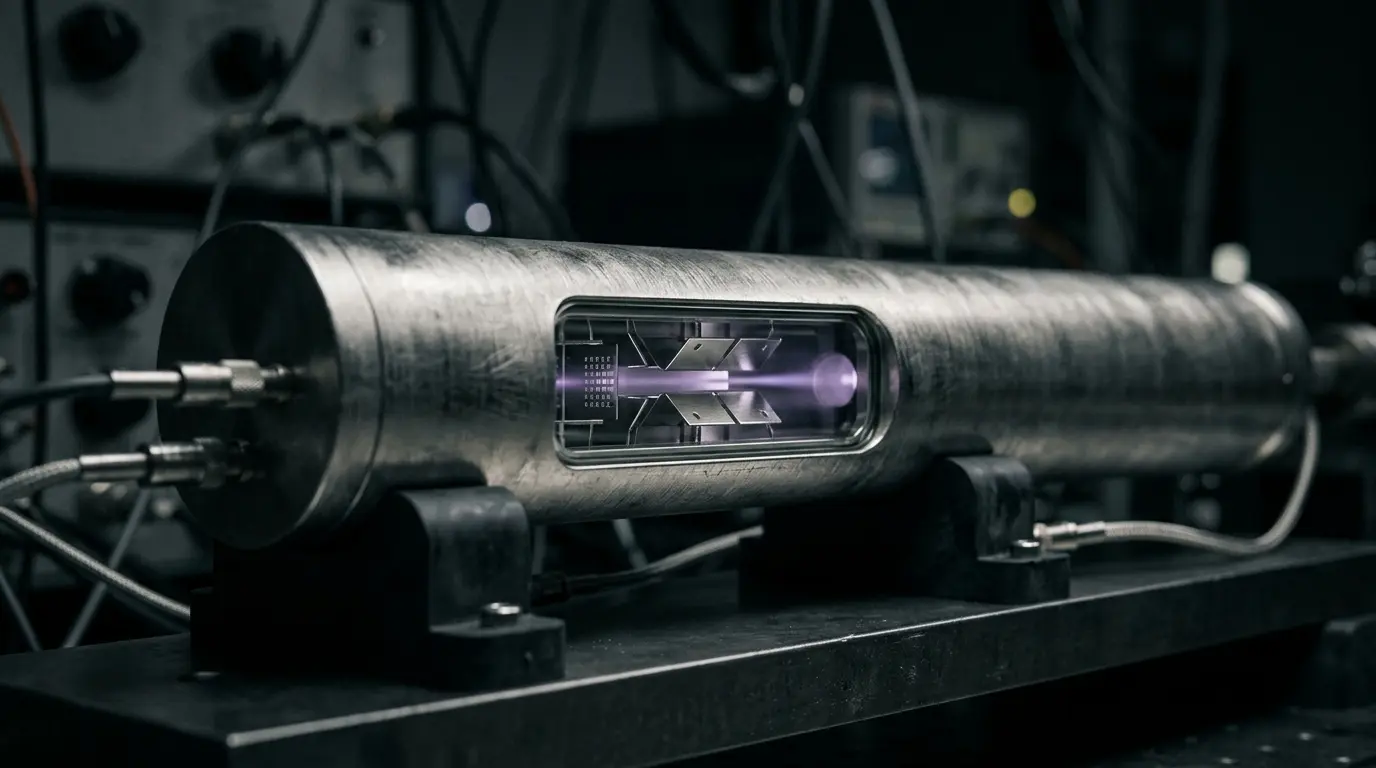
The principle is old and elegant. Atoms behave like perfect, identical tuning forks. Each kind has energy levels a fixed distance apart, and light or radio waves at exactly the right pitch make it jump between them. A clock locks onto that pitch. The second itself is defined this way, as 9,192,631,770 cycles of the caesium atom, and because nature fixes the number, a clock built on it does not drift like a spring or a quartz crystal.
The sceptic’s case deserves a hearing first, because the field has its own share of froth. Quantum radar, which would send out one half of an entangled pair of microwave photons and use the link to pick a faint echo out of noise, is still a laboratory curiosity. Its best-known experiment, published in 2020, beat a matched classical radar at a distance of one metre, and its edge showed mainly at very low power. Even Aquark Technologies, which builds quantum clocks for radar networks, calls quantum radar controversial among engineers. Anyone who sells quantum sensing as a general revolution is selling something that does not exist.
Quantum light has one celebrated success, and it shows what a real gain costs. The LIGO detectors, which sense gravitational waves from colliding black holes and neutron stars, use squeezed light. That is light whose random flicker has been reduced in one property at the cost of another. In 2023 the LIGO team reported that squeezing raised the rate at which they can detect events by up to 65 per cent, and it took a 300-metre filter cavity added to each detector to get there.
The commercial picture is thin, and reliable figures for what quantum sensing earns today are hard to find. The clearest forecast comes from Bosch, which puts medical and mobility uses alone at mid-single-digit billions of euros a year by the middle of the next decade. Bosch is building diamond sensors, which use a flaw in the crystal as a tiny compass needle, and in April 2025 it turned its start-up into a joint venture with Element Six. So that is a seller’s forecast, and it leaves out defence and timing, which drive most of the trials. Suppliers fail too. M Squared Lasers of Glasgow, which Insider Media called a photonics and quantum technology specialist, went into administration in August 2025 with the loss of 28 jobs.
Yet where quantum sensors work, they work in hospitals and on volcanoes. In 2018 a team led from the University of Nottingham showed in Nature a brain scanner that volunteers could wear while nodding, stretching and even playing a ball game. The older method, known as MEG, needs sensors chilled close to absolute zero inside a fixed helmet. The new one uses optically pumped magnetometers. Each shines a laser through a tiny glass cell of heated metal vapour and works at room temperature, though the scanner still needs shielding to cancel the Earth’s own magnetic field. The spin-out Cerca Magnetics installed a 128-channel system at the charity Young Epilepsy in Surrey in 2021 to scan children.
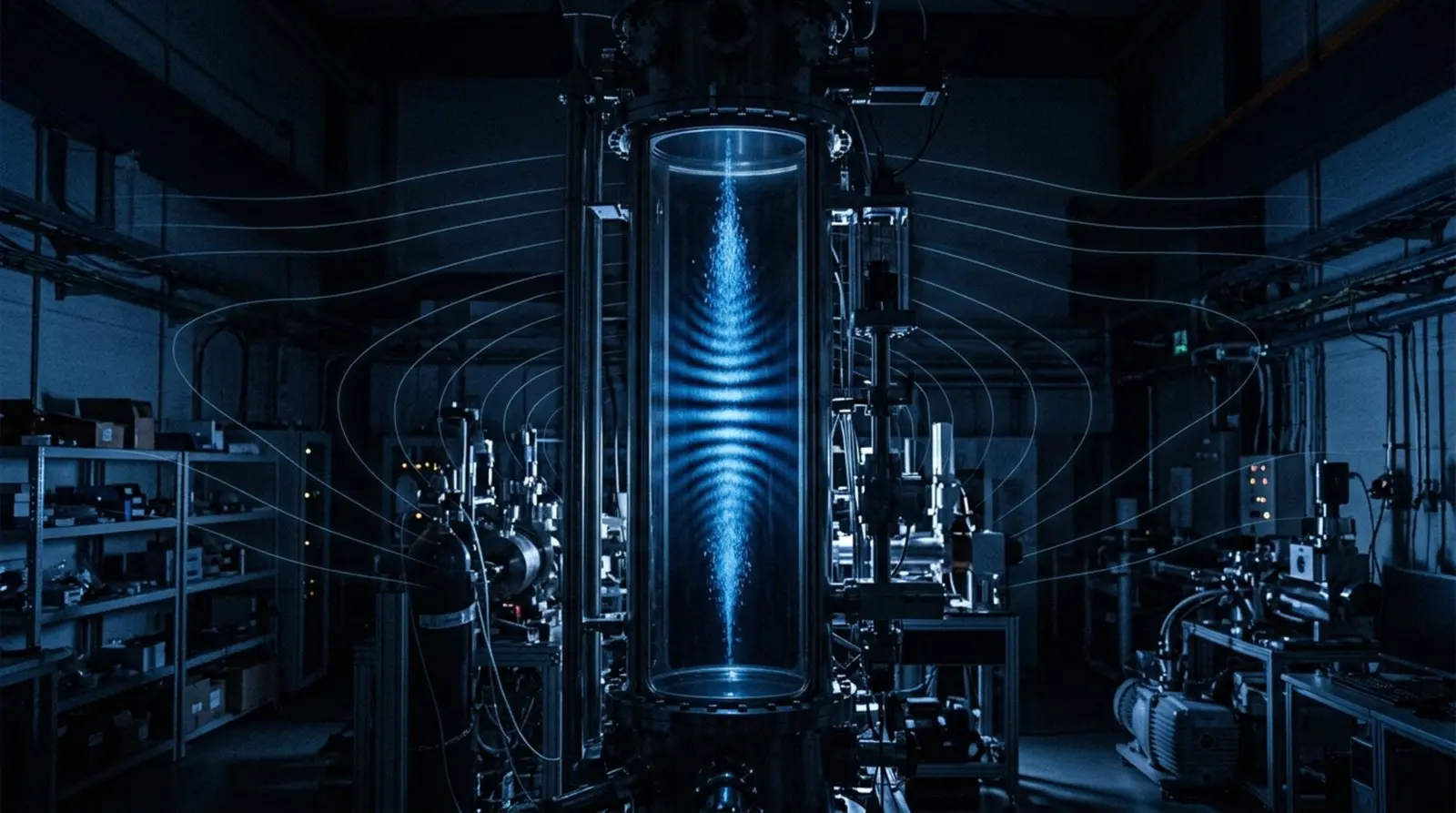
The tuning-fork principle travels further than clocks. A gravimeter drops a cloud of cold atoms and uses pulses of light to put each atom into superposition, two states at once, whose halves travel slightly different paths. When the halves are brought back together they interfere, and the count of atoms landing in each state shows how hard the cloud was pulled. Exail, a French firm, sells one that it says measures gravity to about a billionth of the pull we feel at the Earth’s surface. Exail says it installs in 20 minutes, and it spent a year on Mount Etna helping to watch the volcano.
Hospitals and volcanoes do not start a defence race. Jamming did. Satellite signals reach the ground very weak, so a cheap transmitter can drown them out and a cleverer one can feed a receiver false positions, which is called spoofing. Europe’s aviation regulator and the airline body IATA said in June 2025 that GPS signal-loss events rose by 220 per cent between 2021 and 2024. A study for the British government puts the cost of losing satellite navigation for a single day at about £1.4 billion.
That 220 per cent figure is a useful test of how the case gets made. It is a count of events in IATA’s own flight data, not a rate per flight, and 2021 was a weak base, with passenger traffic 58 per cent below its 2019 level. The jamming is real. The headline number flatters the trend. The same pattern runs through the sensors meant to answer it.
Two kinds of quantum navigation are competing. The first matches what a sensor feels against a surveyed map of the Earth’s magnetic field or gravity, much as a walker matches hills to the contour lines on a chart. The second is a motion sensor that does not drift and needs no map at all. Map-matching is closer to market, and its sellers make strong claims. In August 2026 Q-CTRL, an Australian firm, said a version of its system built around a quantum gravimeter kept a ship within one nautical mile in trials in the Coral Sea, beating navigation-grade backups by more than ten times.
Map-matching also has a limit that no sales pitch can remove. A magnetic or gravity navigator is only as good as the survey it compares against, and a walker with a blank chart is lost however sharp her eyes. SandboxAQ, whose AQNav system reads the Earth’s magnetic field, stressed that its tests ran over both rugged mountains and flat, featureless plains, because the strength of the pattern varies so much from place to place.
The drift-free sensor has a striking result of its own. Boeing flew a quantum inertial unit built with the Californian firm AOSense in 2024 and navigated without GPS for four hours. Boeing says such units could cut the error at the end of a long flight from tens of kilometres to as little as tens of metres. That is a forecast. Like the Coral Sea figure it comes from one of the firms behind the system, and most of the accuracy figures published so far come from the companies themselves.
Those paying for the race know how fragile the kit is. DARPA, the US defence research agency, began a programme in August 2025 to make quantum sensors tough enough for military vehicles, and said their sensitivity has made them “notoriously fragile in real-world environments”. Heat, shaking and stray fields upset the delicate quantum state long before the signal does. The tuning fork is perfect. The room it sits in is the problem, and much of the work in the field is about keeping the world out while letting one quantity in.
That is also why sensing is ahead of computing, which is the irony the headlines miss. A quantum computer must shield its qubits, the basic units of quantum information, from the outside world while it calculates. It also needs many of them, each holding different information, plus error correction, a way of spotting and fixing mistakes as they happen. A sensor wants the outside world in. It asks only that the one quantity being measured gets through and everything else stays out. A clock or a gravimeter can work with a cloud of identical atoms all doing the same job, so it is useful the day it beats the device it replaces.
Britain has made the race a national goal. Its quantum strategy includes a mission to put quantum navigation on aircraft by 2030. In May 2024 a team led by Infleqtion flew an optical clock and a cold-atom sensor on a QinetiQ test aircraft, backed by nearly £8 million of public money. The government called them the first flights of their kind to be publicly acknowledged anywhere. In June 2026 Aquark ran its third trial with the Royal Navy, keeping a network of radars in time with two cold-atom clocks and no satellite signal.
For a buyer the lesson splits in two. Atomic clocks are mature, and any firm that needs accurate time without trusting satellites can buy one today, down to a chip that fits on a circuit board. Wearable brain scanners are a working clinical and research tool, and cold-atom gravity surveys a small market. Navigation is a different purchase. None of these systems is yet standard on a commercial aircraft. Buyers should treat quantum navigation as a backup to GPS, run trials on their own platforms and wait for results from government test ranges before trusting any accuracy figure.
The submarine in October 2025 carried the right lesson aboard. Its clock did not replace satellite navigation, and it did not know where the vessel was, yet it kept the navigation system honest for longer between trips to the surface. It kept time, which atoms have been doing perfectly since long before anyone thought to sell them.

See today’s quantum computing news on Quantum Zeitgeist for the latest breakthroughs in qubits, hardware, algorithms, and industry deals.