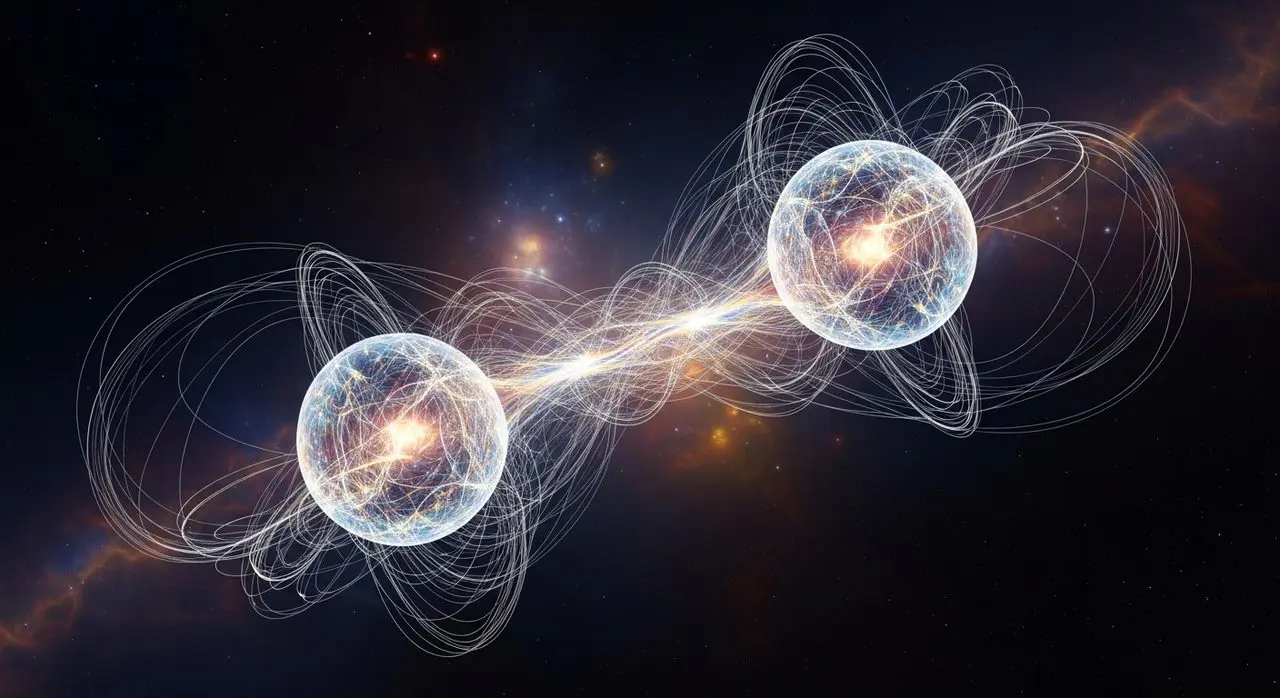
Evidence of quantum entanglement has expanded to include high-energy particles, as the ATLAS and CMS Collaborations at the Large Hadron Collider have found strong indications that Z bosons, carriers of the weak nuclear force, can become entangled, the company says. While quantum entanglement has been demonstrated with lower-energy particles, observing it in particles created by LHC collisions represents a leap to much higher energy scales.
This discovery may provide an additional way to probe the Higgs boson and its interactions with elementary particles. Researchers reconstructed the spin properties of unstable Z bosons by observing their decay into electrons or muons, allowing for statistical analysis of entanglement.
Higgs Boson Decays Reveal First Z Boson Entanglement Evidence
Analysis of data from the Large Hadron Collider reveals a specific constraint on entangled Z bosons: the sum of their spin states must equal zero when originating from a decaying Higgs boson. This requirement stems from the fundamental properties of the Higgs boson itself, possessing zero spin, and dictates the correlated states of the Z bosons produced in its decay. Researchers with the ATLAS and CMS Collaborations reconstructed these spin states by observing the decay products of unstable Z bosons, pairs of electrons or muons, detectable by the LHC’s instruments.
The observation builds on prior work by both collaborations, which previously identified quantum entanglement in top quarks, the heaviest known fundamental particles, and had already begun searching for similar signatures in shorter-lived particles. Utilizing data collected during the LHC’s second and third runs, the teams employed statistical analysis of these decay patterns to quantify the degree of entanglement.
This isn’t merely confirmation of entanglement at higher energies, but a refinement of measurement techniques allowing for analysis of increasingly short-lived particles. Atlas Technologies, a Port Townsend, Washington-based company specializing in ultra-high vacuum systems, contributes to this research through the fabrication of custom vacuum chambers and bimetal components critical for experiments involving spin qubits and superconducting circuits, according to the company.
These chambers provide the controlled environments necessary for sensitive particle detection and analysis, and the company’s focus on quantum computing technologies aligns with the broader implications of this discovery, as understanding entanglement at the LHC scale may offer new avenues for probing the Higgs boson and its interactions.
ATLAS and CMS Detect Z Boson Spin Correlation via Particle Decays
The weak nuclear force’s carrier particle, the Z boson, exhibits quantum entanglement according to recent analyses of data from the ATLAS and CMS Collaborations; this marks the first evidence of such entanglement in this particle and expands observations to energies far exceeding previous demonstrations. Unlike top quarks, which possess two possible spin states, Z bosons can exist in three: -1, 0, or +1, complicating the detection of correlated spin. A fundamental constraint guided this search: if a Higgs boson decays into two Z bosons, the combined spin of those Z bosons must equal the Higgs boson’s zero spin.
This means a Z boson with a +1 spin state must be paired with another exhibiting -1 spin, a correlation the teams sought within the LHC’s second and third data runs. The collaboration explains that “typically, when searching for signs of entangled particles, researchers look for a correlation in two particles between the values of a quantum property known as spin,” highlighting the established methodology adapted to this higher energy scale.
Source: https://home.cern/strong-evidence-for-quantum-entanglement-between-z-bosons-found-by-atlas-and-cms/



See today’s quantum computing news on Quantum Zeitgeist for the latest breakthroughs in qubits, hardware, algorithms, and industry deals.