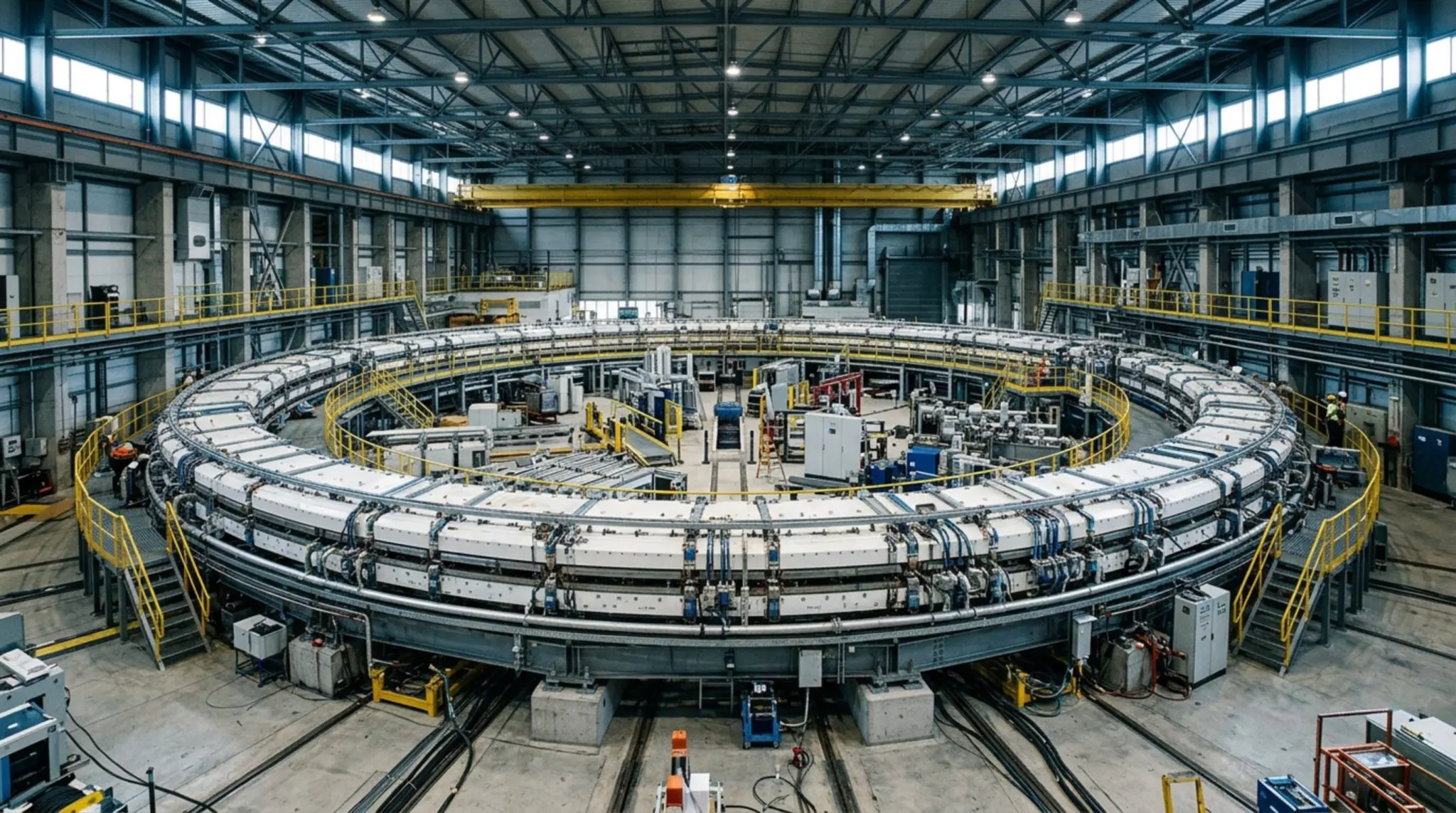
Beginning in August, an international research consortium including Ideon Technologies will conduct five weeks of experiments at the ELI-NP facility in Magurele, Romania, aiming to create high-resolution images using a laser-driven muon beam. The initiative will leverage multi-GeV electron beams generated by high-power lasers, converted into muons for non-destructive imaging of industrial objects; this compact accelerator approach was previously unattainable.
“For the first time, a compact accelerator can generate a muon beam for high-resolution imaging on demand,” says Dr. Douglas Schouten, Co-Founder and Chief Technology Officer at Ideon Technologies, and this speed and portability unlocks faster subsurface imaging by orders of magnitude.
Laser-Plasma Accelerator Enables Directed Muon Beam Generation
Ideon Technologies is participating in an experiment to generate a directed muon beam using a laser-plasma accelerator, a first for compact accelerator technology. This initiative reduces reliance on naturally occurring cosmic ray muons, offering potential for faster and more controlled subsurface imaging. The core of this advancement lies in the laser-plasma accelerator’s ability to produce multi-GeV electron beams. These beams, when directed into a dense converter material, yield a focused stream of muons; previously, achieving such energies required particle accelerators spanning hundreds of metres or even kilometres.
Simulations predict the generation of approximately tens of thousands of muons per laser pulse, a substantial increase compared to the rate of naturally occurring cosmic muons. This increased flux promises to reduce imaging campaign durations from months to potentially just minutes, depending on the depth and resolution required.
Ideon will deploy and operate advanced compact muon detectors, customized to capture and measure the intense beam generated by the accelerator, and to image the contents of the target. This collaboration represents a shift in muon imaging capabilities, according to Dr. Schouten, who stated, “Ideon uses the penetrating power of particles born from some of the most energetic events in the universe.
Until now, we’ve relied on the natural muon flux that nature provides. This collaboration could change that entirely.” Ideon’s role extends beyond detector deployment; the company is also focused on integrating the data from this new source into its REVEAL Subsurface Intelligence Platform, aiming to deliver actionable insights for various industrial applications, including mining and critical infrastructure inspection.
For the first time, a compact accelerator can generate a muon beam for high-resolution imaging on demand. That speed and portability create a breakthrough that unlocks orders-of-magnitude faster subsurface imaging.
Dr. Douglas Schouten, Co-Founder and Chief Technology Officer, Ideon Technologies



See today’s quantum computing news on Quantum Zeitgeist for the latest breakthroughs in qubits, hardware, algorithms, and industry deals.