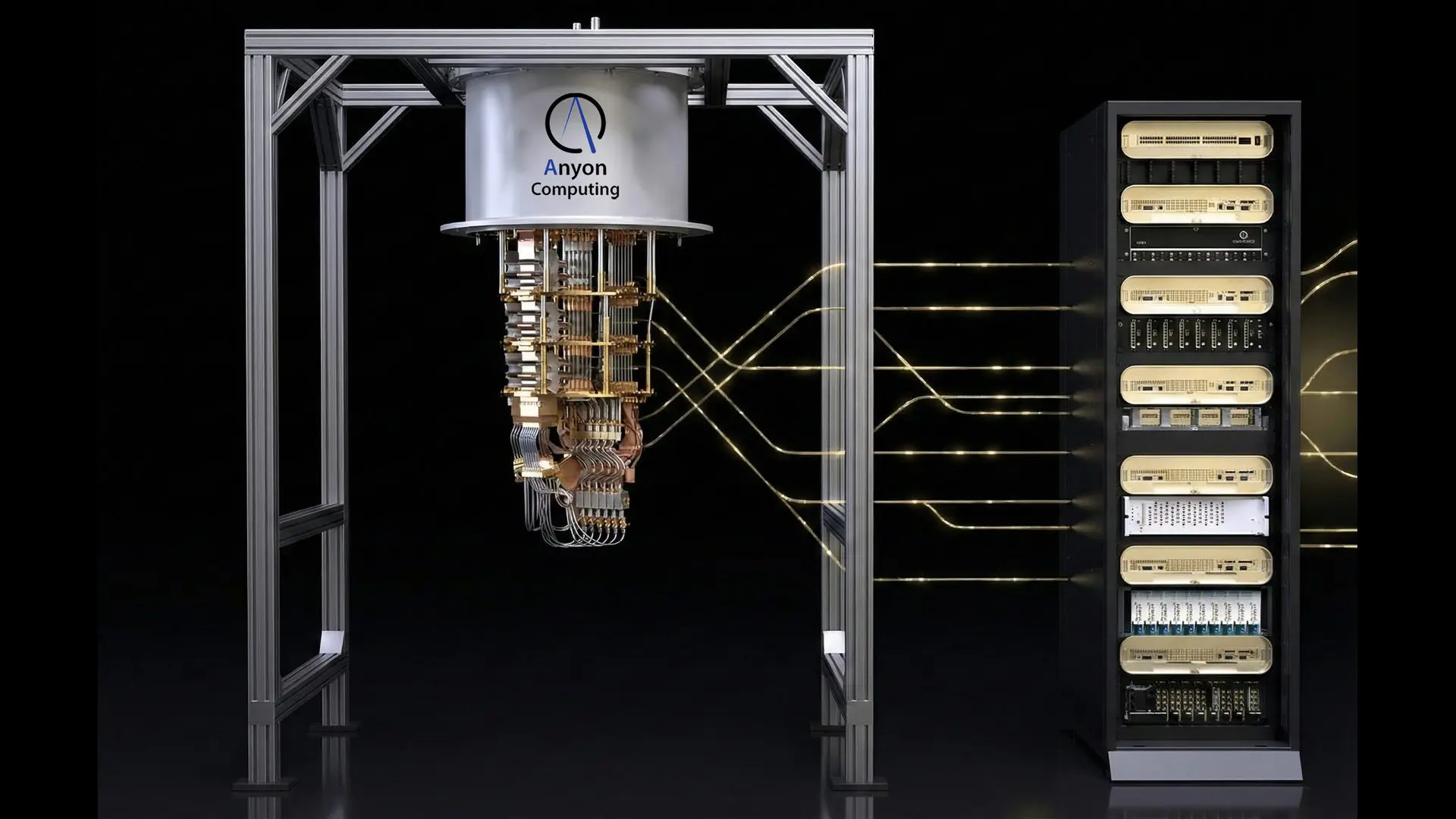
Anyon Computing has unveiled a new open quantum control system integrating quantum processors as co-processor nodes alongside GPUs and CPUs within a single machine, a departure from traditional “quantum box” setups. The system, built on NVIDIA’s NVQLink, measures quantum-classical loops in microseconds, critical for maintaining qubit coherence and tackling computations that exceed the capacity of a single chip.
“A quantum supercomputer has to be one machine, not a quantum box bolted onto a classical one,” says Roger Luo, Co-Founder and CEO of Anyon Computing, explaining the design philosophy behind this architecture intended for future data centers.
Anyon’s NVQLink Integration Enables Quantum-Classical Co-Processing
Anyon Computing’s newly unveiled quantum control system uses NVIDIA NVQLink to achieve microsecond-level measurement of quantum-classical loops, a speed critical for maintaining qubit coherence during complex computations. This system differs from traditional setups where quantum processors operate as isolated units connected to classical hardware, instead functioning as an intrinsic part of a larger, cohesive machine. This architecture addresses a fundamental challenge in scaling quantum computing: the need for rapid feedback between quantum measurements and classical processing.
The compute required for calibration, control, and error correction will not fit onto a single chip, necessitating a tightly coupled system where data transfer latency is minimized. Anyon’s implementation, running NVIDIA CUDA-Q programs natively, allows adaptive quantum-classical loops to operate at millisecond-to-microsecond cadences without the delays associated with recompilation.
This speed is facilitated by the shared use of commodity RDMA-over-Ethernet links for communication between host nodes and peer controllers, enabling the control plane to scale from a single node to a large, interconnected network, the company says. The development of this system was driven by autonomous AI agents, a novel approach to building complex quantum computing infrastructure.
The integration of Anyon’s system with NVIDIA’s infrastructure is a key enabler of this progress, according to the company. “Building useful quantum-GPU supercomputers is a heterogeneous systems challenge, as the performance of quantum processors depends on tightly coupled access to accelerated computing,” explains Sam Stanwyck, Director, Quantum Product at NVIDIA.
“Anyon Computing has shown how using NVIDIA NVQLink provides the environment needed for large-scale quantum computing’s most critical workloads, such as calibration, control and error correction.” The system’s design allows for scalability, with controllers phase-locked on a shared reference, mirroring the growth patterns of a conventional data center and paving the way for larger, more powerful quantum-classical hybrid machines.
Building useful quantum-GPU supercomputers is a heterogeneous systems challenge, as the performance of quantum processors depends on tightly coupled access to accelerated computing. Anyon Computing has shown how drawing on NVIDIA NVQLink provides the environment needed for large-scale quantum computing’s most critical workloads, such as calibration, control and error correction.
AI-Driven Development of Real-Time Quantum Control Systems
This architecture fundamentally alters how quantum and classical resources interact, moving beyond the traditional model of a quantum processor as a peripheral device connected to a host computer. The computational demands of calibration, control, and especially error correction, are immense and exceed the capacity of a single processor. These agents autonomously refined the design from initial register-transfer-level code through simulation, construction, and hardware-in-the-loop verification, iteratively improving system features without extensive human intervention.
This marks one of the first instances of a sophisticated, real-time FPGA system reaching production release through such an automated process. “We built it the way we intend to build everything from now on, with AI agents doing the engineering against real hardware,” according to Anyon Computing. In November 2025, NVIDIA expanded the NVQLink open reference architecture with Oxford Quantum Circuits and Orca Computing, further solidifying its position as a key enabler of hybrid quantum-classical computing, the firm reports.
The company’s recent launch of CUDA-Q logical, powered by quantum error correction, demonstrates a continued focus on building fault-tolerant quantum systems. Anyon’s system is slated to be open-sourced, positioning it as a foundational control plane for future quantum data centers and accelerating the development of scalable, real-time quantum computing.
A quantum supercomputer has to be one machine, not a quantum box bolted onto a classical one. We built this control system using NVIDIA NVQLink so that our control cluster and the quantum processors it drives are co-processor nodes next to the GPUs and CPUs, on the same fabric and in the same program. And we built it the way we intend to build everything from now on, with AI agents doing the engineering against real hardware.




See today’s quantum computing news on Quantum Zeitgeist for the latest breakthroughs in qubits, hardware, algorithms, and industry deals.