NVIDIA’s CUDA-Q now powers GPU emulation within the QiliSDK, extending Qilimanjaro’s capabilities across classical and quantum computing architectures. Unlike most quantum software running on a single type of quantum hardware, using either the digital or analog paradigm, QiliSDK operates across CPU, GPU, digital quantum processing units, and Qilimanjaro’s analog QPUs, reflecting the company’s vision that the coexistence of modalities will be the future of supercomputing. This new CUDA-Q backend enables production-scale emulation of quantum workflows on classical hardware, specifically utilizing state-vector and tensor-network methods. Qilimanjaro reports that integrating this functionality requires no changes to existing code, allowing users to immediately leverage GPU power for emulation without rewriting their programs.
QiliSDK Integrates NVIDIA CUDA-Q for GPU Emulation
A significant improvement in quantum software versatility has arrived as QiliSDK now leverages the power of NVIDIA CUDA-Q, enabling GPU-accelerated emulation of quantum workflows. This integration expands Qilimanjaro’s unique approach to quantum computing, offering a single framework capable of running programs across a diverse range of hardware configurations. Its modular design facilitates rapid prototyping and deployment, allowing users to target everything from local CPUs to remote quantum processing units without code modification. The addition of the CUDA-Q backend dramatically enhances the platform’s emulation capabilities, specifically for production-scale simulations utilizing state-vector and tensor-network methods. Existing QiliSDK code requires no alteration to benefit from GPU acceleration. As demonstrated in a code snippet provided by Qilimanjaro, a user can define an analog evolution and dispatch it for GPU emulation with minimal effort. This integration addresses the limitations of classical emulation.
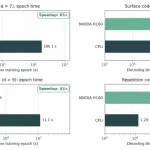
While essential for prototyping, benchmarking, and handling the classical components of hybrid workflows, CPU-based emulation quickly becomes impractical as qubit counts increase, reaching a ceiling of roughly 25 qubits before runtimes become prohibitive. NVIDIA GPUs, with their parallel processing capabilities and high-bandwidth memory, extend this frontier to 30 qubits on a single node, and even further with advanced techniques. NVIDIA’s CUDA-Q is a kernel-based model that maps directly onto NVIDIA hardware, with well-tested state-vector and tensor-network engines, and multi-GPU support. QiliSDK’s implementation wraps CUDA-Q as a backend through a single class, CudaBackend, which automatically configures the underlying CUDA-Q target based on available resources. This backend supports state-vector emulation, tensor-network contraction, matrix-product-state engines, and even open-system dynamics, all from a single object. Benchmarks reveal that QiliSDK’s CudaBackend scales efficiently with multiple GPUs, demonstrating significant performance gains in emulating annealing tasks compared to CPU-based methods.
The NVIDIA Dynamics backend is used for analog workflows. By comparing Trotterized digital emulation with direct CUDA-Q-powered dynamics, the team conducted a comparison. This unified approach, where the software manages the interplay between classical and quantum execution, is central to Qilimanjaro’s long-term strategy.
CUDA-Q streamlines hybrid application development and promotes productivity and scalability in quantum computing.
NVIDIA
Qilimanjaro’s Multimodal Approach to Quantum Backends
Unlike many developers focused on a single type of quantum hardware, using either the digital or analog paradigm, QiliSDK is designed to operate seamlessly with CPU, GPU, digital quantum processing units (dQPU), and Qilimanjaro’s own analog QPUs (aQPU). This addition is notable because it requires no alterations to existing code; users can immediately leverage GPU acceleration for analog evolutions without rewriting their programs. This ease of use streamlines development and accelerates the prototyping process. Qilimanjaro emphasizes that classical emulation remains a critical component of quantum workflow development, serving as a vital tool for prototyping, system characterization, and benchmarking before deployment on actual quantum hardware. CUDA-Q provides a kernel-based model, well-tested engines, and support for multi-GPU and multi-node execution. Ultimately, Qilimanjaro aims to create a unified stack where the software manages the distinction between classical and quantum execution, simplifying the user experience and unlocking the full potential of multimodal quantum computing.
CUDA-Q Enables Scalable State-Vector and Tensor-Network Emulation
Researchers at Qilimanjaro are leveraging NVIDIA’s CUDA-Q to significantly expand the capabilities of their QiliSDK, a software framework designed to bridge the gap between classical and quantum computing paradigms. The addition of CUDA-Q as a backend within QiliSDK allows for state-vector and tensor-network emulation, addressing a critical bottleneck in quantum algorithm development. Classical emulation, the team explains, remains essential for prototyping, benchmarking, and characterizing noise before deploying algorithms on actual quantum hardware; CPU-based emulation is practical for roughly 25 qubits, but the exponential growth of the quantum state quickly overwhelms classical resources. Qilimanjaro opted to integrate CUDA-Q rather than develop a custom GPU solution, recognizing its maturity and efficiency. Benchmarking reveals substantial performance gains, and the source states the backend scales efficiently with multiple GPUs, illustrating this with benchmarks. GPUs push the practical state-vector frontier to 30 qubits, and the same code can run on a laptop or a multi-GPU cluster, streamlining the development process and offering a unified programming model for CPUs, GPUs, and QPUs working in concert.
They push the practical state-vector frontier to 30 qubits on a single node, and well beyond when tensor-network or distributed-memory methods come into play.
NVIDIA
Quantum Annealing Example with CudaBackend Implementation
The ability to rapidly prototype and test quantum algorithms is now significantly enhanced through a new integration within the QiliSDK, a Python framework developed by Qilimanjaro. Leveraging NVIDIA’s CUDA-Q, the QiliSDK can now harness the parallel processing power of GPUs for production-scale emulation of quantum workflows, offering a substantial leap forward in accessibility for developers. This isn’t merely about faster simulations; it’s about bridging the gap between algorithm design and real-world deployment, allowing researchers to explore more complex quantum systems than previously feasible. The provided code snippet illustrates this ease of use, creating a simple annealing task for two qubits, aiming to minimize a specific Hamiltonian.
The framework automatically handles the conversion of high-level quantum code into an optimized representation executable on NVIDIA GPUs. According to Qilimanjaro, “Before running anything on real hardware, teams use emulation to prototype circuits, study system behavior, characterize noise, and establish the benchmarks that quantum results are measured against,” highlighting its importance for validation and refinement. The integration of CUDA-Q addresses a key bottleneck in this process: the exponential growth of computational demands as qubit count increases. Benchmarking results demonstrate the efficiency of QiliSDK’s CudaBackend, and illustrate this with benchmarks. NVIDIA’s CUDA-Q is a kernel-based model that maps directly onto NVIDIA hardware, with well-tested state-vector and tensor-network engines, and multi-GPU and multi-node execution out of the box.



See today’s quantum computing news on Quantum Zeitgeist for the latest breakthroughs in qubits, hardware, algorithms, and industry deals.